How Anya Agents Operationalize Agentic Workflows for Security Teams

Today, security teams are already using AI within their security workflows. Engineers paste findings into LLMs to summarize vulnerabilities, investigate CVEs or generate remediation guidance. The productivity gains are real, but most organizations still lack standardized, reusable agentic workflows for security operations.
Every interaction starts from scratch. Context has to be manually assembled across findings, assets, threat intelligence, and software supply chain data. Outputs vary across users and teams, and the reasoning behind them is often inconsistent. What one engineer learns or builds rarely becomes reusable across the organization.
The underlying problem is that security workflows are deeply context-driven. Determining whether a vulnerability matters requires understanding relationships across assets, dependencies, exploitability, existing findings, and organizational exposure. Generic AI assistants can explain a CVE, but they cannot reason about your environment because they do not operate within it.
Most vendor “AI features” do not solve this either. In many cases, they are still chat interfaces layered on top of a narrow slice of product data rather than systems capable of executing security tasks with full organizational context.
This is the problem space Anya Agents are designed to solve.
Anya Agents are purpose-built AI agents within ArmorCode that execute specific agentic workflows using a unified risk context. Unlike generic assistants, they operate as task-oriented agentic systems with defined scope, consistent reasoning, and direct access to security data such as findings, assets, supply chain relationships, and threat intelligence.
How Anya Agents Power Agentic Workflows
Purpose-Built Agents for Security Teams
Each Anya Agent is scoped to a single, well-defined workflow and is purpose-built to solve a specific security task end to end. This narrow focus ensures deterministic behavior, where the agent produces consistent and predictable outputs regardless of who invokes it or when it is used. This combination of scope, structure, and predefined instructions ensures reliability at scale across teams and use cases.
Grounded in ArmorCode’s Unified Risk Context
Anya Agents operate on top of ArmorCode’s unified risk context, which brings together the data and relationships already understood by the platform. This includes findings, assets, software supply chain relationships, and threat intelligence. Instead of requiring users to assemble or translate this context manually, agents operate directly on this unified layer that offers more accurate and relevant results.
Reusable Agentic Workflows
Anya Agents are designed as reusable workflow components that can be invoked repeatedly across teams and use cases. Instead of being one-off AI interactions, each agent functions as a shared asset that encodes best practices for a specific security workflow.
Role-Aware AI for the Entire Security Org
Security workflows vary across roles, and the context required by a developer is different from what a security engineer or executive team needs. Anya Agents are designed to be role-aware, surfacing the right agent in the right workflow based on the user and the task at hand. Developers can access remediation guidance directly within findings, security engineers can assess exposure during a new CVE event, and leaders can use risk-focused agents to understand and communicate organizational impact.
Taken together, these principles turn Anya agents into an operational layer capable of executing real security work.
Agentic Workflows for Security Teams
The Remediation Agent
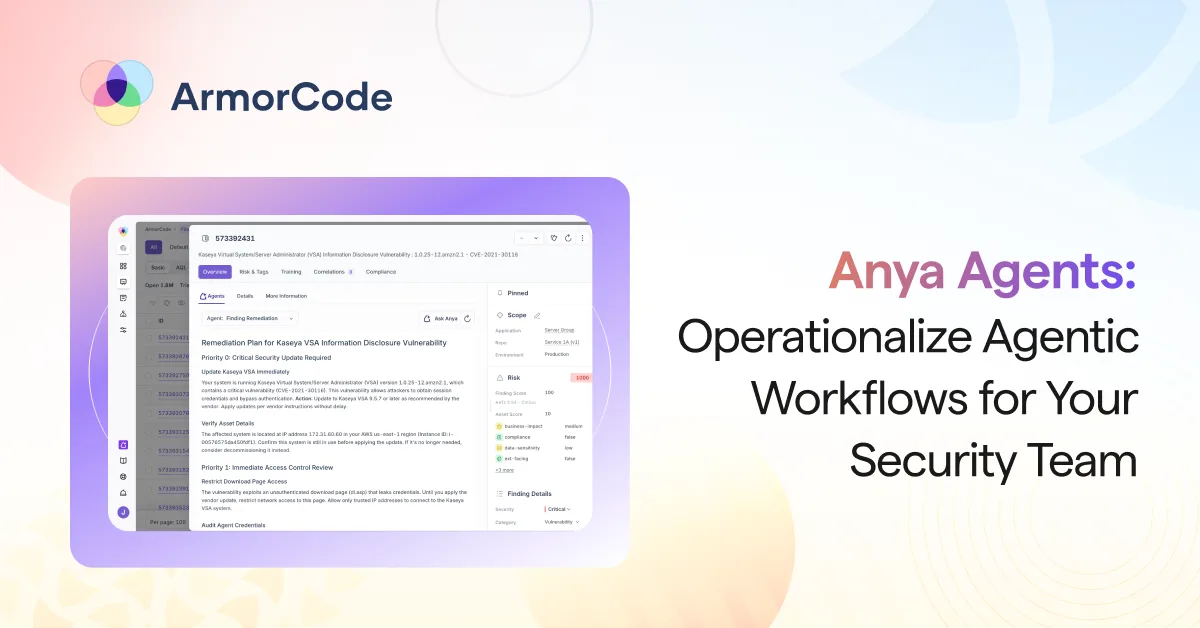
You can select a finding or a group of findings, and the agent generates remediation guidance using the available metadata, environmental context, and relevant external sources. The output is grounded in the actual issue and its surrounding context, giving teams a consistent vulnerability remediation workflow that moves from identification to fix without relying on generic recommendations.
The Zero-Day Exposure Hunting Agent
When a new CVE is disclosed, the agent assesses its impact against your environment. It pulls in threat intelligence, identifies affected components, checks for exposure across your software supply chain, and correlates this with existing findings. The result is a consolidated impact view that would otherwise require stitching together multiple sources of information.
The Finding Overview Agent
Instead of manually piecing together context or writing summaries, this agent produces a clear, structured explanation that highlights what matters most. This makes it easier to align across engineers, developers, and stakeholders without introducing inconsistency.
The Risk Analyzer Agent
The Risk Analyzer Agent breaks down the factors behind a risk score across findings, groups, or subgroups. It provides the reasoning behind the number, enabling teams to justify decisions, prioritize effectively, and communicate risk with clarity.
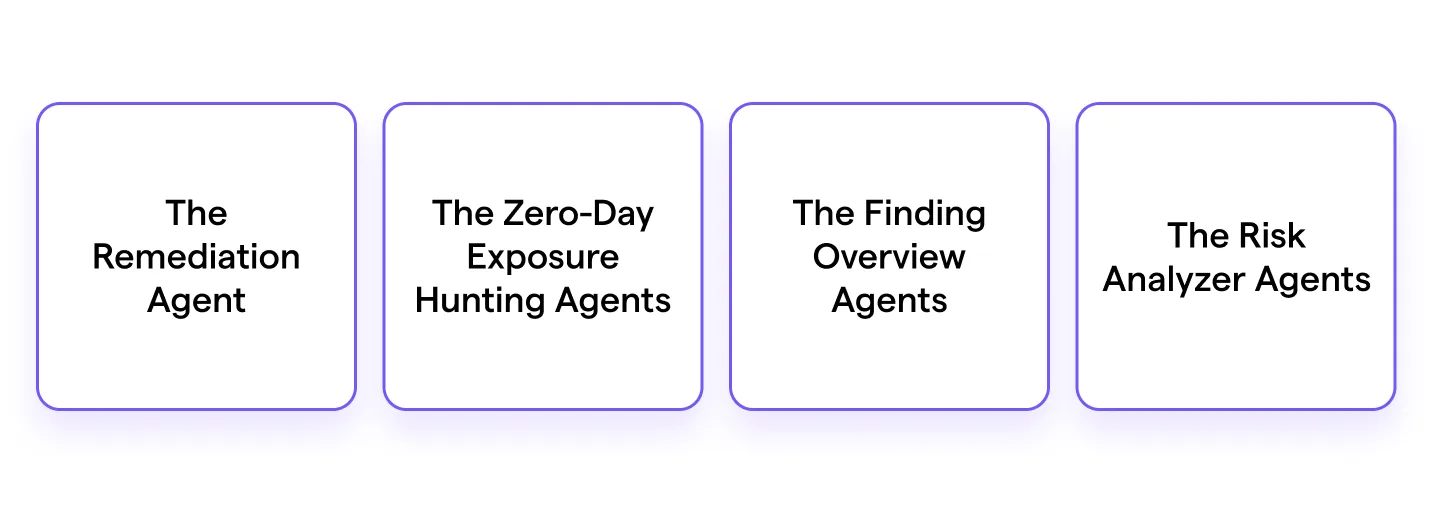
Each one replaces a specific category of manual work with a consistent and context-aware system that can be relied on across the team. These Anya Agents are available out of the box and are ready to be used across the platform.
Alongside these agents, teams can also create and use custom agents tailored to their requirements.
How to Use Anya Agents
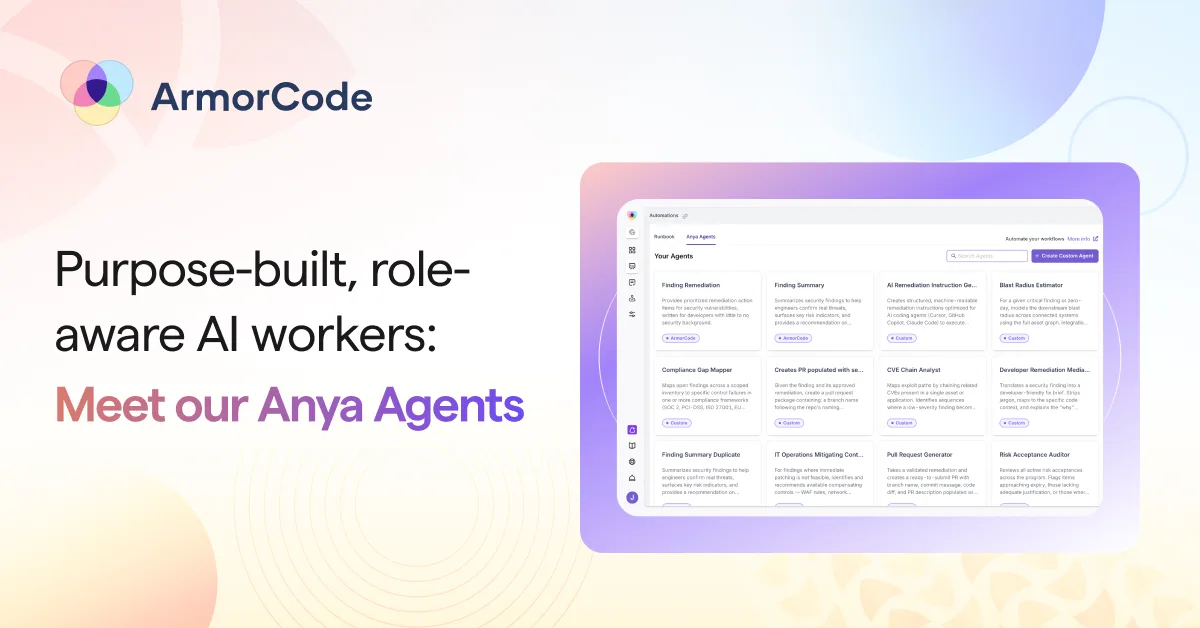
Anya Agents operate directly within the ArmorCode platform. To view and manage the agents, navigate to the platform and go to Manage → Automations and then select Anya Agents. Here, you can view the out-of-the-box agents available to your team, including remediation, finding summary, and other specialized agents.
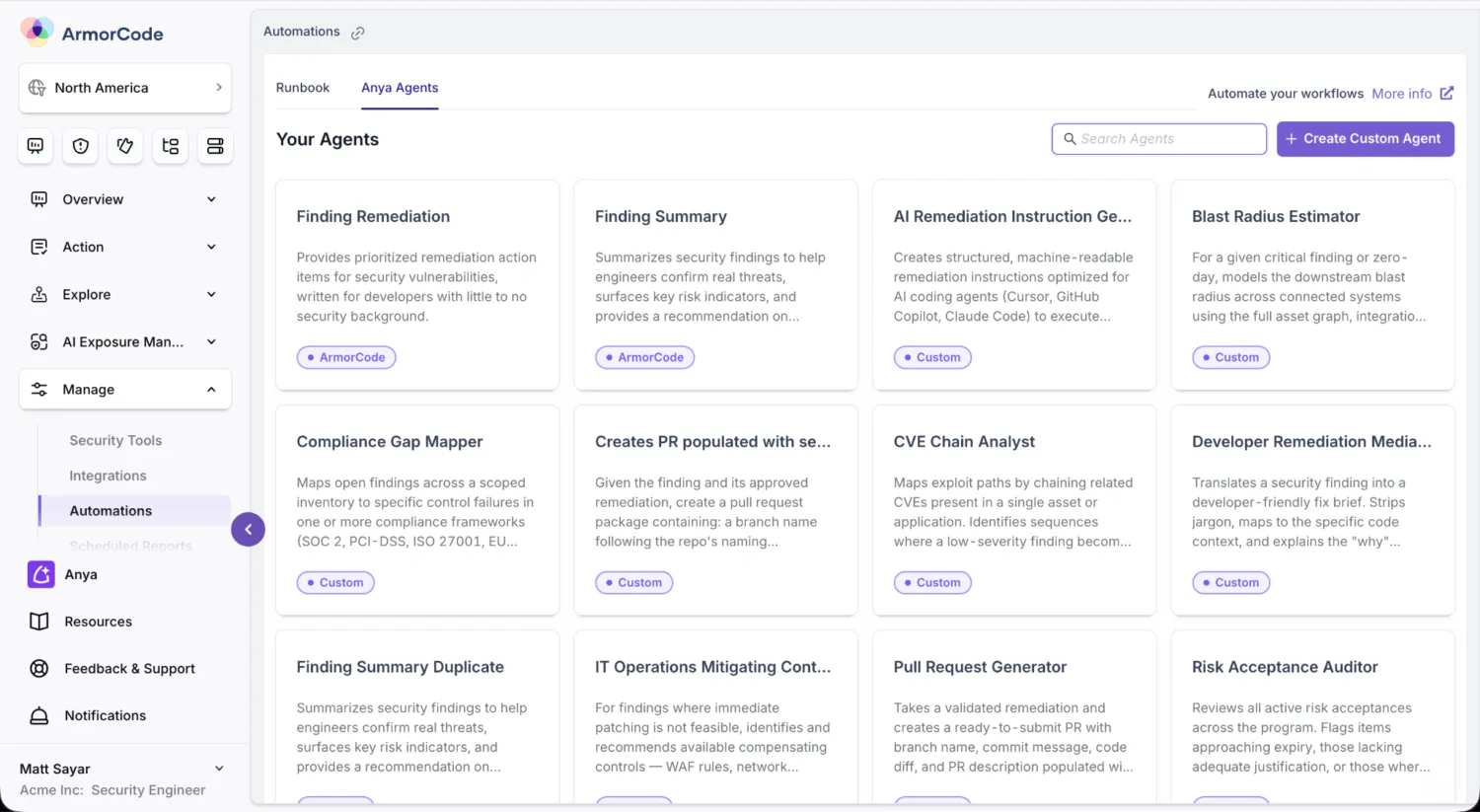
Selecting an agent allows you to review its configuration, including its name, description, instructions and scope. The out-of-the-box agents come preconfigured with defined instructions and context. If you need to modify an existing agent, you can duplicate it and update its instructions to better reflect your requirements.

You can also create a custom agent by defining its name, description, and instructions. This allows teams to operationalize agentic workflows that are specific to their environment while using the same underlying agent framework.
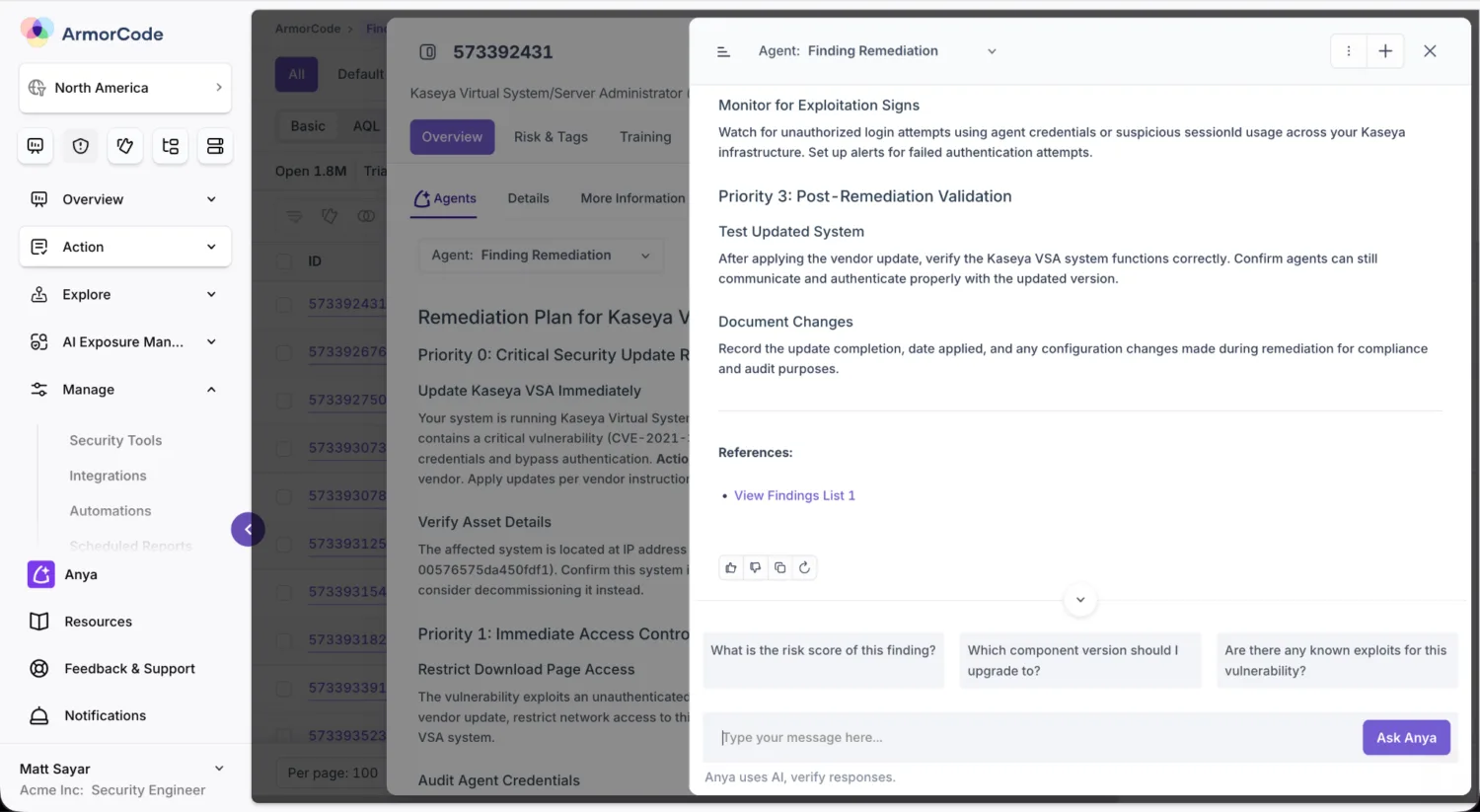
Agents can be invoked directly from within the findings page, where you will see the Agents option. From there, you can select the appropriate agent, such as the Finding Summary Agent, and run it. The agent will then generate an output aligned to its purpose, such as a structured summary, remediation guidance, or an impact analysis.

Users can also interact with Anya AI to ask follow-up questions, request additional context, or investigate findings directly within the platform.
Getting Started
Anya Agents are available as part of the ArmorCode Agentic AI Platform and are accessible to existing ArmorCode customers today.Reach out to your ArmorCode account team or request a demo if you are interested in using Anya agentic workflows to reduce repetitive manual work, and improve productivity across your security organization.