Agentic Vulnerability Remediation Without the Runaway AI Bill

Finding vulnerabilities was never the hard part. Most security teams already have more findings than they can act on: across applications, cloud environments, infrastructure, containers, and the software supply chain, the queue only grows. The hard part is that attackers don’t need a critical CVE to do damage. They can cheaply chain together the “low” and “medium” findings a team deprioritized last quarter into a real attack path to a critical system. Defenders, meanwhile, are being told to point AI at the backlog to catch up, only to run into a second problem nobody budgeted for: AI without context is both inaccurate and expensive.
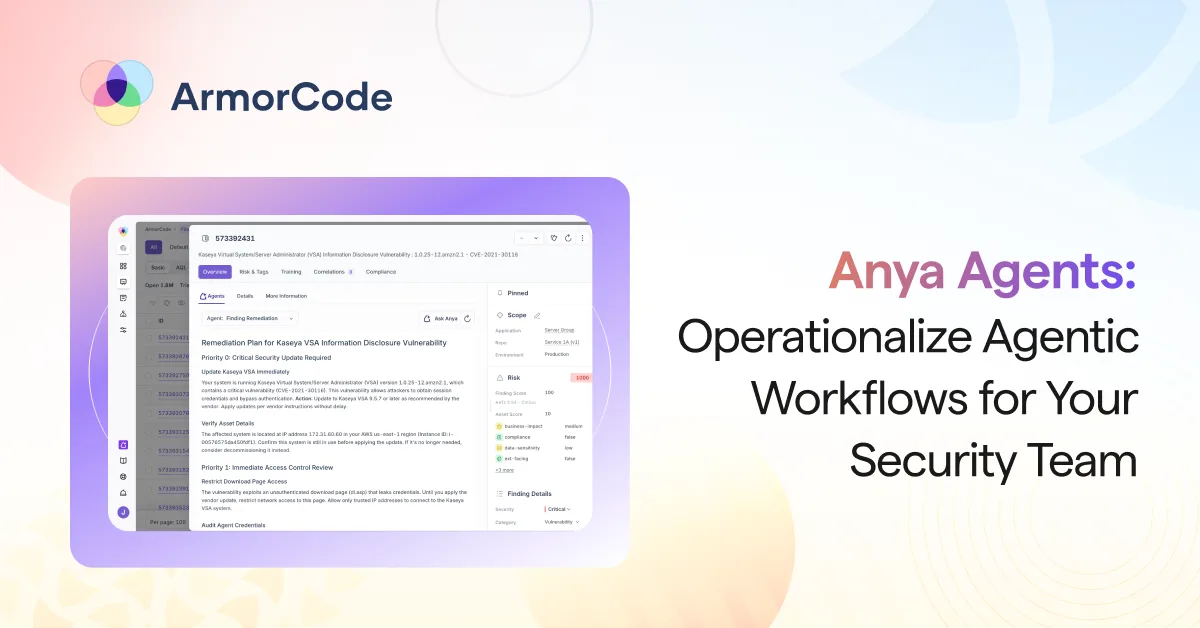
At Black Hat USA 2026, ArmorCode is announcing a major expansion of its Agentic Control Plane to close that gap: four new capabilities added to the Context Risk Graph, and four new purpose-built agents joining Anya, ArmorCode’s agentic workforce for security teams. Together, they’re built to help teams move from finding to fixing the vulnerabilities that matter, more accurately, faster, and without the AI bill spiraling alongside the finding count.
Agentic vulnerability remediation costs are no longer hypothetical
This isn’t a future risk. It’s a live, board-level line item right now. Uber burned through its entire 2026 AI coding budget in four months, and Microsoft has pulled back internal Claude Code access after token bills started outpacing what the productivity gains could justify. One enterprise reportedly spent $500 million on Claude in a single month because nobody had set a usage limit. The FinOps Foundation’s State of FinOps 2026 report found that 73 percent of enterprises saw their AI costs exceed original projections, and the problem is now big enough that the Linux Foundation has announced its intent to launch a Tokenomics Foundation to bring the same kind of standards to token spend that FinOps brought to cloud spend a decade ago.
Security has a version of this problem that’s worse than a bloated invoice. When an unconstrained agent burns budget re-deriving analysis it already produced, that’s waste. When it applies that same lack of discipline to fixing a vulnerability, the outcome is both an inflated bill and a change that ships into production without the scrutiny it needed. The root cause in both cases is the same: agents operating without sufficient context. Without a Context Risk Graph grounding what an agent reasons over, every run starts cold, re-spending tokens on analysis that should already be settled and producing fixes that lack the contextual awareness to be trusted. Cost and risk are effectively the same failure mode with two different price tags.
More findings, thinner context, bigger AI bill
ArmorCode’s Context Risk Graph already connects security findings with asset inventory, ownership, business context, threat intelligence, and remediation data. That’s the foundation Anya agents reason over instead of a raw finding list. And it is what keeps those agents from re-deriving the same analysis cold on every run. At Black Hat USA 2026, ArmorCode is expanding that graph with four new sources of context:
- Network Topology and Reachability Context: Traces how exposures connect across applications, cloud, containers, infrastructure, and network environments, so teams can see whether a vulnerability is actually reachable, not just theoretically present.
- Patch Management Integration: Understands patch availability and coordinates remediation planning through the patch systems teams already run, instead of asking them to manage another queue.
- Existing Compensating Control Integration: Connects with tools organizations already own, including web application firewalls and endpoint detection and response (EDR) platforms, to reduce exposure while a permanent fix is in progress.
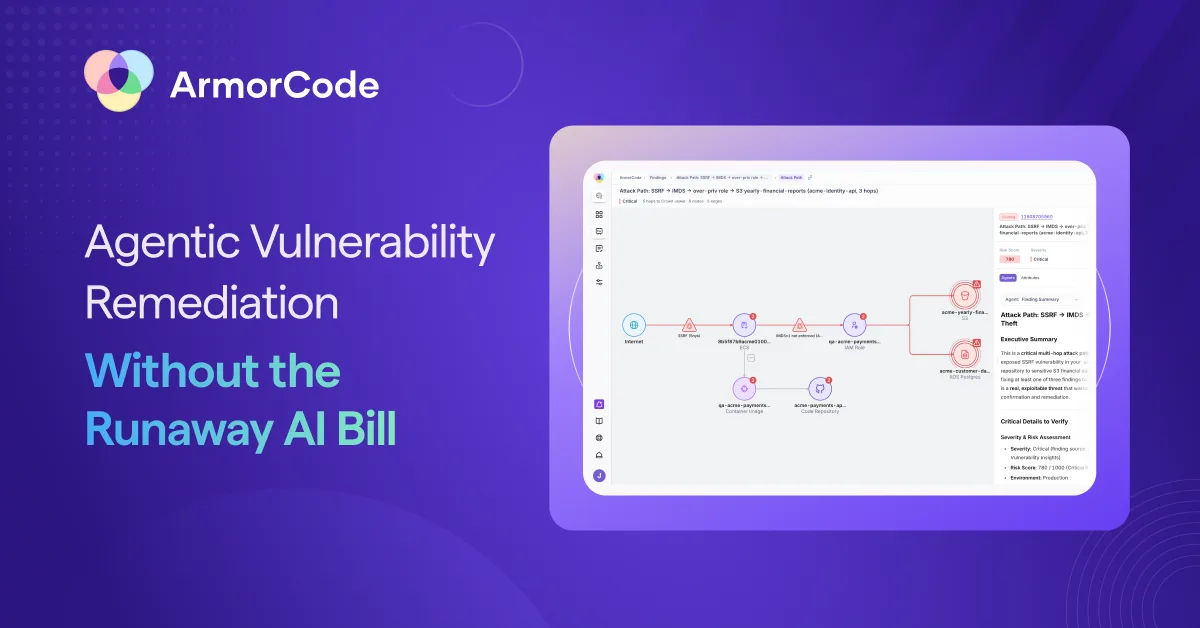
- Expanded Attack Path Analysis: Uses Vulnerability Insights to correlate findings with this environmental context, determine what’s reachable and exploitable, and generate high-fidelity Attack Path Visualizations.
None of this is context for context’s sake. It’s what turns “we have 40,000 open findings” into “these 200 are reachable, exploitable, and worth an agent’s time.” And because Anya agents are grounded in that same enriched graph, every token they spend is working from a shared, settled picture of the environment — not rebuilding one from scratch.
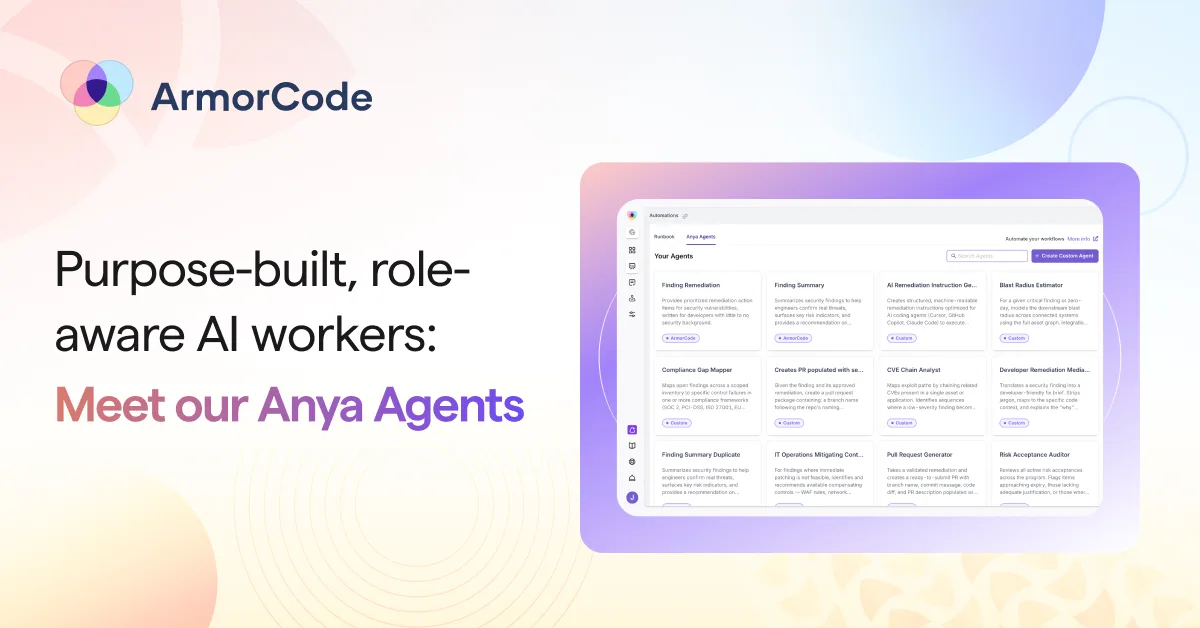
Four new members of Anya’s agentic workforce
A richer Context Risk Graph is only useful if the AI acting on it can use the extra signal. ArmorCode is announcing four planned additions to Anya’s agentic workforce, each grounded in the findings and data already unified inside the platform:
- Cloud Security Engineer: Evaluates cloud misconfigurations and exposures against the broader environment to surface the ones with real business impact, not just the ones that trip a rule.
- Vulnerability Researcher: Investigates whether a given CVE is actually exploitable inside your environment — drawing on attack path analysis to trace how a finding connects to critical assets — and explains the exposure clearly, so remediation teams aren’t guessing at severity.
- Mitigation Engineer: Works with the compensating controls you already have, including WAF rules and EDR policies, to contain risk while the permanent fix is being planned.
- Patch Orchestrator: Plans and sequences patch rollouts across affected systems to support efficient remediation with minimal disruption to the business.
Teams can run these prebuilt agents as-is, or build custom agents on the Anya harness to match their own remediation processes and policies.
How Anya keeps token spend bounded instead of linear
Point an agent at a growing backlog with no governor on how it spends tokens, and the bill scales with the backlog, not with the risk. Analysts estimate that re-sending accumulated context at every reasoning step can account for as much as 62 percent of an agent’s total inference cost, because a standard agentic workflow calls the model ten to twenty times per task and resends everything it has already reasoned through on every call. That’s before you count the cost of ten agents separately re-analyzing what is really one root cause, or an expensive model being used to do triage that a cheaper one could handle.
Anya’s harness is built to close each of those gaps:
- Harness reuse: The remediation plan is built once when an agent is created and reused on every run, instead of re-derived from scratch each time it fires.
- Correlation and deduplication: Findings that trace back to the same root cause are treated as one problem with one fix, so the platform isn’t paying full analysis cost N times over for a single issue.
- Model selection (in active development): Lighter-weight models will handle triage, with more expensive reasoning reserved for findings that clear the bar for real remediation work.
- Prioritization and focus: Vulnerability prioritization is built into how tokens get allocated — spend is directed at findings that are reachable, exploitable, and worth the human review and testing that follows a fix, not on the ones that would get closed as noise anyway.
“Finding vulnerabilities was never the hard part,” said Mark Lambert, Chief Product Officer at ArmorCode. “What is challenging is that attackers can cheaply chain the findings teams deprioritized into real attack paths, while defenders find that AI without context is both wrong and expensive. The expanded ArmorCode Context Risk Graph gives AI the context to fix what actually matters and do it economically.”
Because vulnerability prioritization is embedded in the Context Risk Graph that Anya’s agents reason over, teams aren’t paying agent costs to re-examine findings that shouldn’t have made the cut in the first place. They reuse trusted analysis instead of standing up separate agents that each re-derive the same answer and re-spend the same tokens getting there.
“Every security team is being pushed to adopt AI, and every finance leader is watching the AI bill climb,” said Chandra Sekar, Chief Marketing Officer at ArmorCode. “ArmorCode brings financial and risk discipline to agentic remediation, so enterprises can fix what matters without the runaway costs of pointing AI at everything.”
Governing the token bill doesn’t remove the other risk
Bounding cost is half the problem. Every AI-generated fix still needs a human in the loop, and that review step is where the second failure mode shows up if it’s skipped or rushed to save time. A survey covered by VentureBeat found that 43 percent of AI-generated code changes need debugging once they hit production. A peer-reviewed study from the University of San Francisco, the Vector Institute, and UMass Boston went further, finding that asking an LLM to iteratively “improve” code security produced a 37.6 percent increase in critical vulnerabilities after just five rounds of refinement — the opposite of what the refinement was supposed to accomplish. IBM’s most recent Cost of a Data Breach research puts a number on what happens when that gets missed: breaches involving AI-enabled activity now average about $6 million, roughly a million dollars above the overall average.
Put those together and the framing flips. AI agent cost control is a necessary discipline, but it isn’t the whole answer. This isn’t a cost problem that happens to look like a risk problem. It’s a risk problem that shows up first on the token invoice, because ungoverned agents spend the most on exactly the findings where a wrong or rushed fix costs the most to unwind. Context and governance are the connective layer: the same reachability, ownership, and compensating-control data that keeps token spend bounded is also what keeps an agent from recommending a fix that breaks something a human wouldn’t have missed.
Why this matters at the scale most teams are operating at
ArmorCode processes more than 300 billion findings a year across 375-plus integrations. Correlating security and business context across that volume is how the platform helps organizations narrow in on the roughly 3 percent of findings that account for about 80 percent of actual risk, instead of treating every finding, and every agent run, as equally worth the spend.
Customers using ArmorCode have seen a 75 percent reduction in mean time to remediate, a 60 percent reduction in vulnerability backlog, and a 3.2x first-year return on investment. The expanded Context Risk Graph and the new Anya agents are built to extend that same discipline to agentic remediation specifically, so the AI layer doesn’t become the thing security and finance leaders end up arguing about next quarter.
See it at Black Hat USA
ArmorCode is joining The Purple Book Community for PBC Connect at Black Hat USA on August 4 at Mandalay Bay, with a fireside chat on AI security and emerging risk featuring Jason Clinton, Deputy CISO at Anthropic, and Phil Venables, former CISO of Google Cloud and Goldman Sachs. Attendees can stick around afterward for an ArmorCode Capture the Flag event. Request a seat here.
Want to see the expanded Context Risk Graph and the new Anya agents on your own findings? Book a demo.
Key Takeaways
- The AI bill is a board-level problem already. Uber, Microsoft, and a reported $500 million single-month overspend are public examples; 73 percent of enterprises say their AI costs beat projections.
- Most of that spend is structural, not necessary. Re-sent context alone can account for up to 62 percent of an agent’s inference cost, before duplicated analysis and mismatched model selection are even counted.
- Attack path analysis is what separates signal from noise. By correlating findings with reachability, exploitability, and business context, the Context Risk Graph narrows 40,000 open findings down to the ones worth an agent’s time — and an agent’s tokens.
- Anya’s harness governs spend at four points: plan reuse, correlation and deduplication, model selection (in progress), and prioritization, so cost tracks risk instead of backlog size.
- An ungoverned token bill and an ungoverned fix are the same root problem. Studies show AI-generated patches can introduce new vulnerabilities even when asked to improve security, and breaches tied to AI activity now cost more than the average. Context — including attack path context — is what keeps both in check.