
Context Risk Graph
Security Graph Built for Real Remediation
Stop stitching point tools together by hand. The ArmorCode Context Risk Graph maps end-to-end attack paths across code, cloud, and network layers, giving your team high-fidelity findings and automated, cost-bounded remediation in one agentic control plane.
The Problem
The backlog is no longer just a workload. It is a liability.
Your vulnerability backlog isn’t just a queue; it’s an open door. Attackers no longer wait for a critical CVE. Using cheap AI, threat actors easily chain low- and medium-severity findings into lethal, end-to-end attack paths that reach your crown-jewel assets. Pointing traditional AI assistants at this backlog only escalates the crisis:
AI Without Context Fails
Standard AI agents operating without deep context deliver inaccurate fixes, introduce compliance risks, and miss cross-silo attack paths.
Runaway Token Costs
Re-sending accumulated context on every reasoning loop can make up to 62% of an AI agent’s total cost. Pointing ungoverned AI at a 40,000+ finding backlog turns remediation into an unsustainable financial liability.
Fragmented Point Scanners
Point tools only see single lanes, forcing teams to manually stitch context together
The Solution
One graph built on your unified risk context
The ArmorCode Context Risk Graph is the foundation driving the Anya Agentic Control Plane. Instead of treating every CVE as an isolated issue, the Context Risk Graph correlates findings from 400+ security tools with asset inventory, ownership, business context, threat intelligence, network topology, and compensating controls.
It stops asking “What is the severity label?” and starts answering “What is reachable, exploitable, and worth an agent’s time?”
Five capabilities, one economical path to fixing what matters
With network topology now in the graph, the expanded Context Risk Graph turns unified risk context into economical action through five capabilities
Attack Paths Across Unified Exposure
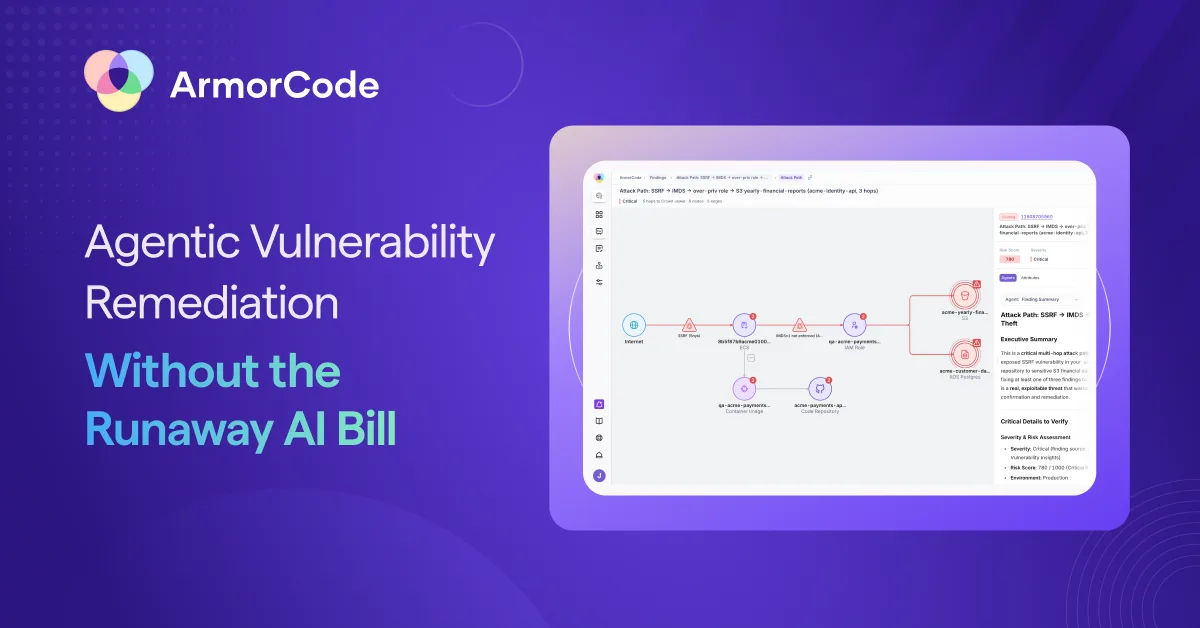
Findings chain into real attack paths, end to end, across code, cloud, container, and network.
Patch Orchestration
The right patch reaches the right asset, through the systems your team already runs.
Compensating-Control Mitigation
Existing controls like WAFs and EDR reduce exposure while a permanent fix is in flight.
Agents for AI-Driven Pipelines
Anya hands your AI code pipeline governed, context-rich instructions through MCP or a runbook.
Scoped Pull Requests
Fixes for tightly scoped issues arrive as pull requests, right where the code lives.
Measurable Enterprise Outcomes
Real Security Results. Bounded AI Costs.
Reduction in Mean Time to Remediate (MTTR)
Reduction in Vulnerability Backlog Volume
First-Year ROI across unified exposure management
1 Source: Forrester Blog: Your AI Bill Is A Context Problem
2 Source: ArmorCode Press Release
Frequently Asked Questions
Q: What is the Context Risk Graph?
A: The Context Risk Graph provides unified risk context in ArmorCode’s Platform. It connects findings from across the toolchain with asset inventory, ownership, business context, threat intelligence, and network topology, then scores risk by reachability and exploitability instead of severity labels alone.
Q: How does the Context Risk Graph reduce AI costs for vulnerability remediation?
A: By giving Anya agents a shared, settled picture of the environment to reason over, so agents reuse trusted context and plans instead of re-deriving analysis from scratch on every run, deduplicating findings that trace back to one root cause, and routing lighter-weight models to triage.
Q: What’s the difference between an attack path and a vulnerability finding?
A: A finding is a single weakness in isolation. An attack path is a traced route showing how one or more findings chain together across code, cloud, container, and network, from an internet-facing entry point to a crown-jewel system, showing what’s actually reachable and exploitable rather than theoretically present.
Q: Does the Context Risk Graph replace my existing scanners or point tools?
A: No. It connects to the tools and controls you already run, including patch-management systems, WAFs, and EDR platforms, and unifies what they see into one graph rather than asking teams to adopt another standalone tool.
Q: How does Context Risk Graph help with CTEM
A: The Context Risk Graph enables Continuous Threat Exposure Management(CTEM) by continuously correlating findings from your toolchain with asset inventory, threat intelligence, and network topology. It surfaces real attack paths instead of isolated vulnerabilities, so your team prioritizes what’s actually reachable and exploitable rather than severity scores alone.