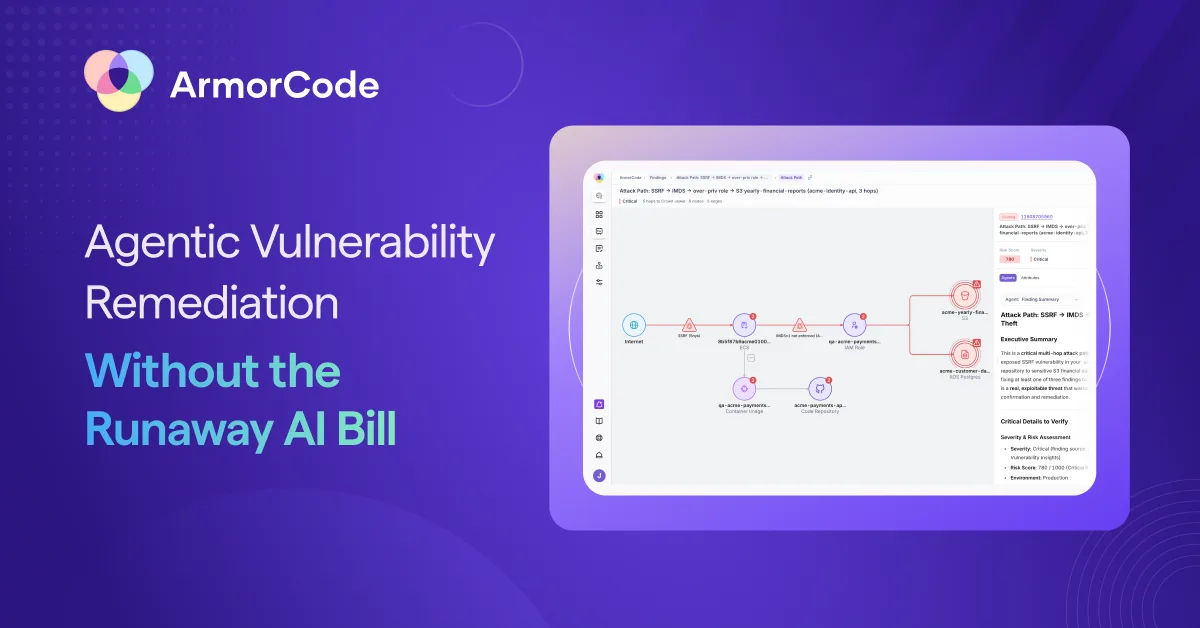
Context Risk Graph with Attack Path Analysis & Agentic Remediation
Download the ArmorCode Context Risk Graph Feature Focus: learn how findings, assets, and code connect to power attack path analysis, patch orchestration, and agentic remediation.
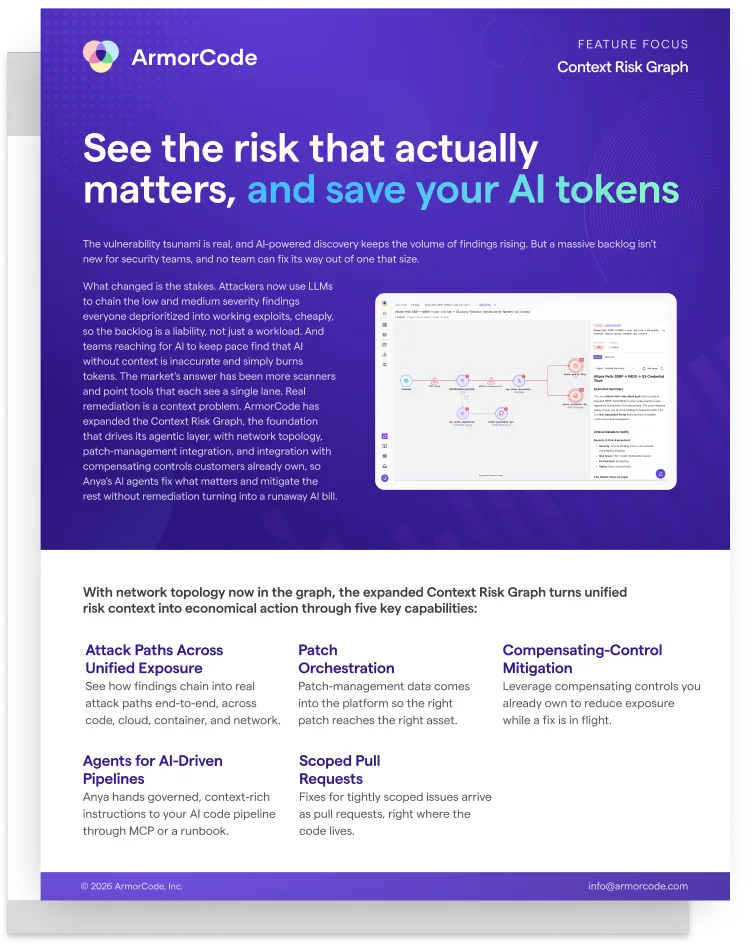

In this Feature Focus brief, you’ll find:
- How the Context Risk Graph integrates findings, assets, code repositories, and business context into a unified relationship model.
- How attack path analysis evaluates risk based on reachability and exploitability, using three levels of confidence, to identify critical paths.
- How Anya’s agents leverage attack path analysis at varying automation levels, from scoped pull requests to full orchestration.
Findings in isolation don’t show you the path to your crown jewels
AI-powered discovery continues to increase the volume of findings, and attackers now utilize LLMs to chain seemingly low-risk findings into cost-effective exploits. The real challenge is that findings are scored and stored individually, disconnected from the asset, the code repository, and their business context. This disconnection means no one sees the chain from an entry point to a crown jewel until an attacker has already exploited it.
The Context Risk Graph addresses this issue by creating a single relationship graph that links findings, assets, code repositories, and business context, now enhanced with network topology, patch orchestration data, and compensating controls a team already possesses. Attack path analysis reads that graph by scoring risk on reachability and exploitability rather than severity labels, ensuring Anya’s agentic remediation addresses what truly matters without wasting resources on less critical issues.
Graph relationships
The Context Risk Graph connects what other tools keep isolated into a comprehensive relationship model.
Scoring model
Risk evaluation focuses on actual reachability and exploitability, not solely on severity labels.
Confidence levels
Attack path analysis categorizes risk through exploitability clusters, vulnerability chains, and full attack paths from entry point to crown jewel.
What are the five capabilities of ArmorCode’s Context Risk Graph?
From the relationship graph itself to the agentic remediation on top, these are the five capabilities that make the Context Risk Graph, including its attack path analysis, an economical, repeatable part of unified exposure management.
- Attack Paths Across Unified Exposure
Attack path analysis reveals how findings connect into comprehensive attack paths across code, cloud, container, and network infrastructures. - Patch Orchestration
Patch-management data is integrated into the platform, ensuring the right patch is delivered to the appropriate asset. - Compensating-Control Mitigation
Existing compensating controls reduce exposure while a fix is being implemented. - Agents for AI-Driven Pipelines
Anya provides regulated, context-rich instructions to your AI code pipeline through MCP or a runbook. - Scoped Pull Requests
Solutions for specific issues are delivered as pull requests, directly within the codebase.
Frequently Asked Questions About ArmorCode’s Context Risk Graph and Attack Path Analysis
Q: What is attack path analysis?
A: Attack path analysis refers to the process of tracing how individual findings, such as vulnerabilities or misconfigurations, connect into a realistic route an attacker might use to reach a target. Instead of scoring each finding independently, attack path analysis leverages the Context Risk Graph’s relationships to highlight which chains of findings are significant, from the attacker’s entry point to the business impact.
Q: What is the Context Risk Graph, and how does it relate to attack path analysis?
A: The Context Risk Graph is a relationship model that connects findings, assets, code repositories, and business context, along with network topology, ownership, and threat intelligence. Attack path analysis is built on this graph, providing insights into actual exposure rather than relying solely on public definitions.
Q: What are the three confidence levels in attack path analysis?
A: Attack path analysis surfaces risk at three confidence levels: exploitability clusters, vulnerability chains, and full attack paths that trace from an internet-facing entry point to a crown-jewel system.
Q: Does attack path analysis replace our existing security tools?
A: No. Attack path analysis is part of ArmorCode’s platform, which unifies exposure management across ASPM, Vulnerability Management, Software Supply Chain Security, and AI Exposure Management, enhancing visibility, insight, and control over existing tools rather than replacing them.
Q: What is exploitability-based vulnerability prioritization?
A: Exploitability-based vulnerability prioritization scores findings by their reachability and active exploitability, rather than by severity labels alone. This approach prioritizes confirmed exploits that pose a direct threat to critical systems over high-severity findings that are less accessible to attackers.
Q: What is agentic remediation?
A: Agentic remediation refers to Anya’s AI agents acting on attack path analysis at any level of automation a team is prepared for, from precise fixes to comprehensive orchestration. These agents are role-scoped, permissioned, governed, and auditable, ensuring a human remains involved in the process.
Q: How does attack path analysis keep AI remediation costs down?
A: Attack path analysis focuses Anya’s agents on findings within a confirmed, exploitable path to a crown-jewel system, allowing agentic remediation to address critical issues and use compensating controls for less urgent ones. The approach reuses plans and treats a single root cause as one fix, keeping costs manageable as volume increases.
Key Takeaways
- The Context Risk Graph integrates findings, assets, code repositories, and business context into a unified relationship model.
- Attack path analysis evaluates risk by reachability and exploitability, at three levels of confidence, to identify critical paths.
- Anya’s agents leverage attack path analysis at varying automation levels, from scoped pull requests to full orchestration.
- Risk evaluation focuses on actual reachability and exploitability, not just severity labels.
- Attack path analysis categorizes risk through exploitability clusters, vulnerability chains, and full attack paths from entry point to crown jewel.