
Technology & Cybersecurity
Software security solutions that scale
Technology companies are the software supply chain, and their customers know it. ArmorCode lets you ship at full velocity while proving security at every step: findings unified across every tool, AI-generated code made visible, and SBOMs and VEX documents produced on demand for every customer who asks.
TRUSTED BY THE WORLD’S TOP BRANDS













Industry Challenges
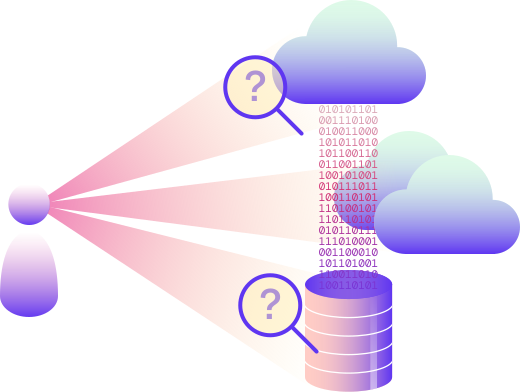
Your vulnerabilities become everyone’s vulnerabilities
When a technology company ships a flaw, the whole market inherits it, and regulators have noticed: the EU Cyber Resilience Act now governs tech companies as software vendors. Breach costs average 4.79 million dollars (IBM, 2025), release velocity is the business model, and AI-assisted development adoption is the highest of any sector, multiplying the code and the findings. For SaaS cybersecurity teams especially, developer-to-security ratios are the most extreme anywhere, and customer security questionnaires and SBOM demands arrive daily. Security here is not just protection. It is a sales requirement.
Customer Testimonials
Built by engineers, chosen by engineering companies
“The [ArmorCode] ASPM solution has been a game changer for me! It’s helped centralise data from several security sources and in turn helped to define actionable metrics, create consistent workflows in engineering, manage risk profiles and automate much of the work involved when it comes to handling security tooling data.”

“ArmorCode transformed our security landscape by providing a centralized framework for risk management. The visibility we gained into our product suite allowed us to assess and compare security postures effectively, aligning our teams in understanding and prioritization.”

“We needed an application security operations platform because we wanted to automate security testing at all phases of the SDLC and get that information back to the right teams. ArmorCode is a dramatically more mature product than anything else we have seen and it actually supports the use cases and workflows that we need.”
“ArmorCode allows me to pull everything into one place and get accurate, real-time metrics on the security posture of my applications, giving me a broad picture of risk & compliance on a per-product, per-division or entire organizational basis.”

“ArmorCode has made our Product Security team more efficient in addressing vulnerabilities and staying in compliance.”
How ArmorCode Helps
Why ArmorCode is the software security solution for technology companies?
Technology companies are the natural full-platform buyer: ASPM at the core, SSCS for customer-facing SBOM and VEX, AIEM to govern the AI their teams adopt fastest, and RBVM across cloud infrastructure. Scanner-agnostic by design, ArmorCode works with the stack engineering already chose and survives every future swap.
Ship Fast, Prove It’s Safe
Release velocity is the business model, and security that can’t keep CI/CD pace gets bypassed. Exploitability clusters keep teams on the 3 percent of findings that carry 80 percent of real risk.
Turn Your SBOM Into Trust
Customer questionnaires and SBOM requests arrive daily, and a slow answer costs deals. ArmorCode generates composite SBOMs with real VEX disclosure automatically, ready whenever a customer asks.
Govern AI Your Own Team Uses
You have the highest AI-assisted development adoption of any sector, so governance starts at home. AIEM brings every copilot, agent, and MCP server your engineers use under one inventory and audit trail.
Related resources
Frequently Asked Questions
Q: What are software security solutions for technology companies?
A: Software security solutions for technology companies unify findings from every scanner, cloud platform, and pentest into one prioritized view, so security teams can keep pace with release velocity instead of slowing it down. For tech and SaaS businesses specifically, this means:
- Aggregating vulnerabilities across hundreds of repos and multiple product lines
- Surfacing the small fraction of findings that carry most of the real risk
- Automating customer-facing artifacts like SBOMs and VEX disclosures on demand
Q: What is ASPM, and how does it support continuous threat exposure management?
A: ASPM aggregates and correlates findings from existing scanners rather than replacing them. It provides the continuous visibility, risk-based prioritization, and remediation workflows needed to operationalize continuous threat exposure management across application risk. ArmorCode is scannerless by design, working with the tools your engineering team already uses instead of adding another scanner to the stack.
Q: Do technology companies need to comply with the EU Cyber Resilience Act?
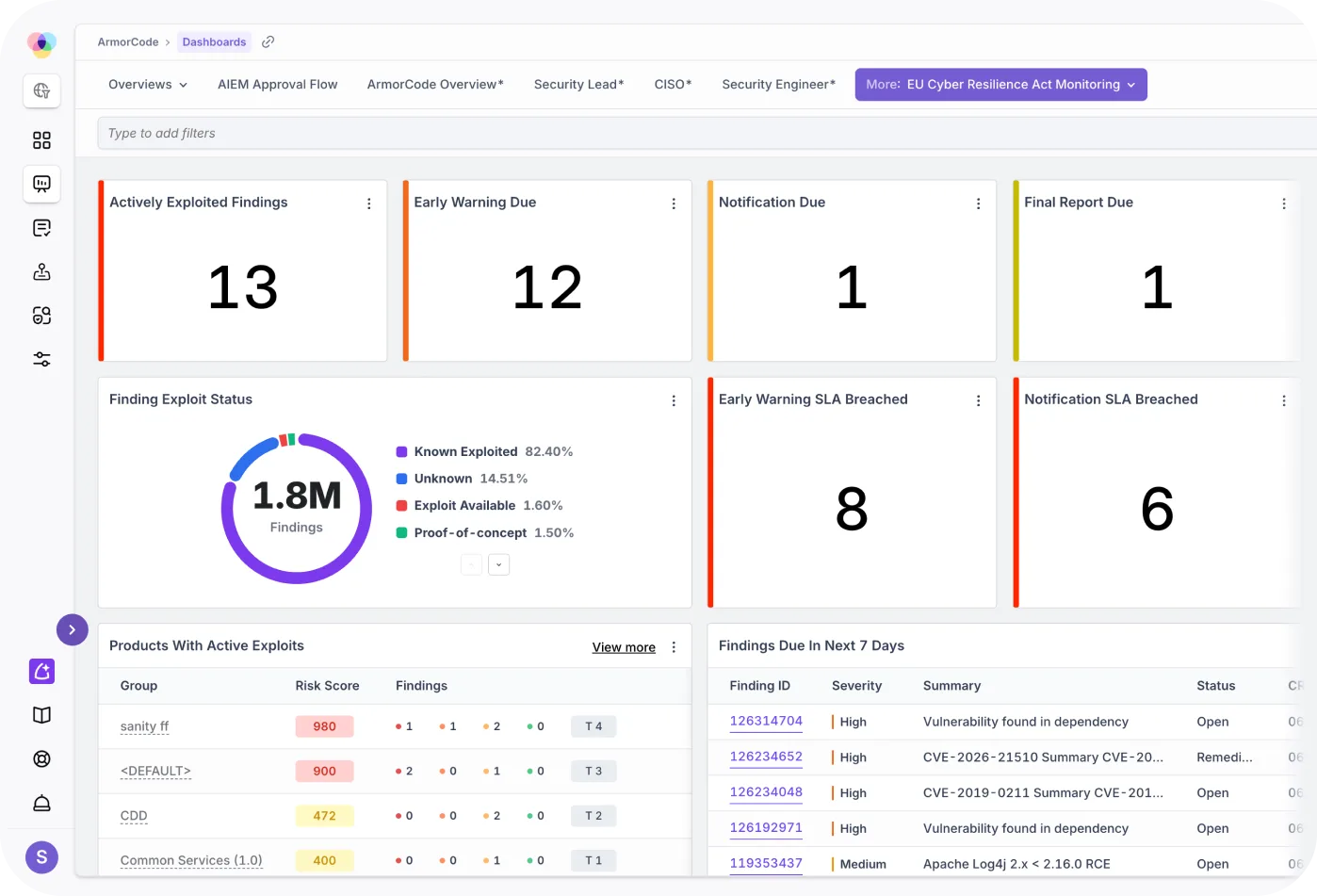
A: Most technology companies selling software or connected products into the EU market fall under the EU Cyber Resilience Act as manufacturers or vendors. Compliance is the company’s own obligation; ArmorCode supports readiness by giving teams visibility into vulnerabilities, SBOM generation, and reporting timelines the regulation requires, but the compliance determination and responsibility stay with the customer.
Q: How can SaaS companies generate SBOMs and VEX documents for customers?
A: SaaS companies can generate composite SBOMs and VEX disclosures automatically by aggregating component and vulnerability data across their codebase into one platform, rather than compiling them manually per customer request. This turns a recurring software supply chain security ask from procurement teams into an on-demand answer instead of a multi-day scramble.
Q: What is software supply chain security and why does it matter for tech companies?
A: Software supply chain security covers the visibility and controls a company has over the components, dependencies, and build processes that make up its software, and it matters most for technology companies because their vulnerabilities become their customers’ vulnerabilities. A flaw shipped once gets inherited by every downstream business relying on that product.
Q: How does AI-assisted development change application security risk?
A: AI-assisted development increases both the volume of code shipped and the volume of findings it generates, since AI-written commits still carry the same class of vulnerabilities as human-written ones, just faster. For SaaS cybersecurity teams with the highest AI adoption of any sector, this means governance needs to extend to the copilots, agents, and MCP servers generating that code, not just the code itself.