
Why Can’t Your Team Shrink the Vulnerability Backlog?
Vulnerability management teams are overwhelmed, not because they lack scanners but because they have more findings than they can realistically remediate. VM scanners, cloud security platforms, container tools, workload scanners, and frontier models generate more findings than any team can address. They face:
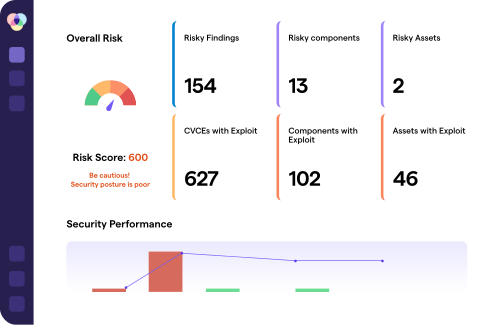
The Backlog Crisis: Scanners flood teams with millions of findings lacking unified risk context.
CVSS Triage Fails: Severity scoring ignores business context; only ~5% of CVEs are ever exploited.
Unassigned Risk: Infrastructure assets lack clear owners, leaving findings unaddressed in queues.
Manual Overhead: Spreadsheet triage and manual ticketing burn thousands of hours without reducing risk.
Unlock the benefits of Risk-Based Vulnerability Management (RBVM)
The ArmorCode Platform delivers a scannerless, vendor-agnostic approach to RBVM that helps teams operationalize continuous exposure management, moving from reactive firefighting to continuous, systematic risk reduction.
Prioritize
Apply Adaptive Risk Scoring with AATI threat intelligence, reachability, and business impact to target the ~5% of CVEs driving real risk.
Automate
Use Anya agents and no-code runbooks to automate triage, routing, escalation, and closed-loop fix verification across your existing IT stack.
Reduce Risk
Create one prioritized backlog across cloud and hosts, map findings to owners, and use risk-calibrated automation to cut MTTR up to 97%.
Manage vulnerability risk across your entire infrastructure
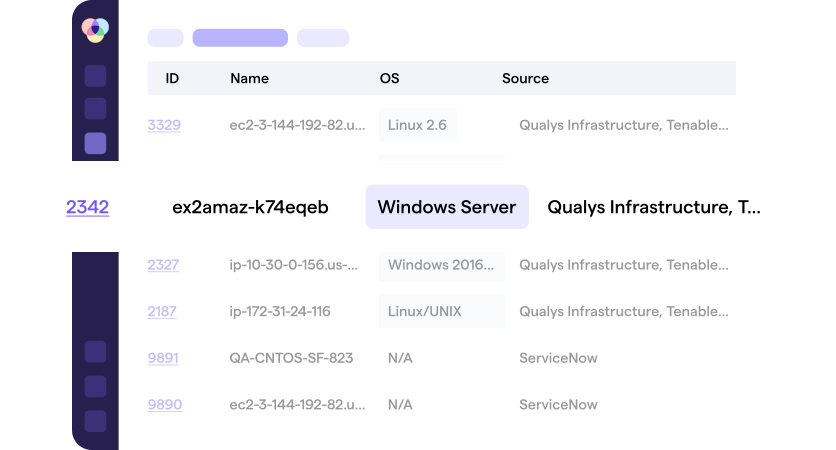
Bring vulnerability findings from your existing security investments into one unified exposure management program. ArmorCode gives infrastructure security teams a vendor-neutral layer to prioritize, assign, remediate, and verify exposures without scanner lock-in..
Insight
Correlate findings with network topology, reachability, WAF/EDR controls, and business context in one Context Risk Graph.
Agility
Streamline find-to-fix with automated runbooks that track SLAs, gate risk, and verify patches closed-loop.
Collaboration
Route context-rich issues directly to asset owners in native workflows to cut friction and SLA breaches.
Customer Testimonials
Experiencing ArmorCode for RBVM
“Wonderful Product. Highly Satisfied! 5+ Stars
ArmorCode is a world class platform that is quickly emerging as a leader in the vulnerability management space. It works to manage both application security and infrastructure security vulnerabilities and is a crucial tool for any Security team needing vulnerability consolidation and looking to implement vulnerability management automation.”

“Amazing Platform For Managing Appsec And Infrastructure Vulnerabilities
ArmorCode is a fantastic platform that brings vulnerabilities across dispersed areas into a single place to triage, assign and report. It has simplified workflows for both my application security and infrastructure security team.”
“Excellent Product And Company. Highly Recommend!
ArmorCode is a fantastic product that brings together in a single place vulnerabilities across all platforms and disciplines. It is highly customizable and easy to use. ArmorCode has saved my Appsec and Security Engineers countless hours in managing vulnerabilities from multiple sources and belonging to multiple technology teams.”
“ArmorCode Is Certainly The Best AppSecOps Platform Available In The Market
ArmorCode AppSecOps is definitely a great platform that gives complete visibility into application security postures”
“ArmorCode: Comprehensive platform with visibility and integration
Armorcode is an excellent product for vulnerability management….Overall, this product provides end-to-end visibility, integration and collaboration features to make it a good choice for any company to enhance their AppSec capability.”
TRUSTED BY THE WORLD’S TOP BRANDS























Frequently Asked Questions
Q: What is Risk-Based Vulnerability Management (RBVM)?
A: Risk-Based Vulnerability Management (RBVM) is a cybersecurity practice that prioritizes infrastructure vulnerabilities based on real-world threat intelligence, asset criticality, reachability, and business impact, rather than relying solely on generic CVSS severity scores.
Q: How does ArmorCode RBVM differ from traditional scanner-native tools?
A: ArmorCode is scannerless, vendor-neutral, and sits as an independent control plane above your entire stack. Unlike scanner vendors whose prioritization logic is biased toward their own findings, ArmorCode normalizes and correlates findings from 400+ security tools without vendor lock-in.
Q: Can ArmorCode help us migrate off Cisco Vulnerability Management (Kenna Security)?
A: Yes. ArmorCode preserves the independent, scanner-agnostic governance model that Kenna customers rely on while expanding RBVM into a broader Unified Exposure Management platform spanning Application Security (ASPM), Software Supply Chain Security (SSCS), and AI Exposure Management (AIEM), helping organizations operationalize CTEM across exposure domains.
Q: How does Adaptive Risk Scoring cut vulnerability noise by 90%?
A: ArmorCode correlates findings with business context, ArmorCode Advanced Threat Intelligence (AATI), CISA KEV, EPSS scores, and network reachability to isolate the ~5% of vulnerabilities that pose actual exploitability risk to your organization.
Q: How does ArmorCode automate remediation without risking production downtime?
A: ArmorCode uses risk-calibrated automation. Low-impact, low-outage-risk fixes trigger automated remediation, while high-impact production changes are automatically routed to accelerated human review through Anya agents and no-code runbooks.