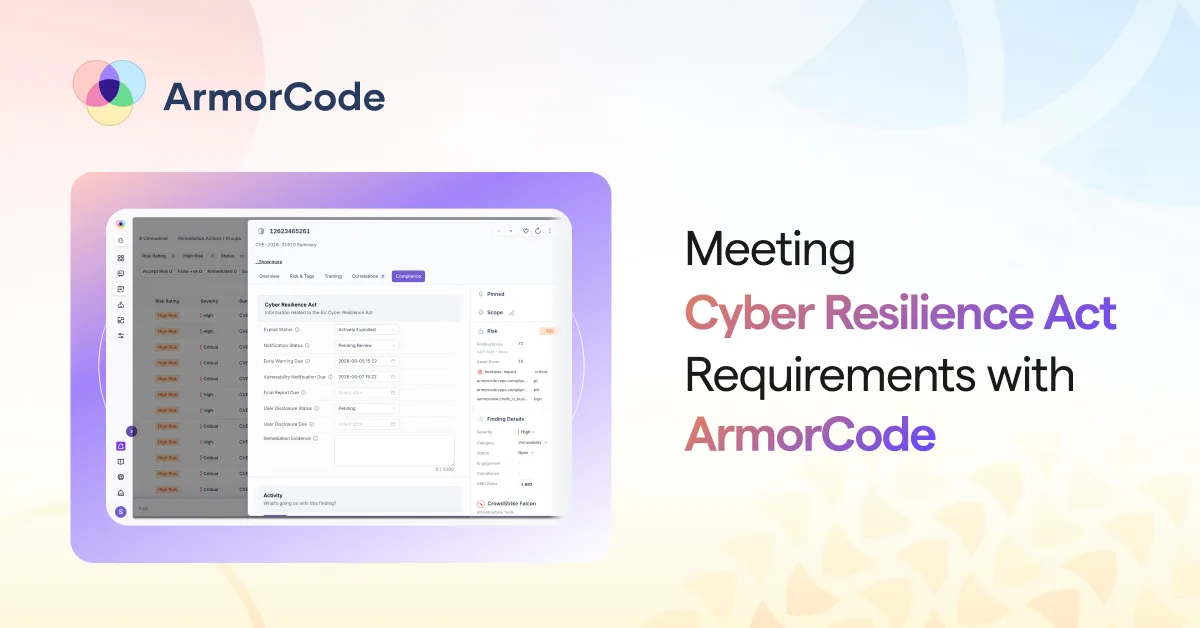
Automate EU Cyber Resilience Act Compliance Workflows
Meet 24-hour disclosure deadlines, generate SBOMs, and prove continuous readiness. Learn how to automate CRA compliance with ArmorCode.
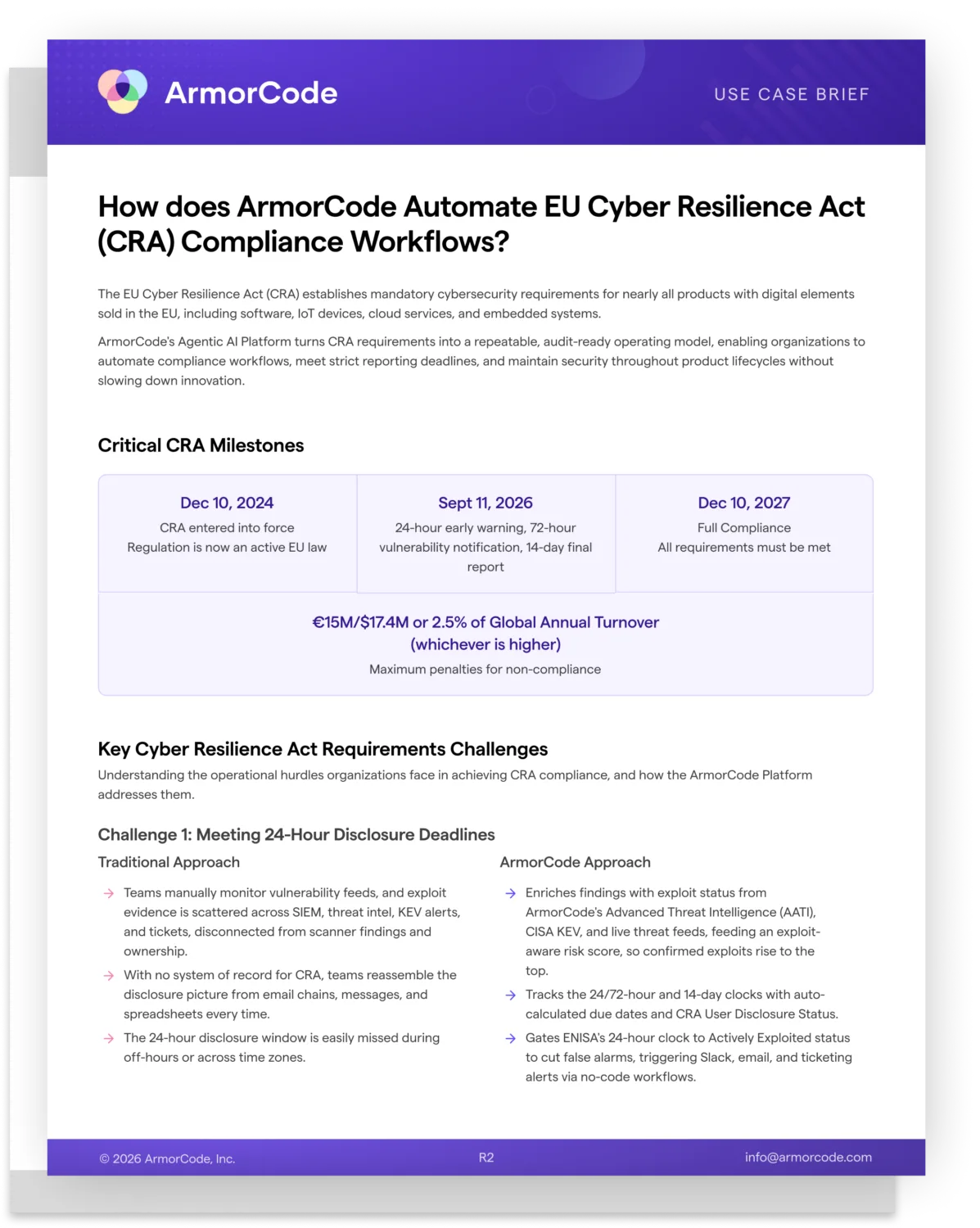

In this Use Case Brief, you’ll find:
- The key CRA challenges and milestones, paired with the ArmorCode approach to each
- A CRA-readiness checklist to assess your team across five compliance dimensions
- Why organizations choose ArmorCode for CRA compliance
How Does ArmorCode Automate EU Cyber Resilience Act (CRA) Compliance Workflows?
The ArmorCode Agentic AI Platform turns EU Cyber Resilience Act compliance into a repeatable, audit-ready operating model. This document breaks down the operational challenges of CRA, from meeting 24-hour disclosure deadlines to scaling remediation and proving continuous compliance, and shows how a single source of truth automates each one without slowing development.
How Do Organizations Meet the CRA 24-Hour Vulnerability Disclosure Deadline?
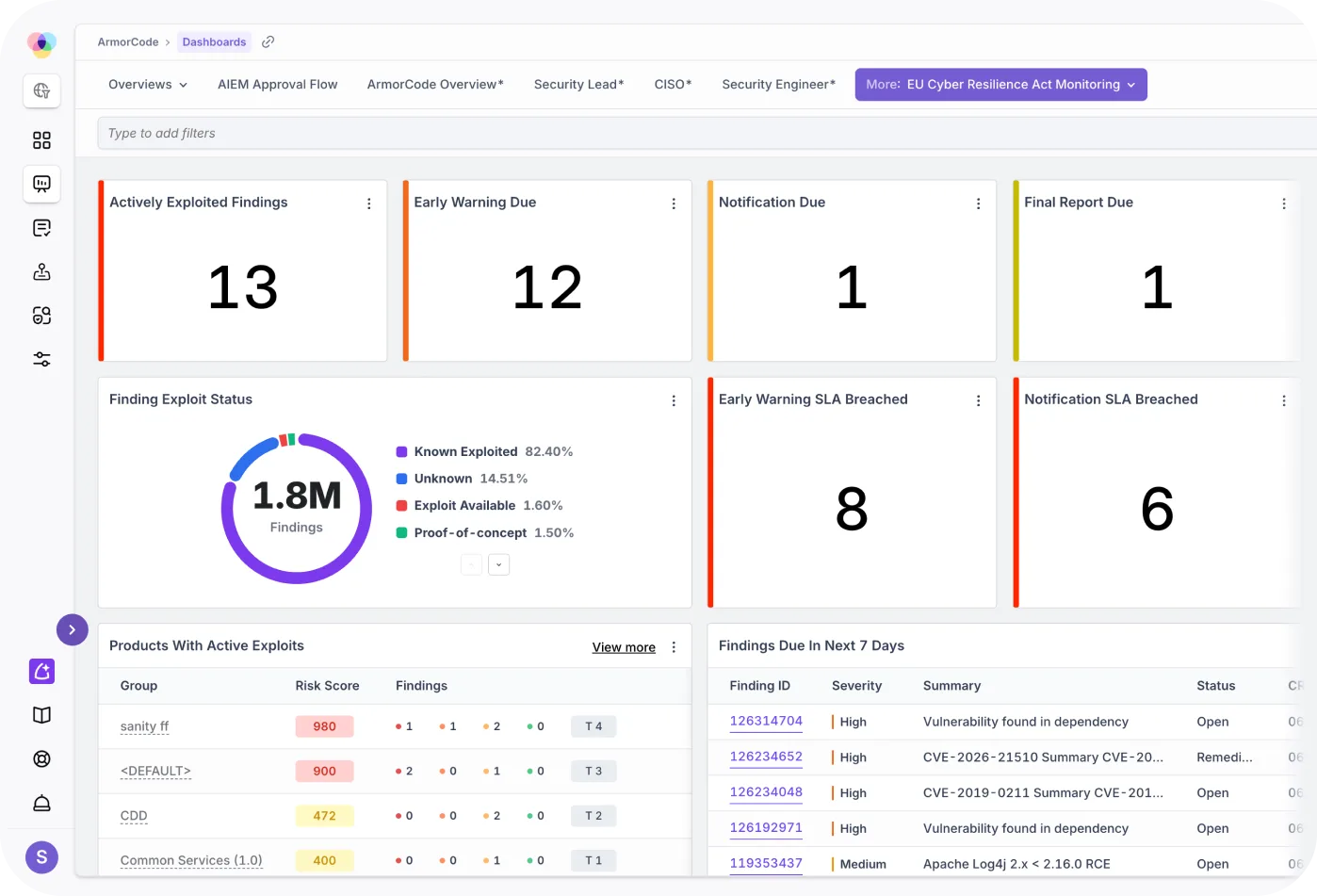
Organizations meet the CRA 24-hour vulnerability disclosure deadline by enriching findings with real-time exploit intelligence and tracking reporting clocks automatically. ArmorCode pulls exploit status from ArmorCode Advanced Threat Intelligence (AATI), the CISA KEV catalog, and live threat feeds, then tracks the 24-hour, 72-hour, and 14-day clocks with automatically-calculated due dates.
By gating the 24-hour ENISA clock to Actively Exploited status, ArmorCode cuts false alarms and triggers automated alerts through no-code workflows, ensuring confirmed exploits rise to the top and disclosure stays on time—across any time zone.
How Do Organizations Manage Continuous SBOM Generation at Scale for CRA Compliance?
Organizations manage continuous SBOM generation at scale by automating Software Bill of Materials and VEX creation across every product and release. ArmorCode automatically generates SBOMs and triggers continuous updates from CI/CD pipeline events and release milestones, keeping inventories current instead of relying on point-in-time snapshots.
ArmorCode standardizes output in CycloneDX format across the entire product portfolio for consistency, and provides a secure portal for tamper-resistant distribution that gives auditors verifiable proof of authenticity.
How Do Organizations Achieve Unified Vulnerability Visibility Across Fragmented Infra, Apps, Cloud, and AI Security Tools?
Organizations achieve unified vulnerability visibility by consolidating findings from every security tool into a single source of truth. ArmorCode supports 350+ integrations and provides a unified dashboard that displays a complete security posture across applications, code, cloud, infrastructure, and AI tools.
ArmorCode uses correlation to identify and consolidate duplicate findings, reducing noise so teams act on unique issues. ArmorCode classifies every product with digital elements from Default through Critical and consolidates context from assets and findings to confirm full product coverage, freeing teams to focus on remediation instead of manual data aggregation.
How Do Organizations Scale Vulnerability Remediation Without Slowing Development?
Organizations scale vulnerability remediation without slowing development by automating ticket creation, routing, and assignment through no-code workflows. ArmorCode delivers context-rich, code-aware fix guidance through the Anya Remediation agent, so developers resolve issues faster with the context they need.
ArmorCode configures multi-tier SLAs across triage, resolution, and remediation with automated monitoring and breach alerts, and integrates deeply with Jira and ServiceNow for seamless collaboration. ArmorCode captures Evidence of Remediation that flows directly into the CRA vulnerability notification and final report.
How Do Organizations Demonstrate Continuous Cyber Resilience Act Compliance to Auditors?
Organizations demonstrate continuous CRA compliance to auditors by maintaining always-on dashboards with real-time audit evidence. ArmorCode backs this with immutable audit trails for every decision and action, replacing last-minute evidence gathering with continuously available proof.
ArmorCode enables exception management through structured workflows with multi-stakeholder approvals and generates one-click compliance reports from configurable templates. ArmorCode demonstrates sustained CRA adherence with continuously maintained evidence rather than point-in-time checks.
Frequently Asked Questions About the EU Cyber Resilience Act
Q: When do the EU Cyber Resilience Act vulnerability reporting requirements begin?
A: The European Union Cyber Resilience Act mandates that manufacturers must report actively exploited vulnerabilities and severe incidents starting on September 11, 2026. Companies must provide an early warning within 24 hours of detection via the European Union Agency for Cybersecurity Single Reporting Platform (SRP).
Q: What are the penalties for non-compliance with the Cyber Resilience Act?
A: Organizations that fail to comply with the European Union Cyber Resilience Act face maximum financial penalties of 15 million Euros ($17.4 million in current US Dollars), or 2.5 percent of their global annual turnover, whichever amount is higher.
Q: Which SBOM formats are required for CRA compliance?
A: The Cyber Resilience Act requires manufacturers to prepare a Software Bill of Materials in a commonly used, machine-readable format. The widely accepted industry standard for compliance is CycloneDX format.