Cyber Resilience Act Compliance: From Regulatory Pressure to Operational Excellence

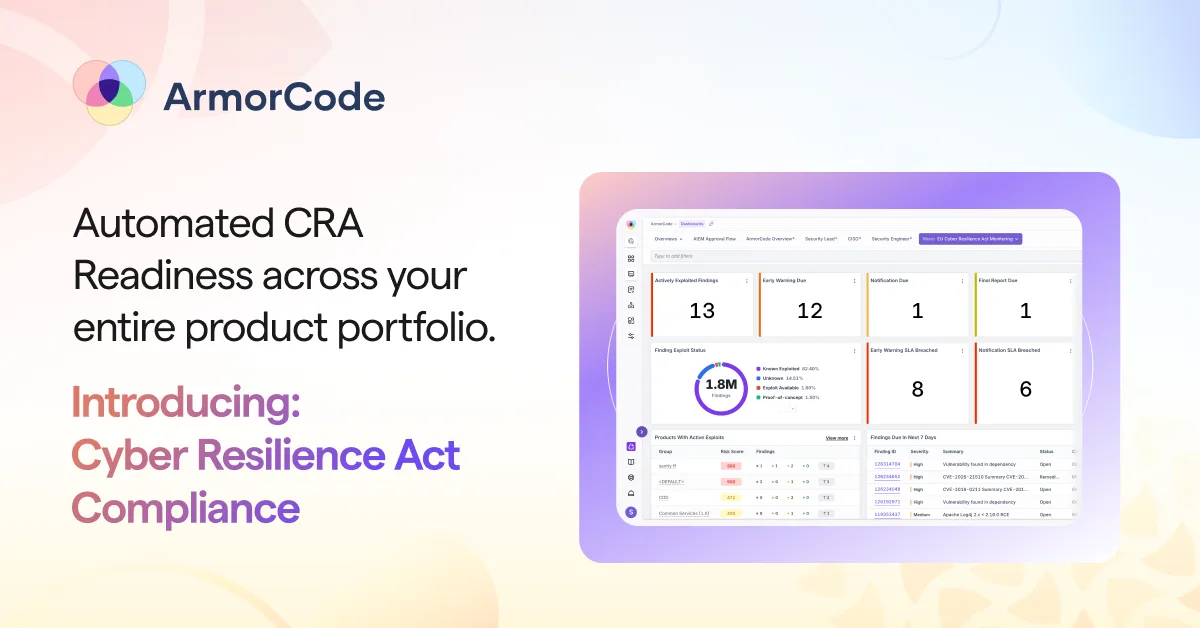
The Signal Behind the Noise: Why Cyber Resilience Act Compliance Matters Now
EU Cyber Resilience Act compliance landed on most security leaders’ radar as a 2027 problem. I want to argue it’s already a 2026 problem, and for some organizations, it’s a problem that started the moment the regulation entered into force.
Here is what the CRA does: it moves legal accountability for insecure software from the end-user, who had no practical ability to fix it anyway, to the manufacturer who built and shipped it. If your organization places products with digital elements on the EU market, YOU are the responsible party. That covers software vendors, device manufacturers, and open-source stewards whose components end up inside commercial products. The regulation mandates continuous vulnerability handling, lifecycle-aware security practices, machine-readable SBOMs, and a formal reporting cascade with hard deadlines attached to real penalties: including a 24-hour window to notify ENISA of actively exploited vulnerabilities.
What’s interesting to me is that none of the underlying pressure is new. Security teams have felt for years that periodic scanning isn’t enough, that remediation backlogs are a structural problem, and that there’s no clean, auditable record of how security decisions get made. The CRA didn’t invent these problems. It attached real, legal consequences to them.
The full product compliance requirements, covering SBOM obligations, conformity assessment, and lifecycle security, take effect December 11, 2027. But waiting until 2026 to begin building the operational infrastructure to support compliance isn’t a strategy. It’s a bet that you can retrofit fundamental changes into a running software development lifecycle without breaking things. Almost no one will win that bet.
The Inverted Bottleneck of Cyber Resilience Act Compliance
When I talk to CISOs and AppSec leaders about their biggest operational challenge, I almost never hear “we can’t find enough vulnerabilities.” Modern scanner stacks are remarkably good at surfacing findings. The bottleneck is actually on the other side of the pipeline entirely:
- Triaging what matters
- Routing it to the right owner
- Ensuring there’s enough context for them to act on
- Tracking remediation through to verified closure
- And producing a defensible record that proves all of this happened
That’s the inverted bottleneck. The input end scales effortlessly. The output end, where a finding becomes a closed ticket with a verified patch, runs on manual effort, organizational friction, and context that keeps getting lost between handoffs.
The CRA sharpens this problem because it doesn’t accept “we’re working on it” as a compliance posture. It requires a documented, systematic approach to vulnerability management that your team, your organization, and potentially a regulator can trace end-to-end. Spreadsheets and Slack threads aren’t documentation. An auditable, continuous process is.
There’s a compounding factor here that I don’t think gets enough attention: AI-driven vulnerability discovery is accelerating faster than remediation capacity. As the ability to surface vulnerabilities scales up, organizations that haven’t addressed the remediation bottleneck will find their backlogs growing faster than ever, under a regulatory framework that has no patience for backlogs.
When Does the EU Cyber Resilience Act Compliance Timeline Require Full Adherence?
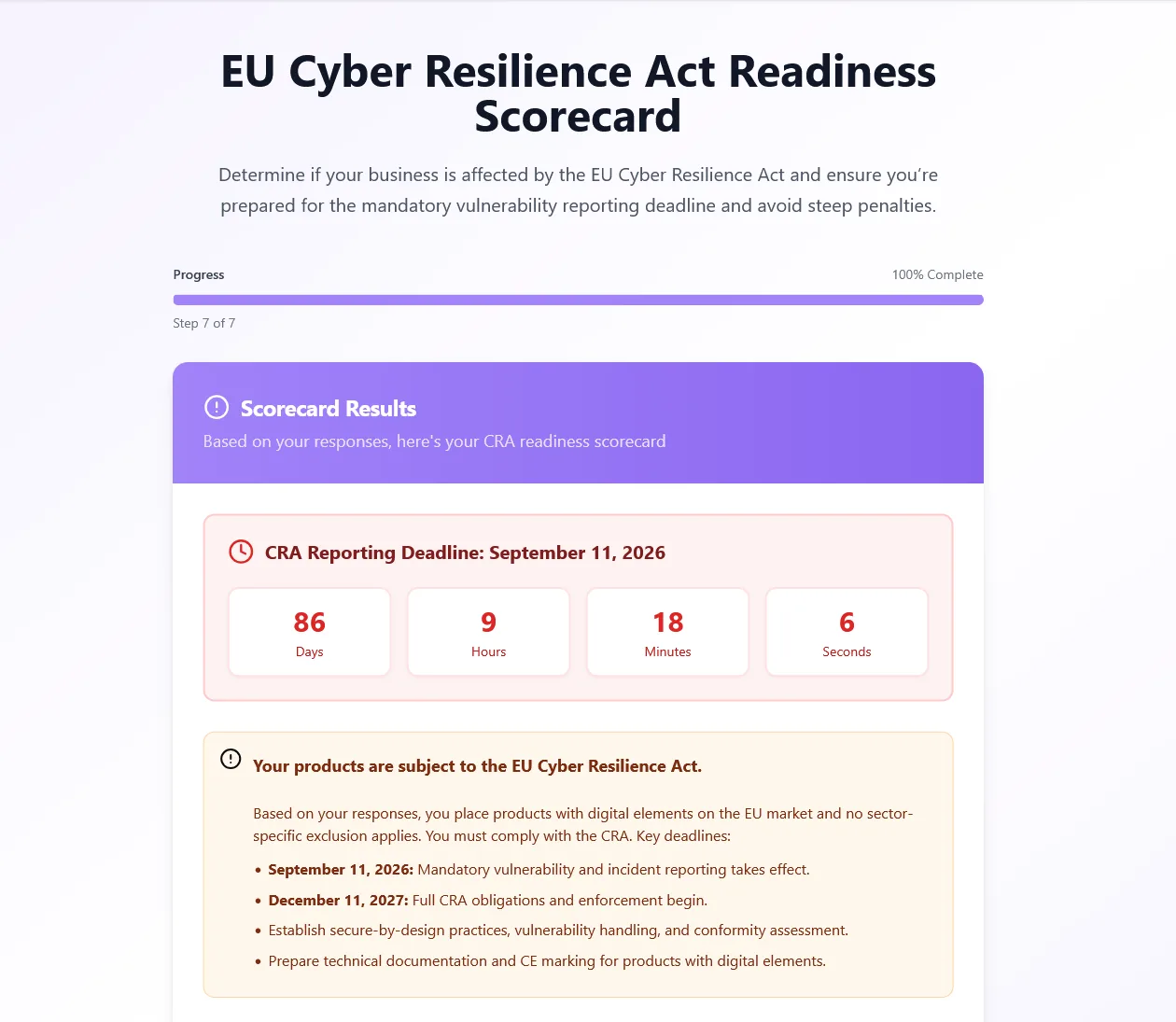
The EU Cyber Resilience Act compliance timeline has two distinct phases. The 2027 deadline gets cited most often, and it’s real. But there’s a huge milestone that I strongly feel organizations are underestimating: the reporting obligations for actively exploited vulnerabilities and severe incidents starts September 11, 2026. That’s less than 90 days away!
Under the CRA’s reporting cascade, manufacturers must notify ENISA within 24 hours of becoming aware of an actively exploited vulnerability, follow with a detailed report within 72 hours, and then submit a final report within 14 days. That sequence requires monitoring infrastructure, an internal escalation path, and tooling that can surface exploitation signals in near-real time. None of that exists out of the box. None of it can be configured in a weekend.
This is the part I keep coming back to in conversations with customers. The 2027 deadline feels manageable from the outside. The September 2026 reporting requirements feel manageable, too, until you ask what process currently exists to detect active exploitation of a specific CVE in your environment within 24 hours, and trace it through to a formal ENISA notification. Most organizations don’t have that process. Building it takes time that’s simply running out.
Beyond the Checklist: Operationalizing Cyber Resilience Act Compliance
Why Static Prioritization Fails the CRA Test
The default response to “how do we meet CRA compliance requirements?” is usually some version of “patch the critical CVEs first.” I understand why. CVSS scores are widely understood, easy to report on, and give security teams a defensible-sounding prioritization rationale.
But severity is a property of the vulnerability. Risk is a property of your environment. They are not the same number, and regulators will expect organizations to demonstrate that they know the difference.
The CRA doesn’t ask whether you addressed your highest-scored findings. It asks whether you addressed your highest-risk ones, with a process that’s transparent, repeatable, and documented.
That requires business-aligned prioritization: correlating technical reachability with asset criticality, environment exposure, data classification, and actual business impact. It requires being able to explain every prioritization decision in language a regulator can evaluate. Organizations that have built a compliance posture on CVSS scores alone are going to discover that their prioritization logic doesn’t hold up under scrutiny, because it was never designed to.
The Reality of EU Cyber Resilience Act Compliance
EU Cyber Resilience Act SBOM compliance has generated more vendor activity than almost any other requirement in the regulation. Every conference has a panel about CycloneDX versus SPDX. Every vendor has a “CRA-ready” SBOM tool. And most of the conversation is missing the actual point.
Generating an SBOM in a machine-readable format is a solved problem. The CRA requires manufacturers to maintain a software bill of materials, and yes, it needs to be machine-readable. But the regulation’s real intent is the ongoing management of the risks those SBOMs reveal, not producing an ingredients list. An SBOM that gets generated quarterly and sits in a document repository is not compliance. It’s a snapshot aging toward irrelevance.
This is what I’d call the Red Queen problem for software supply chain security: open source vulnerability discovery is accelerating. New CVEs drop against widely-used components every day. The SBOM you generate this week will surface with a different risk exposure by next Thursday. If your response to SBOM compliance is a periodic export that feeds no active process, you haven’t met the spirit of the regulation, and I’d argue you won’t satisfy its operational intent under real scrutiny.
Active supply chain security means your SBOM infrastructure is connected directly to your vulnerability management process. When a new CVE lands against a component you ship, you know within hours. You can trace exactly which products, versions, and customers are affected. Remediation gets routed automatically to the right engineering team. That’s what SBOM compliance looks like when it’s operationalized. The SBOM is the foundation. The response is the compliance requirement.
The Role of Unified Exposure Management
The CRA doesn’t recognize organizational silos, and neither do attackers. If you have exposure across cloud infrastructure, container workloads, application code, and third-party dependencies, the regulation treats your security posture as a unified obligation. Your compliance position is only as strong as your weakest visibility gap.
Most security programs I see have evolved organically into exactly the wrong shape for this. Cloud security runs one toolchain. Application security runs a different one. Infrastructure operates separately. Each function has its own prioritization logic, its own reporting cadence, and its own definition of what “handled” means. There is no unified record of risk across the environment, and therefore no unified compliance posture.
Unified Exposure Management is the operational model that closes this gap. It means treating cloud, containers, code, and supply chain as a single exposure landscape, with a common language for risk, a shared prioritization logic, and one continuous record of what was found, what was decided, and what was done about it.
For EU Cyber Resilience Act compliance specifically, this is the architectural prerequisite, not a nice-to-have. The regulation requires continuous vulnerability handling across the entire product surface. Not continuous in application security, periodic in cloud, and ad-hoc in containers. Continuous across all of it. That’s not achievable with a fragmented, multi-silo approach, regardless of how good each individual tool is.
How to Accelerate Cyber Resilience Act Compliance Without Sacrificing Velocity
Why Manual Triage is the Enemy of Compliance
Ask any security engineer how they actually spend their time, and you’ll hear a consistent answer: gathering context. Figuring out who owns a service. Checking whether a finding is a duplicate. Writing enough detail on a ticket to get an engineer to actually look at it. Tracking SLA clocks. Following up on the remediation that was supposed to happen last sprint.
That’s not security work in any meaningful sense. It’s the overhead that sits between finding a vulnerability and fixing it, and it doesn’t scale.
The CRA’s 24-hour notification requirement makes the scale problem explicit in a way that is hard to ignore. When exploitation evidence surfaces, your team needs to correlate it against your product portfolio, confirm which products and versions are affected, determine whether the 24-hour clock is running, and begin assembling the disclosure package, all before the first deadline expires. Manual triage fails that test. You cannot triage your way to a 24-hour window when the evidence is scattered across a SIEM, a CTI feed, a CISA KEV alert, and a Slack message that nobody remembered to log.
The honest version of this problem: triage capacity doesn’t scale linearly with headcount, because the bottleneck isn’t raw processing speed. It’s context. Each finding needs to be understood against the specific environment, business risk, and remediation ownership model of that organization. That context is expensive to transfer, hard to standardize, and almost impossible to automate without the right platform infrastructure. Organizations that haven’t addressed this before the reporting obligations kick in September 2026 are going to face the worst possible introduction to CRA compliance. A Cyber Resilience Act (CRA) compliance checklist built on CVSS scores alone will not survive scrutiny.
Agentic AI as a Capacity Multiplier for Security Operations
The answer to the triage bottleneck isn’t more analysts. It’s removing the work that shouldn’t require analysts in the first place.
I wrote about this when we launched Anya Agents: security teams don’t need AI assistants. They need AI workers, purpose-built agents that execute specific, high-value workflows consistently, grounded in real product and vulnerability context, so engineers can focus on the cases that genuinely require their judgment.
For Cyber Resilience Act compliance, that distinction matters more than for almost any other use case. The regulation demands a process that scales regardless of finding volume, because the volume is not going to decrease. Anya Agents are built for exactly this: the Remediation Agent generates code-aware fix guidance grounded in your actual codebase. The Zero-Day Exposure Hunting Agent assesses the organizational impact of a newly disclosed CVE by pulling threat intelligence, identifying affected components, checking supply chain exposure, and producing a full impact report without a human having to manually assemble any of it.
Those are not AI features. They are AI workers doing defined jobs inside a governed process. The practical outcome: remediation acceleration from 240 days to 7 days. An 80%-plus reduction in critical security technical debt across enterprise customers. And critically for CRA, every action is traceable, every prioritization decision is explainable, and the audit trail exists as a byproduct of the process rather than as a retrospective documentation exercise.
Building Your CRA Compliance Architecture
The structural view of CRA-compliant security operations is not a project plan with a completion date. It is a continuous loop.
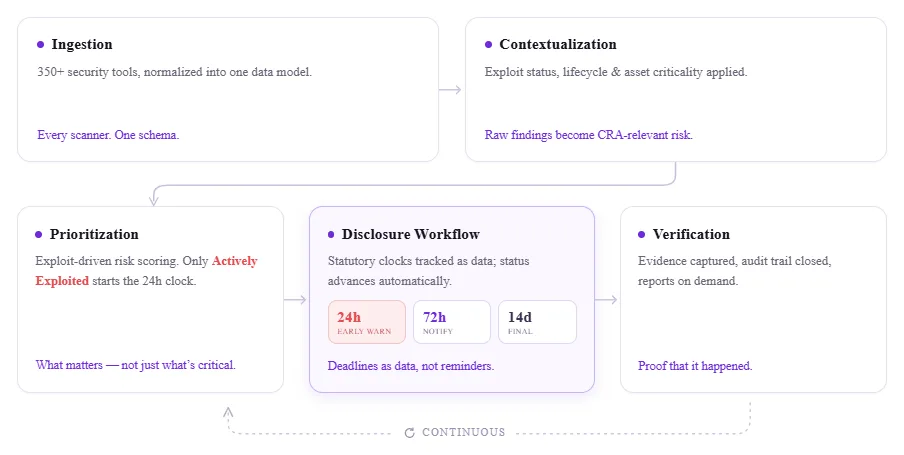
It starts with Ingestion: consolidated findings from every scanner and security tool across the full product surface, normalized into a unified data model that speaks the CRA’s language natively. PDE Classification at the product and sub-product level. Exploit Status as a first-class field, automatically enriched by threat intelligence and adjustable by your analysts. The product lifecycle status that determines which CRA obligations apply.
From there, Contextualization: correlating findings against your specific products, product versions, asset criticality, and real-world exploitation evidence. This is where raw vulnerability data becomes CRA-relevant risk. The Exploit Status field drives this directly. Only the Actively Exploited status triggers the 24-hour ENISA clock, which means your team is not chasing every theoretical vulnerability as a potential disclosure obligation. Confirmed exploitations amplify the risk score. Unproven or theoretical exploits are weighted accordingly. The prioritization logic is tunable and explainable.
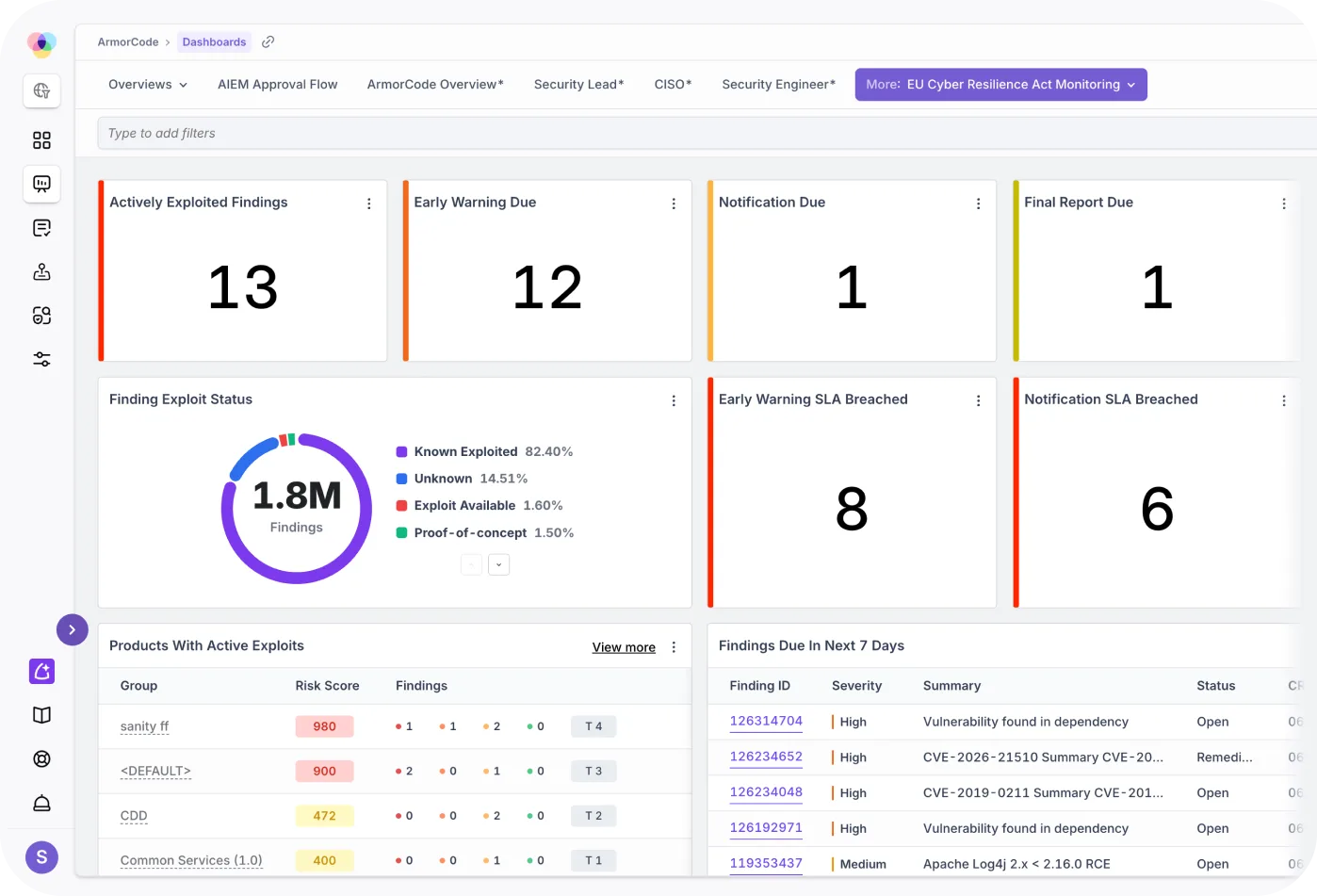
Then Disclosure Workflow: with due dates for the 24-hour Early Warning, 72-hour Vulnerability Notification, and 14-day Final Report tracked as data against each finding, not as calendar reminders managed by a human. When exploitation is confirmed, the clock starts automatically. The CRA Notification Status tracks each finding through the full disclosure lifecycle. No-code automation surfaces alerts as deadlines approach. Evidence of Remediation captured at fix time flows directly into the notification and final report.
And throughout all of it, Continuous Audit Evidence: immutable logs of every status change, exception approval, and disclosure action. Compliance reports available on demand from configurable templates. Real-time SLA dashboards that show exactly which findings are within SLA and which have breached, at the product, sub-product, and finding level.
Conclusion: The Path Forward, from Compliance to Resilience
Compliance as a Competitive Advantage
The organizations that operationalize CRA compliance early will not just avoid a regulatory penalty. They will build a security infrastructure that runs better than it did before, and they’ll get there before their competitors.
The companies that scramble to retrofit compliance controls in 2026 will experience a specific kind of organizational pain that I’ve seen before: engineers pulled off feature work to close security debt, security and product organizations in conflict over timelines, rushed tooling implementations that create as many problems as they solve. That friction is expensive. It’s also visible to customers and partners in ways that matter to business outcomes.
The companies that started building now will arrive in December 2027 with something different. Not just a compliance posture, but a genuinely more capable security organization. The infrastructure built for CRA compliance, Unified Exposure Management, documented remediation workflows, and automated reporting capabilities, creates compounding value across every vulnerability type, not just those touched by the regulation. Mean time to remediation goes down across the board. Engineering teams get cleaner signals about what actually needs their attention. The auditable record that the CRA requires is the same record that builds trust with enterprise customers across every other framework they’re evaluating you against.
The Business Case for Accelerating Cyber Resilience Act Compliance Now
The €15 million penalty gets cited in most Cyber Resilience Act compliance conversations, and it should be on the table. But for most organizations I talk to, the more relevant cost isn’t the regulatory fine. It’s the operational cost of reactive compliance.
Retroactively applying security controls to a mature software development lifecycle is expensive in ways that don’t appear on a single invoice. It’s the engineering sprints redirected from product work. The release cycles that stall because security reviews weren’t built into the process. The technical debt that accumulates when security gets treated as a phase you do before shipping rather than a continuous capability you maintain.
These costs are real, recurring, and they compound. And they fall hardest on the organizations that treated compliance as a future problem right up until it became an immediate one.
The security leaders I respect most are the ones who frame CRA compliance to their leadership not as a regulatory burden but as the forcing function it actually is: an externally mandated deadline for operational improvements that were already overdue. That framing gets resources. It creates alignment with engineering and product. And it produces a security program that’s more capable on the other side of the deadline, not just one that checked the right boxes.
True compliance and genuine operational resilience converge at the same destination. The CRA just made the arrival date non-negotiable. The question isn’t whether your organization builds this capability. It’s whether you build it now, with a thoughtful architecture and enough time to get it right, or later, under pressure, in a fire drill that nobody wins.
If you want to go deeper on what CRA requires and how to build a compliance program that holds up under scrutiny, this CRA Learning Center page is the right next step.
Q&A: Cyber Resilience Act Compliance
Q: What exactly is the Cyber Resilience Act, and why should my organization care?
The EU Cyber Resilience Act shifts the burden of software security from end-users to manufacturers. It mandates continuous vulnerability handling, a formal reporting cascade (24-hour initial notification to ENISA, 72-hour vulnerability notification, 14-day final report), machine-readable SBOM maintenance, and lifecycle security practices. If your organization places products with digital elements on the EU market, compliance is a legal requirement. Non-compliance carries fines of up to €15 million or 2.5% of global annual turnover (whichever is higher), plus potential loss of EU market access.
Q: When is the Cyber Resilience Act compliance deadline?
The primary obligations for manufacturers apply 36 months after the regulation entered into force in December 2024, establishing December 2027 as the full compliance deadline. However, reporting obligations for actively exploited vulnerabilities and severe incidents apply earlier, from September 11, 2026. Organizations should begin operationalizing compliance now. The fundamental changes required for security operations and software development lifecycles cannot be implemented under deadline pressure.
Q: How does the CRA impact my current vulnerability management processes?
The CRA requires a shift from periodic scanning to continuous vulnerability handling. Organizations must establish documented, systematic processes for identifying, triaging, and remediating vulnerabilities, with a reporting cascade for actively exploited vulnerabilities: 24-hour initial notification, 72-hour detailed report, and 14-day final report. This also includes maintaining a software bill of materials in machine-readable format. Most organizations will need to automate and integrate their security processes, specifically around triage, prioritization, and remediation tracking, to meet these requirements at the scale and speed the regulation demands.