Building vs Buying AI: Why DIY Security Tools Cost More

Why would you pay for something you could build yourself? It is the question behind every build vs buy AI decision. With capable LLMs and decent coding harnesses like Claude Code or Codex, it’s easier than ever to build your own AI security tools. It’s a tempting argument: you can customize it to your specific use cases, and you will never have to worry about vendors’ roadmaps, priorities, or support tickets again.
AI has made the “build” argument in “build vs buy” more compelling than ever. Even ArmorCode’s customers have asked us, “Why would we use Anya or Anya Agents when we can use our own LLMs with our data in the platform?” It is a fair question, and the answer rhymes with an older one: when does running your own open source stack beat paying a vendor to run it for you?
The honest answer is that you can build it. The harder question is whether you should, once you account for what production actually costs: the infrastructure, the reliability engineering, the ongoing maintenance, and the audit and data risk of running AI against your most sensitive security findings. Here is how that math tends to play out.
The real cost of building vs buying AI isn’t just the token bill
Cost is usually the primary motivator. Spinning up prototypes with LLMs has accelerated product development by an order of magnitude. Productionizing it is another matter. For a homegrown solution, custom LLM APIs are challenging to manage, meter, and limit. Most teams have heard at least one story of runaway token costs.
We priced Anya to be predictable and fair. You can see your current limits and usage transparently, so you always know what you are spending and what you are getting back. We even include a monthly allotment, so your team can experiment without watching a meter.
Security engineers should be closing vulnerabilities, not maintaining AI infrastructure.
We live inside this platform
ArmorCode has a dedicated team working to make Anya better and faster every day. Prompt engineering for security workflows is a specialized, ongoing discipline. We’re continuously tuning agents against real data, not generic use cases. The network effect of our product learnings from all Anya usage across customers compounds and benefits everybody.
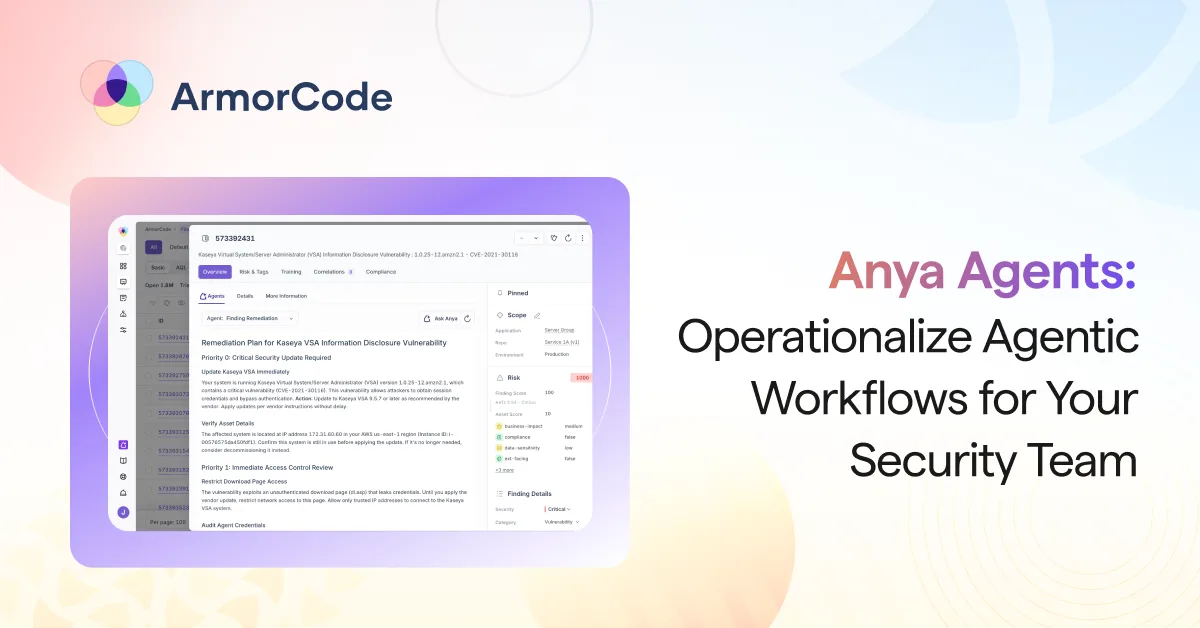
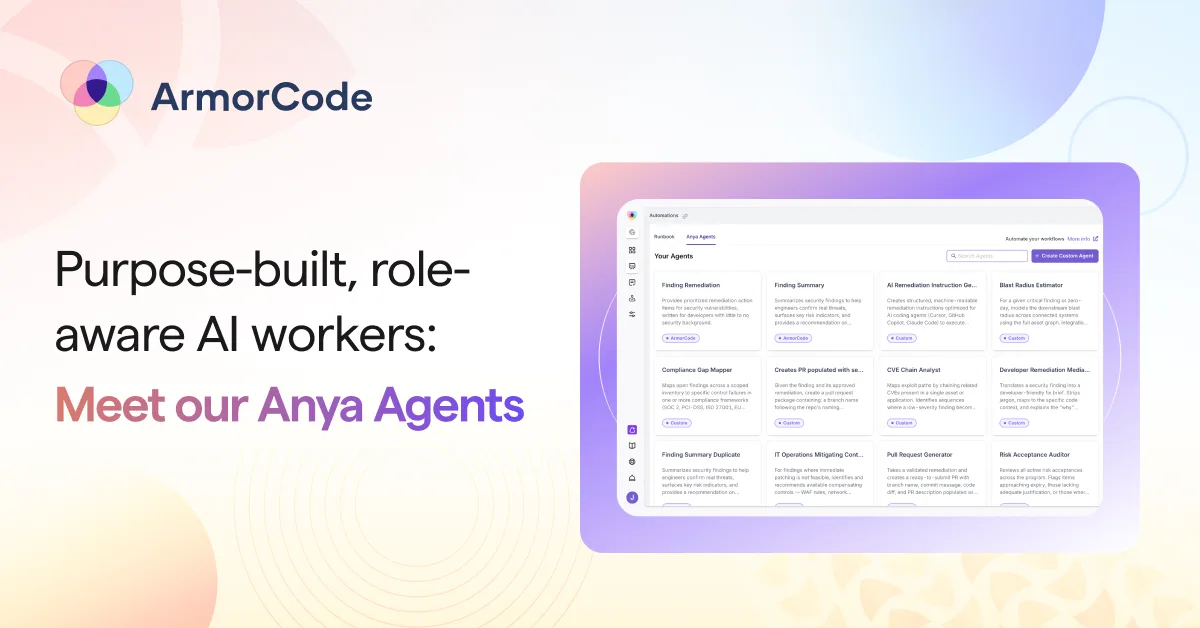
This is where agentic AI for security differs from a general-purpose model you wire up yourself. There’s a lot of value you can get out of our agentic AI platform. Prioritizing mountains of vulnerabilities is easier with ArmorCode, and we’re elbow-deep in it with multiple customers every day. Because of this experience, we intimately know the platform enough to solve problems most teams can’t. Our continuously improving context engineering will get you the information you didn’t know you needed to fix your vulnerabilities. Our Anya Agents have native, privileged access to platform internals that provide prompt context that is unachievable via the API alone.
When AI security tools break, whose problem is it?
When you build your own solution, you have to run it on your own infrastructure. What if something breaks, or something needs to be fixed? With Anya, ArmorCode absorbs the reliability and retry logic. We handle the flaky LLM calls, the rate limits, and the partial failures so your team never has to. If something breaks, we’ll fix it. If a custom solution breaks, it becomes your next project.
The maintenance treadmill you’re signing up for
As ArmorCode adds new integrations and data sources to existing 375+ integrations, agents automatically get broader context and capability with no work on your side. A homegrown solution has to chase every new integration manually. Inevitably, maintaining your own harnesses and infrastructure that duplicates our functionality will fall behind over time. It will need its own Software Development Lifecycle (SDLC). It will become another code repo to maintain. It would be a good candidate to monitor with ArmorCode!
The pace of AI moves quickly, and ArmorCode stays up to date on the latest and best practices for LLMs so a customer doesn’t have to. Our infrastructure lets us build and deploy quickly, taking advantage of developments like Model Context Protocol, skills, and memory management without you needing to lift a finger.
Build it, and you own the risk
ArmorCode handles authentication, secrets management, and permissioning within our platform security boundary. You don’t have to solve enterprise SSO, RBAC, and audit logging yourself.
And when an audit comes, are you ready? Compliance and audit logging for Anya actions (who triggered what, on which finding, when) is built in. Your sensitive security findings never leave our boundary. Rolling your own introduces data egress risk you would have to account for yourself.
Finally, we have enterprise-grade security with SOC 2 Type 2 compliance, partitioned tenants, and data transmitted with 256-bit SSL/TLS encryption and ECDHE_RSA Key Exchange Algorithms, so you don’t have to worry about certifying your own solution.
Final Thoughts
Simon Willison recently highlighted a tweet from Matthew Yglesias, “… I don’t want to vibecode — I want professionally managed software companies to use AI coding assistance to make more/better/cheaper software products that they sell to me for money.” Anyone who’s tried to roll their own SIEM in a weekend understands that you’re handcuffing yourself to maintain it into perpetuity.
That is the real lesson of building vs buying AI. Coding was never the hard part. Let ArmorCode handle what we’re best at, and let your team focus on protecting your organization.
See Anya Agents at work in your environment. Book a demo and watch the platform prioritize and guide remediation on real findings, with none of the infrastructure to run yourself.
Build vs buy AI: Frequently Asked Questions
How does agentic AI help with vulnerability management?
Agentic AI for security adds context to vulnerability management by drawing on platform-native data to prioritize and guide remediation. Inside ArmorCode’s Unified Vulnerability Management, Anya Agents use privileged access to platform internals and learnings across customers to surface the findings that matter most. Because the agents run inside the platform, that context is available without building and maintaining your own integrations.
Should you build or buy AI security tools?
You can build them, but most teams find that buying wins once production costs are included. A homegrown build means owning the token budget, the reliability engineering, every new integration, and the audit and data-egress risk of running AI against sensitive findings. A managed platform like ArmorCode absorbs that operational burden so security teams can focus on remediation instead of infrastructure.
Is it worth building your own LLM integration for security workflows?
Building a prototype is fast, but productionizing it is a separate, ongoing project with its own software development lifecycle. Prompt engineering for security workflows is a specialized discipline that needs continuous tuning against real data, alongside retry logic, rate-limit handling, and monitoring. For most teams, that maintenance treadmill outweighs the flexibility of a custom build.
What does it really cost to build your own AI security agent?
The token bill is only the visible cost. The higher costs are the infrastructure to run it reliably, the engineering time to chase new integrations and keep up with fast-moving LLM practices, and the security work to add SSO, RBAC, audit logging, and tenant isolation. Those recurring costs are what the build vs buy AI decision usually turns on.
Key Takeaways
- The token bill is the cheap part. The real cost of build vs buy AI is the infrastructure, reliability engineering, and ongoing maintenance you take on to run your own AI security tools in production.
- A homegrown build is a permanent project. Every new integration, LLM advancement, and security control becomes yours to chase, and a custom harness falls behind the moment you stop maintaining it.
- You inherit the risk you didn’t price in. Authentication, audit logging, tenant isolation, and data egress all land on you when you build, whereas a managed platform keeps sensitive findings inside its security boundary.