Vulnerability Management vs. CTEM: Why it’s Time to Upgrade in 2026


The debate over vulnerability management vs. CTEM is no longer about which approach is newer. It is about which one actually keeps pace with how attackers operate today. Most security teams already know their vulnerability management program is producing more noise than progress: scanners flag thousands of CVEs each week, tickets pile up, and the same critical findings resurface month after month because nothing in the workflow forces a decision about what really matters.
Continuous Threat Exposure Management changes that workflow. Instead of treating every CVE as a task to be patched, it asks a sharper question: which exposures, across our entire attack surface, can an attacker actually reach and use against the business? That single shift in framing is why so many organizations are rebuilding their programs around CTEM heading into 2026.
The Evolution of Cybersecurity: From VM to CTEM
For years, Vulnerability Management (VM) has been the cornerstone of enterprise cybersecurity programs. However, as IT environments have grown increasingly complex, spanning hybrid clouds, ephemeral containers, and third-party APIs, the vulnerability management limitations of traditional VM have become glaringly apparent. CTEM represents a modern, risk-centric approach that is rapidly replacing legacy VM.
The Core Differences at a Glance
At a high level, the difference between CTEM and vulnerability management comes down to scope and intent. Traditional VM focuses on identifying and patching known software flaws, working through queues of CVEs ranked by CVSS scores. It is built around scanning, ticketing, and patch management cycles that operate on weekly or monthly cadences.
CTEM takes a holistic view of the entire attack surface. Instead of treating every CVE as an isolated finding, it correlates vulnerabilities with misconfigurations, identity exposures, cloud posture gaps, and software supply chain weaknesses. Prioritization is driven by actual exploitability, reachability, and business risk rather than technical severity alone. The result is a program that remediates fewer items but addresses far more meaningful exposure.
Why the Shift is Necessary Now
Modern adversaries no longer rely solely on published CVEs. Zero-day exploits, identity-based attacks, and sophisticated supply chain compromises now account for a growing share of breaches. Attackers chain misconfigurations, weak permissions, and exposed secrets in ways that no CVE feed will surface.
A security posture deemed acceptable by a Tuesday scan can be compromised by Wednesday afternoon. This is the central reason why CTEM has gained traction so quickly. Continuous exposure assessment, rather than point-in-time scanning, is now the only viable model for environments that change by the hour.
The Structural Limitations of Legacy Vulnerability Management
Traditional vulnerability management programs suffer from fundamental structural limitations that make them increasingly inadequate for modern security operations. These legacy systems rely heavily on point-in-time scanning tools that generate massive volumes of alerts based on CVSS scores, lacking the business context needed for effective prioritization.
The Burden of Alert Fatigue and the Reconciliation Tax
Security teams running legacy VM programs are buried under high-volume, low-context findings. Alert fatigue is no longer a productivity issue; it is a security risk in its own right, because exhausted analysts miss the signals that matter. When every scanner reports thousands of “critical” issues without environmental context, prioritization becomes guesswork. It is the reason that alert fatigue inevitably leads to alert indifference.
Compounding this is what practitioners call the reconciliation tax. This is the manual effort required to aggregate findings across scanners, de-duplicate overlapping detections, normalize severity, and stitch the result into a coherent picture. Many teams spend more hours on this data wrangling than on actual remediation. The engineers hired to harden systems end up running spreadsheets instead.
The Problem with Dead Ends and False Urgency
Industry research consistently shows that up to 75[1] percent of identified exposures are dead ends. They sit on assets that are not reachable, not exploitable, or not connected to anything that matters. Yet legacy VM treats them with the same urgency as exposures on internet-facing crown-jewel systems.
The downstream effect is corrosive. Teams chase the loudest alerts rather than the most dangerous ones, and a large share of remediation effort ends up directed at findings that would never have been weaponized. Meanwhile, the handful of exposures sitting on a true attack path remain open long enough for an adversary to find them first. This is the strongest argument for why CTEM is no longer optional.
How CTEM Solves the Vulnerability Management Crisis
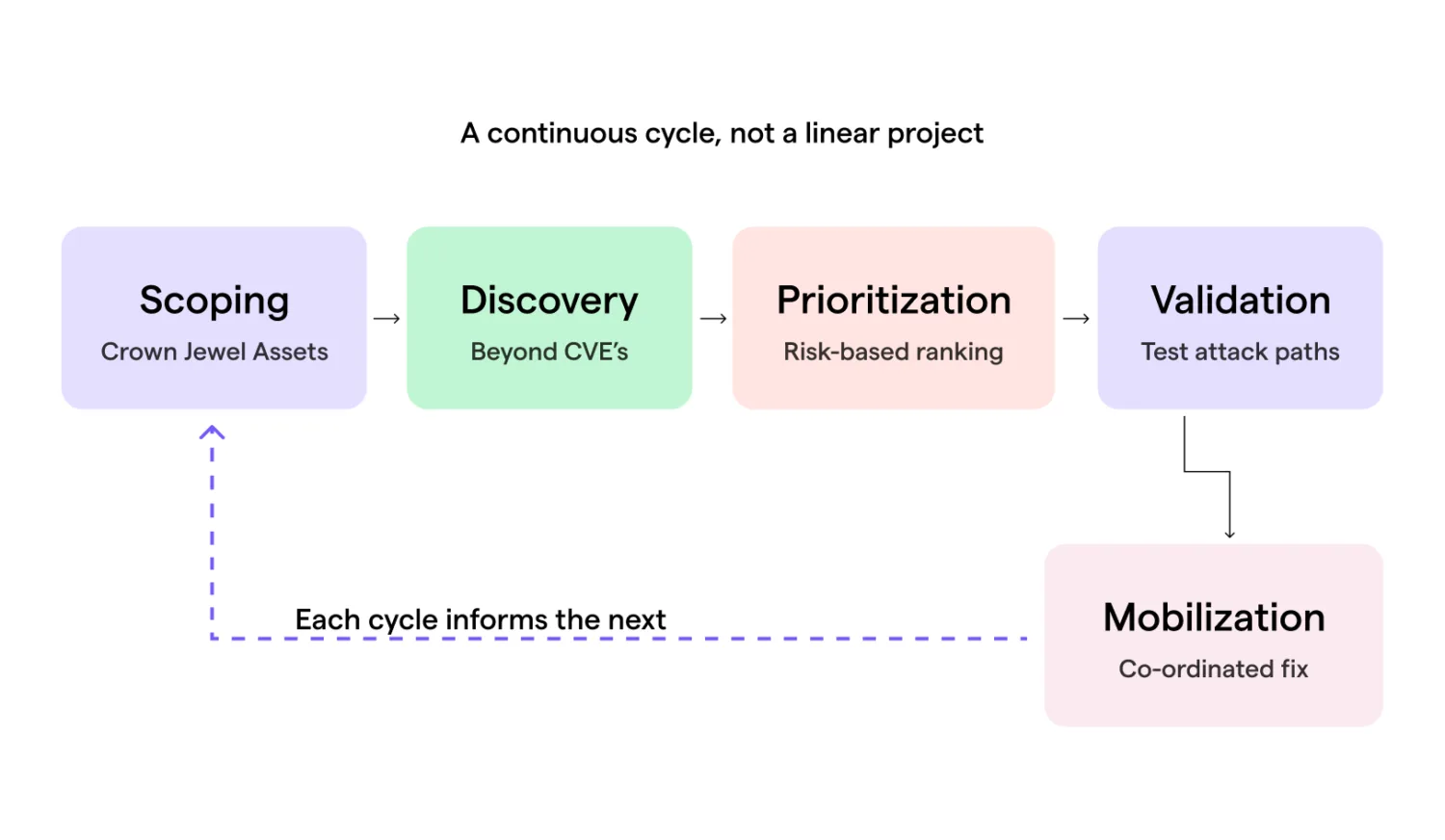
CTEM addresses the fundamental flaws of traditional VM by shifting the focus from volume to context. It provides a structured, five-stage framework, Scoping, Discovery, Prioritization, Validation, and Mobilization, that ensures security efforts are aligned with actual business risks. The CTEM benefits are measurable: less work, lower risk, and a defensible story for leadership.
Contextual Prioritization Over CVSS Scores
The first major break from legacy VM is what gets treated as “critical.” Traditional vulnerability management inherits its priority queue from CVSS, which means a CVSS 9.8 finding on an isolated lab server outranks almost everything else by default, regardless of whether an attacker could ever reach it. The queue reflects technical severity, not organizational risk.
CTEM rejects that hierarchy. Business context, not score, decides what moves to the top. The practical effect inside a security operations team is significant: remediation cycles get shorter because engineers stop being handed long lists of high-CVSS findings that have no path to impact. The conversation with application owners shifts from “patch this because the scanner said so” to “patch this because here is how an attacker would use it.” That is a meaningful cultural change, and it is one of the clearest CTEM benefits over the legacy model.
Continuous Validation and Mobilization
The other structural change CTEM introduces is the assumption that a finding is not actionable until it is proven. Traditional VM operates on inherited trust: if a scanner flags it as critical, it goes into the patch queue. CTEM inverts that. A finding only earns urgency once it has been tested against the live environment and confirmed as reachable and exploitable. The downstream benefit is direct: fewer tickets, higher confidence per ticket, and far less wasted developer time chasing theoretical risk.
Remediation also looks different on the other side of that filter. Legacy VM tends to hand a flat list of CVEs to IT and treat the ticket as the deliverable. CTEM treats the closed exposure as the deliverable, which forces shared ownership across security, engineering, cloud, and application teams. The siloed handoffs that stall traditional patch management cycles get replaced with workflows where the right finding reaches the right owner with the context needed to act.
Transitioning to CTEM with ArmorCode
Making the shift from traditional vulnerability management to Continuous Threat Exposure Management requires more than a new tool. It requires an independent, scanner-agnostic control plane that can orchestrate data, decisions, and action across the security stack from infrastructure, apps, and cloud, to AI and agents. ArmorCode provides the foundational architecture needed to operationalize CTEM, enabling organizations to remediate less while reducing risk faster.
What a Migration from Legacy VM to CTEM Actually Looks Like
The question security leaders ask once they have decided to move toward CTEM is rarely conceptual. It is practical: what happens to the vulnerability management stack we already own, and how do we phase the transition without breaking what is working?
The shift from VM to CTEM does not have to be a rip-and-replace exercise. The scanners that generate findings today, whether SAST, SCA, container scanning, cloud posture, or infrastructure scanning, continue to produce signals. What changes is what sits above them. The aggregation layer, the prioritization logic, the validation loop, and the remediation workflow get replaced with a unified, Agentic Control Plane that turns disconnected scanner outputs into coordinated exposure management.
In practice, that migration tends to unfold in three phases. The first is consolidation: every existing source of finding data gets ingested, normalized, and de-duplicated in one place, which alone eliminates a significant portion of the reconciliation tax. The second is contextual scoring: business criticality, exploitability signals, and reachability replace CVSS as the primary ranking inputs, and the remediation queue shrinks dramatically. The third is workflow rebuild: tickets get routed by validated risk and asset ownership rather than by scanner output, and the mobilization stage finally works as intended, shortening the time to remediate.
ArmorCode supports each phase of that transition by sitting on top of the existing security stack rather than competing with it. Teams keep the scanners they trust, retire the spreadsheets and manual triage processes that were never meant to scale, and operate from a single view of exposure that aligns security, engineering, and the business. Get a deeper walkthrough of how the CTEM lifecycle works in practice.
See how ArmorCode helps security teams retire manual triage, consolidate findings from the security stack they already own, and operationalize CTEM at enterprise scale. Take a tour of the ArmorCode Agentic AI Platform to see unified exposure management in action, or request a demo to discuss your environment with our team.
Frequently Asked Questions (FAQ)
Q: What is the main difference between Vulnerability Management and CTEM?
A: The main difference lies in scope and prioritization. Vulnerability management focuses primarily on identifying and patching known software flaws based on technical severity scores like CVSS. CTEM takes a broader, risk-based approach, continuously evaluating the entire attack surface, including misconfigurations and identity risks, and prioritizing remediation based on actual exploitability, reachability, and business impact.
Q: Why is relying solely on CVSS scores problematic?
A: Relying solely on CVSS scores is problematic because CVSS measures the intrinsic technical severity of a vulnerability but lacks environmental context. A vulnerability with a high CVSS score might sit on an isolated, non-critical test server, while a lower-scoring vulnerability might exist on an internet-facing server hosting sensitive customer data. CTEM incorporates this critical business context, so the remediation effort follows real exposure.
Q: How does ArmorCode help organizations transition from VM to CTEM?
A: ArmorCode serves as a unified control plane that aggregates data from existing security tools, automates contextual prioritization, and operationalizes each stage of the CTEM lifecycle. It eliminates the reconciliation tax associated with legacy VM, accelerates remediation through validated risk signals, and produces the outcome-based metrics that modern security leadership requires.
Key Takeaways
- The vulnerability management limitations of legacy programs, including reliance on CVSS scores, alert fatigue, and the reconciliation tax, leave teams chasing dead-end findings while real risk goes unaddressed.
- CTEM benefits come from a structured five-stage lifecycle that prioritizes exposures by exploitability, reachability, and business risk, which is why CTEM is replacing VM as the standard for modern security programs.
- ArmorCode operationalizes the shift from VM to CTEM by sitting on top of the existing security stack, aggregating findings from the scanners teams already trust, and replacing manual triage with contextual risk scoring and coordinated remediation workflows.
Sources