Frontier AI Models for Cybersecurity: What Mythos/Fable 5, Daybreak, and MDASH Mean for Security Teams

Earlier this year, we wrote about Anthropic’s Claude Mythos and what it signaled for the future of cybersecurity. Since then, OpenAI has launched Daybreak, Microsoft has introduced MDASH, and Anthropic has released updated versions of Mythos and Fable 5. In just a few weeks, three of the world’s leading technology companies have unveiled major AI-driven cybersecurity initiatives. Together, these developments signal the emergence of a new generation of frontier AI models designed to discover, validate, and analyze vulnerabilities at unprecedented speed and scale.
Each company is approaching the problem from a different angle. Anthropic is using frontier AI to uncover previously unknown vulnerabilities in the foundational software that underpins the internet. OpenAI is bringing AI-powered vulnerability discovery, validation, and patch generation directly into the software development lifecycle. Microsoft is applying a coordinated system of specialized AI agents to automate vulnerability research, validation, and exploit generation.
At ArmorCode, we’ve been speaking with CISOs, security leaders, customers, and partners about what these announcements mean for security programs. Interestingly, very few of those conversations are about the models themselves.
The discussion quickly shifts to operational reality.
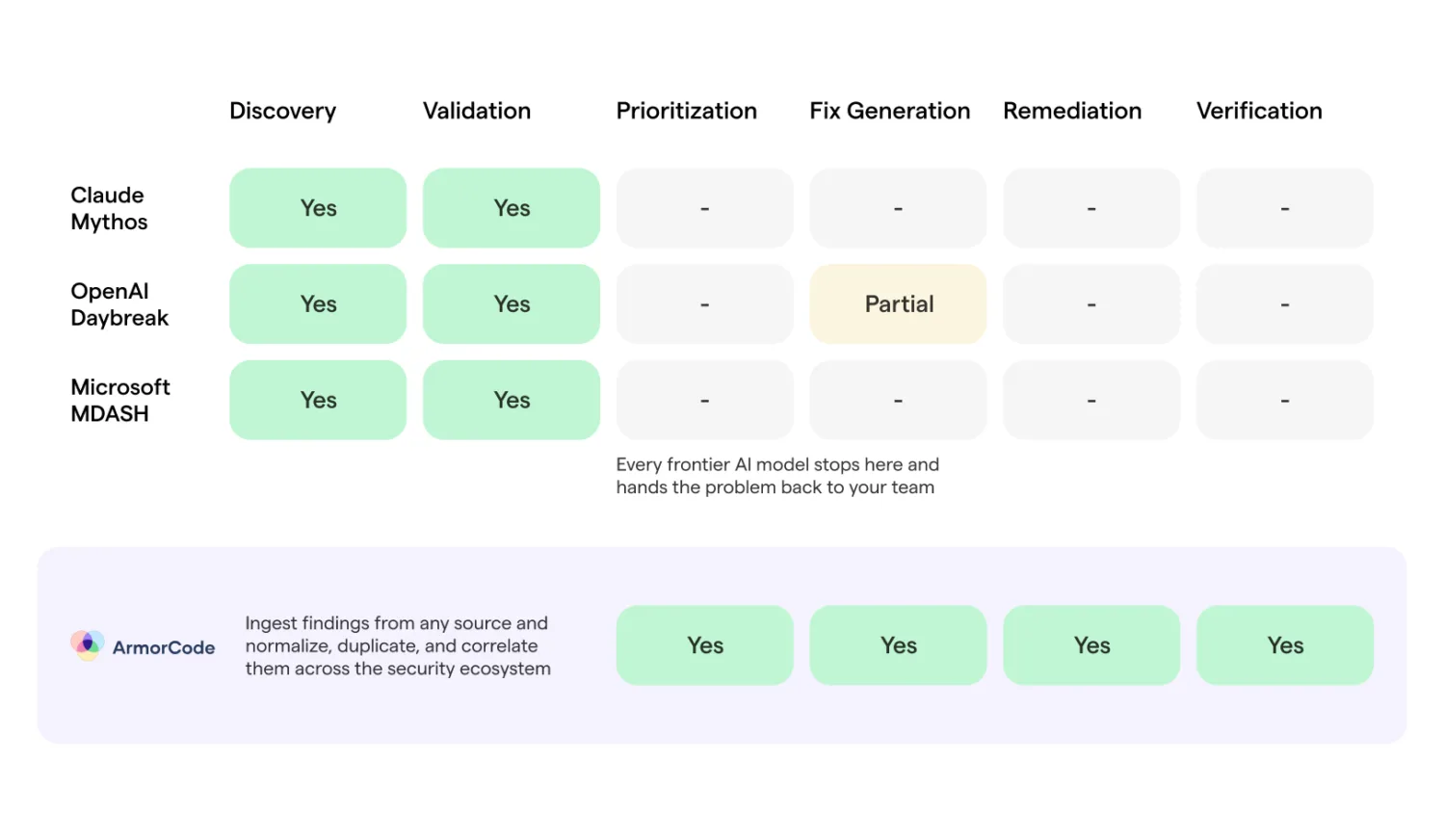
What happens when security teams can discover vulnerabilities faster than they can triage, prioritize, and remediate them? How do organizations determine which findings represent real business risk? And how do they turn AI-generated discoveries into measurable risk reduction?
Before we get into those questions, it’s worth understanding what these systems are, the problems they are designed to solve, and where their capabilities stop.
Let’s start with the systems themselves.
What Are Frontier AI Models?
Frontier AI models represent the most advanced class of AI systems available today, trained with reasoning, coding, and problem-solving capabilities. In cybersecurity, frontier AI models are being used to discover vulnerabilities, validate exploitability, generate patches, and automate security research tasks that previously required highly specialized human expertise.
What Are Anthropic’s Claude Mythos and Fable 5?
Anthropic’s Claude Mythos is an advanced frontier AI model whose cybersecurity capabilities emerged from its broader reasoning and coding abilities. During internal testing, Anthropic discovered that Mythos could analyze complex software systems, uncover previously unknown vulnerabilities, and develop working exploits at a level that surprised even its own researchers.
Rather than releasing the model broadly, Anthropic launched Project Glasswing, a global initiative that gives selected organizations access to Mythos to help secure the software and infrastructure the world depends on.
Since its April 2026 launch, the program has expanded to more than 150 organizations across 15+ countries, adding partners in power, water, healthcare, communications, and government sectors, including NATO and the EU’s ENISA cybersecurity agency. Together, Glasswing partners have already uncovered more than 10,000 high or critical security flaws.
In June 2026, Anthropic released Claude Mythos 5 for Glasswing partners and Claude Fable 5, the first publicly available Mythos-class model, intended to bring frontier-level vulnerability discovery to organizations outside the coalition. Three days after launch, the US government issued an export control directive requiring Anthropic to disable both models for all customers worldwide, citing a claimed jailbreak of Fable 5’s cybersecurity capabilities.
For a deeper dive into Mythos, Project Glasswing, and what it means for security programs, read our guide: The Claude Mythos Security Playbook: Operationalizing AI-Scale Vulnerability Discovery.
What Is OpenAI Daybreak?
OpenAI Daybreak represents OpenAI’s approach to applying frontier AI models to vulnerability discovery, validation, and remediation within enterprise software development workflows. Built on an agentic security framework called Codex Security, Daybreak is designed to help organizations continuously identify, verify, and address vulnerabilities in their own codebases.
The system operates in three stages.
- First, it ingests a software repository and builds a codebase-specific threat model that maps realistic attack paths.
- Next, it validates potential vulnerabilities inside isolated environments to determine whether they are genuinely exploitable.
- Finally, it proposes patches for human review and generates audit-ready evidence to support remediation tracking and compliance workflows.
Daybreak is structured around three model tiers. GPT-5.5 handles general-purpose use with standard safeguards. GPT-5.5 with Trusted Access is available for verified defenders doing authorized security work like vulnerability triage, malware analysis, secure code review. GPT-5.5-Cyber is a limited preview model for red teaming and penetration testing, available only to verified security professionals and controlled validation environments.
What distinguishes Daybreak is its approach to analysis. Rather than relying primarily on signatures or predefined vulnerability patterns, Codex Security reasons across an entire codebase much like a human security researcher. It forms hypotheses, tests them, validates findings, and surfaces only those issues that demonstrate meaningful evidence of exploitability. OpenAI claims this approach can reduce hours of manual security analysis to minutes.
By March 2026, OpenAI reported that the platform had analyzed more than 1.2 million commits and identified 792 critical and 10,561 high-severity issues across major open-source projects, including OpenSSH, GnuTLS, PHP, and Chromium. According to OpenAI, the system also contributed to the remediation of more than 3,000 critical and high-severity vulnerabilities across the open-source ecosystem.
What Is Microsoft MDASH?
Microsoft MDASH (short for Microsoft Security Multi-Model Agentic Scanning Harness) is Microsoft’s AI-driven security research system designed to autonomously discover, validate, and prove exploitable software vulnerabilities.
MDASH orchestrates more than 100 specialized AI agents operating across a combination of frontier and distilled models. The system ingests a codebase, builds a threat model, and deploys specialized auditor agents to identify potential vulnerabilities. Findings are then passed to debater agents that challenge and validate the results, helping eliminate weak hypotheses and reduce false positives. Finally, prover agents attempt to dynamically confirm exploitability by generating working proof-of-concept exploits. Each stage of the workflow is handled by agents optimized for a specific task.
In essence, Microsoft has built a coordinated multi-agent system where different agents specialize in different forms of reasoning, analysis, and validation. Rather than relying on a single model to perform every task, MDASH operates more like an advanced offensive security team working through a structured vulnerability research process.
Microsoft says MDASH has already helped identify 16 previously unknown vulnerabilities across the Windows networking and authentication stack, including four critical remote code execution flaws. At Microsoft Build 2026, the system reported an updated CyberGym benchmark score of 96.55%, up from 88.45% at initial announcement, outperforming Claude Mythos at 83.1% and GPT-5.5 at 81.8%.
How Leading Frontier AI Models for Cybersecurity Compare
| Claude Mythos / Fable 5 | OpenAI Daybreak | Microsoft MDASH | |
| What it is | Mythos is a Frontier AI model with vulnerability discovery capabilities, deployed through the Project Glasswing coalition. Fable 5 is the first publicly available Mythos-class model, intended for general use. | OpenAI’s security platform that scans your company’s own codebase for vulnerabilities and suggests fixes. | Microsoft’s vulnerability hunting system that runs 100+ specialized AI agents in a structured pipeline |
| Best suited for | Foundational software such as operating systems, browsers, and critical open-source libraries | Your own company’s codebase – most useful for teams actively building and shipping software | Large enterprise codebases where every finding needs to be proven exploitable |
| What it does well | Exceptional at discovering previously unknown vulnerabilities Strong offensive security reasoning Effective at multi-step exploit chaining | Built directly into the software development lifecycle Combines discovery, validation, and patch generation Most accessible and enterprise-ready deployment model | Highest reported CyberGym benchmark score (96.55%) Multi-agent pipeline reduces false positives more systematically than single-model approaches |
| The operational challenge | High CVE volume with no business context. Security teams must manually determine what is urgent, what can wait, and who owns the fix. | Machine-speed findings from your own codebase overwhelming your team’s ability to triage, prioritize, and route them to the right developers. | Proven exploits demand immediate action. But without prioritization by asset criticality, reachability, and business impact, everything feels equally urgent. |
| Where ArmorCode fits | Prioritizes Mythos-discovered vulnerabilities using business context, asset criticality, reachability, and exploitability. Orchestrates remediation through ITSM workflows while tracking ownership, SLAs, exceptions, and risk reduction. | Operationalizes Daybreak findings through root-cause grouping, routes issues to the right developers with business context, and tracks remediation from discovery through closure. | Adds business-risk prioritization and remediation orchestration to validated findings. Provides governance for AI-driven security agents through AIEM. |
| Availability | 150+ Glasswing Coalition partners. Note: Mythos 5 suspended under US export controls as of June 12, 2026. The original Mythos Preview continues to operate within Glasswing. | Publicly available | Expanded preview, available now. |
How ArmorCode Turns AI Discoveries Into Measurable Risk Reduction
ArmorCode’s platform sits at the intersection of discovery and action. Processing more than 200 billion findings annually across 350+ native integrations, ArmorCode helps organizations unify, prioritize, investigate, and remediate risk across applications, cloud environments, code, infrastructure and AI systems.
Take a product tour to learn how ArmorCode helps security teams operationalize AI-generated findings, prioritize what matters, and drive remediation through to completion.
- Capture the Context Behind Every Finding
ArmorCode automatically captures and preserves metadata from AI-generated findings as tags, including information such as the source model, confidence level, scan type, review status, upload date, and source tool.
These tags remain attached to findings throughout their lifecycle and can also be inherited from groups, subgroups, and source systems. By keeping this context attached to every finding, teams can more easily prioritize, investigate, and manage AI-generated findings.
- Prioritize Findings with Business Context
Static severity ratings rarely tell the full story. ArmorCode’s Adaptive Risk Scoring evaluates findings using a combination of technical and business context, including asset criticality, exploitability, reachability, internet exposure, threat intelligence, data sensitivity, and compensating controls.
- Get Contextual Answers with Anya AI
Anya, ArmorCode’s AI security assistant, helps security teams understand their security posture, investigate findings, answer risk-related questions, and surface insights from across their security data. By leveraging findings, assets, ownership information, business context, and threat intelligence, Anya delivers role-specific insights tailored to CISOs, security teams, and developers.
- Automate Workflows with Anya Agents
ArmorCode’s Anya Agents are purpose-built agentic workflows that help teams automate security operations using the full context of their environment, including findings, assets, software supply chain data, ownership information, and threat intelligence.
Teams can use Anya Agents to generate finding summaries, deliver code-aware remediation guidance, assess exposure to newly disclosed vulnerabilities, and conduct risk investigations. Anya Agents are extensible through ArmorCode’s APIs and MCP Server, enabling organizations to build custom agents tailored to their own security workflows.
- Orchestrate Remediation
ArmorCode’s workflow automation capabilities route findings to the appropriate owners, integrate with ITSM tools such as Jira and ServiceNow, track remediation progress, enforce SLAs, assign ownership, trigger notifications, and automate escalation workflows. As AI-driven discovery increases the volume of findings, automation becomes critical for ensuring that vulnerabilities are resolved efficiently.
- Track SLAs and Remediation Progress
Remediation SLAs can be defined based on risk, asset criticality, or finding type, with every open finding continuously tracked against those targets. Security teams can identify issues approaching or breaching SLAs, automate escalations, and gain real-time visibility into remediation performance across teams and business units. It also provides security leaders with defensible metrics to demonstrate risk reduction to boards and auditors.
- Measure and Communicate Risk Reduction
ArmorCode provides customizable dashboards and reports that give teams visibility into findings originating from AI models. Teams can track finding trends, remediation progress, ownership, and risk posture through stakeholder-specific views tailored for practitioners, security leaders, and executives.
- Govern the AI Doing the Discovering
Every new AI agent, copilot, model, or AI-powered application introduces a new attack surface and a new governance challenge. Security leaders need visibility into which AI applications, agents, models, APIs, and MCP servers exist across their environment, who owns them, whether they are approved, and what risk they pose to the business.
ArmorCode’s AI Exposure Management (AIEM) capabilities help organizations discover, inventory, and govern AI assets across the enterprise. This includes identifying AI applications, embedded AI components, APIs, models, agents, and MCP servers. ArmorCode also provides ownership tracking, approval workflows, policy enforcement, and reporting to help organizations govern AI usage.
Preparing for What Comes Next
In the span of a few weeks, Anthropic, OpenAI, and Microsoft each introduced a new generation of frontier AI models and AI-driven security systems designed to transform vulnerability discovery and security research. The pace of innovation is accelerating, and it is clear that AI will play an increasingly important role in how vulnerabilities are discovered, analyzed, and validated.
At the same time, the operational gap between what these systems can discover and what security teams can realistically act on is widening. As Mythos-class capabilities become more broadly available over the next 12 to 18 months, that gap will only continue to grow.
If you’re wondering whether your security program is ready, we built something specifically for this moment.
The Claude Mythos Readiness Blueprint is a practical 90-day guide for security leaders looking to prepare their vulnerability management programs for AI-scale vulnerability discovery.
It includes the six capabilities every enterprise program will need, a three-phase 90-day action plan, a 10-point practitioner checklist informed by security leaders, and a four-stage maturity assessment to help you understand where your program stands today.
Download the Blueprint to assess your readiness and build the operational foundation needed to act on the findings generated by Mythos, Fable 5, Daybreak, MDASH, and whatever comes next.