How to Build an Automated Vulnerability Remediation Workflow


The Cost of Manual Remediation
Manual remediation is the unglamorous half of security, the part that decides whether a finding actually gets fixed or just gets logged. Scanners have never been better at telling us what is wrong. The trouble starts after the alert fires. Someone has to read it, judge whether it matters, track down the team that owns the broken code, and open a ticket. Repeat that a few thousand times a week, and you have the place where most programs quietly fall behind. Vulnerability remediation automation exists precisely because that cycle does not scale, and the cost of leaving it manual shows up in two places: the risk that lingers in your backlog and the people who burn out managing it.
The Burden of Manual Triage
Most teams are still running their vulnerability remediation workflow by hand in spreadsheets. In the Ponemon Institute’s research[1] on vulnerability response, 52% of organizations said that relying on manual processes leaves them at a disadvantage when responding to vulnerabilities. You can feel that number in the daily grind of manual triage. A security engineer opens a finding, decides whether it is real, hunts down the owner, files the ticket, and then starts over on the next one. Security people have a name for the part of this that involves shuttling issues between systems and chasing status updates: Jira jockeying. It looks like security work. Most of it is clerical work, and it does not scale when your organization does.
The Impact on Risk and Burnout
That overhead bleeds into two places that matter. The first is your people. Ask anyone to spend forty hours a week on copy-paste triage and watch how fast the sharp ones start eyeing the exit; alert fatigue dulls judgment long before it drives anyone out the door. The second and most important is risk. A critical, exploitable bug sitting untouched in a queue is not waiting politely for your sprint to wrap up. Attackers keep their own schedule, and every day a fix is stuck in coordination is a day the door stays open. Vulnerability remediation tools that automate triage and routing exist precisely to break that cycle, cutting the time between discovery and fix without adding headcount to absorb the load.
Deconstructing the Remediation Workflow
You cannot automate a workflow you have not mapped. Before vulnerability remediation automation can do any real work, you need to lay the full remediation workflow out end-to-end and be honest about where the hours actually go.
The Traditional Workflow
Most vulnerability remediation workflows move a finding through five stages. Ingestion pulls it out of whatever scanner caught it. Normalization rewrites it into a common format, so a code flaw and a cloud misconfiguration can sit side by side. Prioritization sorts what gets worked on first. Ticketing hands it to whoever owns the fix. Validation confirms if it is actually closed and not just marked closed. In a manual vulnerability remediation workflow, a person touches nearly every one of those steps, and the seams between them are where findings stall, duplicate, or vanish.
Identifying Automation Opportunities
Not every stage pays back the same when you automate it. Prioritization and ticketing are the two worth attacking first. They are high-volume, rule-driven, and repetitive, which is a polite way of saying they burn security analyst hours without rewarding the analyst’s brain. Hand those two to automation, and you strip out most of the triage burden without touching the judgment calls that should stay with people. That is also where vulnerability remediation tools earn their keep: not by replacing the workflow entirely, but by absorbing the steps that do not need a human and leaving the ones that do. That is the sweet spot for vulnerability remediation automation.
The Power of Unified Ingestion
Here is the catch with vulnerability remediation automation: it is only as good as the picture it works from. Point it at data scattered across a dozen tools, and it will just make bad calls at high speed. Garbage in, automated garbage out, only faster and at a greater scale than any manual process could manage.
The Problem with Siloed Tools
Siloed tools are where vulnerability remediation workflow automation projects go to die. The same vulnerability shows up three times under three different IDs, the severity scores disagree, and there is no single record anyone trusts. So a human gets pulled back in to sort out the mess, which is manual triage, wearing a different hat. Until that reconciliation problem is solved, there is a hard ceiling on how much of the vulnerability remediation workflow you can actually automate.
Creating a Single Pane of Glass
Unified ingestion lifts that ceiling, and the right vulnerability remediation tools make it practical. For a vulnerability remediation automation program, what matters is what unification makes possible next. ArmorCode is scannerless, so it does not bolt another scanner or tool onto your stack. It ingests and correlates findings from the vulnerability remediation tools you already run, across 375+ integrations, into a single platform. Once every finding lives in that one normalized view with duplicates and ownership already resolved, your automated vulnerability remediation program finally has something solid to stand on. Everything later in this piece depends on that foundation being there.
Automating Prioritization with Context
Speed alone is not the win here. Vulnerability remediation automation that fires off a ticket for every finding just generates alert fatigue faster than any human could. The goal is smarter filtering, not faster noise.
Moving Beyond CVSS
The model that makes automated routing safe — CVSS read alongside EPSS, reachability, and asset criticality — is essential to any serious vulnerability remediation workflow. But the automation question is narrower and more practical: once you have that combined signal, what do you actually do with it? A score can rank a list. It cannot pick up the phone and assign the work. Closing that gap is the entire point of building a vulnerability remediation workflow that actually runs on its own.
Context-Aware Prioritization
This is where context-aware prioritization earns its place. The combined risk signal does more than sort the queue. It sets a bar for what deserves a developer’s attention, then pushes only the findings that clear it — the exploitable and reachable ones — to the engineer who owns that code. No dispatcher, no triage meeting. Everything under the bar stays out of sight. Vulnerability remediation tools that operate with this kind of context do not just accelerate the workflow; they change what the workflow produces. Instead of routing every finding and letting developers sort out the noise, they filter before anyone is interrupted, so whatever reaches a developer is already worth their time. That is the real reason context-aware prioritization beats brute-force ticketing: the signal improves, not just the speed.
Agentic AI: The Next Frontier of Automation
Rule-based prioritization and routing handle the repetitive part of vulnerability remediation automation well. What rules cannot do is reason about a finding and then act on it. That is the line agentic AI crosses.
Introducing Agentic AI
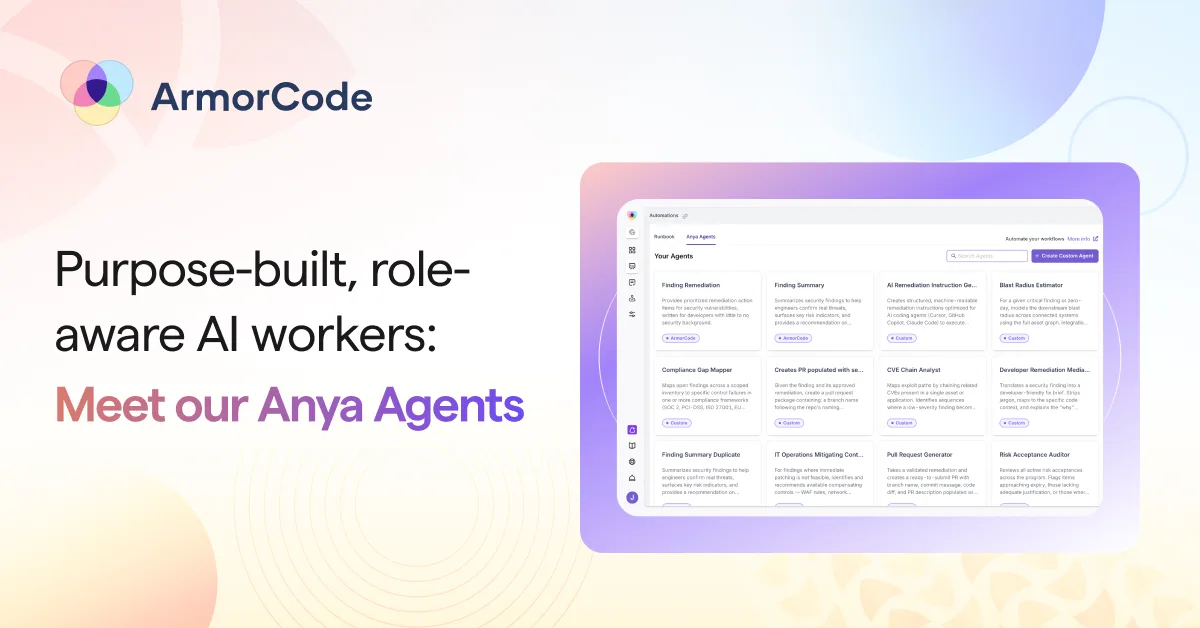
A script and an agent are not the same animal. A script runs the exact steps you wrote for it. An agent works from a defined goal, draws on the context around a finding, and produces something you can act on. ArmorCode’s Anya Agents bring that shift to the vulnerability remediation workflow. They are purpose-built, role-aware AI workers, each scoped to a single high-value workflow and grounded in ArmorCode’s unified risk context: findings, assets, software supply chain data, and threat intelligence. Because each agent reasons over the same data the platform sees, it does more than a public LLM can. A generic model can define a CVE. An Anya Agent can speak to your actual exposure.
What the Agents Do
For a remediation workflow, the one to know is the Remediation Agent, which generates code-aware remediation guidance for a finding, or a group of findings, drawing on the finding’s metadata and external sources, right on the finding details page. It sits alongside other bounded agents in the framework, including ones that assess the impact of a newly disclosed CVE, summarize a finding in plain language, and explain the reasoning behind a risk score. Where vulnerability remediation tools have traditionally stopped at surfacing the problem, the Anya Agents go a step further by producing an analysis that a developer can act on immediately, without waiting for a security engineer to translate the finding into something useful. The dividing line stays consistent: each agent handles the bounded, well-defined analysis, and the human keeps the decisions that need judgment, such as whether to pull a system offline or how to weigh business risk against engineering capacity. The agent gets the developer to the next step faster. It does not take the developer out of the loop.
Measuring Success: Metrics for Automated Vulnerability Remediation
None of this counts for much if you cannot show the numbers to the people who fund the program. A consistent vulnerability remediation automation program produces consistent metrics almost on its own, and that consistency is what makes the case to leadership when budget conversations come around. ### Key Performance Indicators (KPI) Mean time to remediate is the headline. In a manual program, a critical, exploitable finding can sit in a queue for weeks before anyone touches it, and that lag is the number to attack first. Real MTTR reduction, moving the exposures that matter from months down to days, is the clearest sign the automation is working. Keep an eye on security technical debt, too. The backlog of unresolved findings should be shrinking over time, not piling up. Both numbers are easier to track when vulnerability remediation automation is handling ingestion, prioritization, and routing consistently, because the data stops depending on whether someone remembered to update a spreadsheet.
Key Performance Indicators (KPI)
Mean time to remediate is the headline. In a manual program, a critical, exploitable finding can sit in a queue for weeks before anyone touches it, and that lag is the number to attack first. Real MTTR reduction, moving the exposures that matter from months down to days, is the clearest sign your vulnerability remediation workflow is doing what it should. Keep an eye on security technical debt, too. The backlog of unresolved findings should be shrinking over time, not piling up. Both numbers are easier to track when the vulnerability remediation workflow is handling ingestion, prioritization, and routing consistently, because the data stops depending on whether someone remembered to update a spreadsheet.
Developer Adoption
The most telling metric does not belong to the security team at all. Developer adoption shows you whether people are actually using the automated workflow or quietly routing around it. When the friction drops, when there are fewer escalations, fewer fights over tickets, and faster sign-off on fixes, you know the program has earned some trust. Vulnerability remediation tools that surface findings already validated, routed to the right person, and paired with actionable guidance stop feeling like an interruption and start feeling like part of the job. That shift in developer sentiment is the signal that your vulnerability remediation automation has moved from a security team initiative to something the whole engineering organization actually relies on.
Conclusion: Reclaiming Developer Velocity
Vulnerability remediation automation does not exist to make security teams look busier. It exists to give developers their time back and give security engineers work that actually requires their judgment. When ingestion is unified, prioritization is context-aware, routing is automatic, and agentic AI is handling the translation between a finding and a fix, the workflow stops being a bottleneck and starts being infrastructure. Developers get fewer interruptions, and the ones they do get are already worth acting on.
That is what reclaimed velocity looks like in practice. Not a faster conveyor belt moving the same noise at a higher speed, but a filtered signal that only surfaces what matters, already assigned to the right person, often with remediation guidance attached. The security team stops jockeying tickets and starts doing the work that requires a human: threat modeling, architectural review, and the judgment calls that no ruleset can make.
The path there is not a single tool purchase. It is a workflow built in layers — unified data first, then smart prioritization, then automated routing, then AI-assisted guidance — each layer depending on the one beneath it. ArmorCode is built to support that stack, from ingestion across 375+ integrations to the Anya Agents that turn findings into actionable guidance. But the architecture matters more than any vendor. Build the foundation right, measure what changes, and vulnerability remediation automation becomes something the whole engineering organization relies on rather than something the security team runs in the background and hopes people notice.
The Dual Benefit of Automation
Automated vulnerability remediation is not only about closing findings faster, though it does that. The bigger payoff is that two things improve at the same time. A well-built vulnerability remediation workflow strengthens security posture because the exploitable, high-stakes issues actually get fixed instead of aging in a backlog. And developer velocity recovers, because engineers stop losing their days to triage churn and constant context-switching and get back to building. Done with real context behind it, remediation stops being a tax the whole company pays and slips into the background, where good infrastructure is supposed to live.
If your team is spending its days on Jira jockeying and manual triage, the vulnerability remediation workflow is the bottleneck, not the people working it. Start by mapping your current stages and flagging the repetitive, high-volume steps that automation can take off your team’s plate, so your engineers get that time back for the work that genuinely needs their expertise. For the foundations behind all of this, our Learning Center guide to vulnerability remediation is a good place to go deeper. And if you would like to see context-driven, agent-powered automation in practice, you are welcome to take a tour of the ArmorCode Platform or book a demo.
Frequently Asked Questions
What is automated vulnerability remediation?
Automated vulnerability remediation is the practice of using software to handle the repetitive, rule-driven steps in a remediation workflow — ingestion, normalization, prioritization, and ticket routing — without requiring a person to touch each finding manually. Vulnerability remediation tools that support automation reduce the time between discovery and fix by eliminating the coordination overhead that stalls manual programs.
How is automated remediation different from just running a scanner?
Scanners find problems. Automated remediation acts on them. A scanner produces a list of findings; an automated workflow takes that list, normalizes it, scores each finding against real-world context like exploitability and asset criticality, routes it to the right owner, and tracks it through to closure. The scanner is an input. The remediation workflow is everything that happens after.
Which vulnerability remediation tools should I automate first?
Prioritization and ticketing are the highest-return starting points. Both are high-volume, rule-driven, and repetitive — exactly the conditions where vulnerability remediation tools pay back quickly. Automate those two stages, and you remove most of the manual triage burden before touching any of the judgment calls that genuinely need a human.
Do I need to replace my existing scanners to get started?
No. A platform like ArmorCode is scannerless by design. It ingests findings from the vulnerability remediation tools you already run across hundreds of integrations, normalizes them into a single view, and deduplicates across sources. You keep your existing scanner investments and gain the unified foundation that makes automation reliable.
What role does AI play in vulnerability remediation automation?
Rule-based automation handles routing and prioritization well. Agentic AI goes further by reasoning over a finding’s context and producing guidance that a developer can act on immediately. ArmorCode’s Anya Agents, for example, generate code-aware remediation guidance directly on the finding details page, drawing on finding metadata and external threat intelligence. The agent accelerates the path to a fix; the developer and security engineer make the decisions that require judgment.
How do I know if my automated remediation program is working?
Mean time to remediate is the clearest signal. If critical, exploitable findings are moving from discovery to closure in days rather than weeks, the automation is doing its job. Developer adoption is the other number worth watching. When engineers stop routing around the workflow and start treating automated tickets as a normal part of their work, the program has earned real organizational trust.
What are the best automated vulnerability remediation tools?
The best vulnerability remediation tools have grown well past their scanner roots into full Unified Exposure Management platforms. What sets a tool like ArmorCode apart is that it unifies findings from every scanner you already run and layers Agentic AI on top: purpose-built agents that generate code-aware remediation guidance and impact analysis grounded in your own risk context, rather than generic advice from a model that has never seen your environment.
How does automated vulnerability remediation reduce alert fatigue?
Automated vulnerability remediation applies business context and reachability analysis before a person ever sees the alert. Non-exploitable findings get filtered out, and only the critical, reachable ones reach the right developer. Teams stop drowning in noise and spend their attention on the findings that actually carry risk.
Can automated remediation fix vulnerabilities without human intervention?
Not entirely, and that is by design. Agentic AI like ArmorCode’s Anya Agents takes on the heavy lifting around a fix, generating code-aware remediation guidance grounded in your environment so a developer reaches a confident next step quickly. The judgment calls and final approval of anything headed to production stay with the human. The goal is to remove the manual investigation, not the person.
Key Takeaways
- The bottleneck is fixing, not finding. Scanners surface plenty; what stalls programs is the manual triage and Jira jockeying that come after the alert. Ponemon found that 52% of organizations say manual processes leave them at a disadvantage in responding to vulnerabilities. Vulnerability remediation automation targets exactly that gap, turning high-volume, repetitive triage and routing into something that runs without a person in the middle.
- Automation is only as good as the context beneath it. On a single unified view of findings, context-aware routing sends just the exploitable, reachable issues to the right owner and keeps the rest out of the queue. That filtering, not faster ticketing, is what actually ends alert fatigue and makes vulnerability remediation automation worth the investment.
- Agentic AI assists the fix; it does not replace the fixer. ArmorCode’s Anya Agents generate code-aware remediation guidance grounded in your own risk context, so developers reach a confident next step faster while the judgment calls stay human. Measure the payoff in MTTR reduction and developer adoption, not ticket counts.
Sources: