The Definitive Guide to Vulnerability Remediation in the Agentic Era
Modern vulnerability remediation isn’t a faster version of the old playbook. It’s a different one, built for a world where AI is accelerating discovery and adversaries are compressing exploitation into hours.
Table of Contents
The Vulnerability Tsunami
Vulnerability remediation has become the defining bottleneck of modern security programs, and the gap between what gets discovered and what actually gets fixed is where breaches live. For two decades, the industry obsessed over discovery. We built scanners for code, containers, cloud, APIs, and infrastructure, and we got very good at finding flaws. The problem is that discovery is no longer the hard part. Today, the bottleneck is the operational discipline that comes after: prioritization, triage, ownership, and the actual act of fixing (remediation).
The scale of this problem is hard to overstate. Enterprise security teams now manage findings that number in the hundreds of thousands, and in some cases millions, across a sprawl of code repositories, cloud accounts, container registries, third-party libraries, and runtime environments. Every new tool added to the security stack produces its own stream of alerts, its own severity model, and its own definition of what counts as an asset. The result is a vulnerability tsunami: a flood of signals that no human team can possibly triage, validate, and remediate at the pace adversaries are moving.
The rise of machine-speed discovery has accelerated this shift. Agentic systems from frontier AI labs, including Anthropic’s Claude Mythos and OpenAI’s Daybreak, are reshaping how vulnerabilities surface and how fast they accumulate. These are partners in the broader defensive ecosystem, surfacing flaws at a scale and speed no human team can match.
The challenge for security leaders is not the existence of these capabilities. The same acceleration applies to the offensive side of the equation, where adversaries are compressing reconnaissance and exploitation timelines into hours. When discovery moves this fast, a 90-day patch cycle is not a remediation strategy. It is an open door. The defensive side of this equation has to evolve at the same speed, which means treating remediation as a continuous, automated, orchestrated discipline rather than a periodic project.
Why We Need a New Approach to Vulnerability Remediation
Manual processes were never going to keep up. Spreadsheets, ad hoc ticket handoffs, and quarterly patch windows belong to an era when organizations had hundreds of vulnerabilities, not millions of findings spread across SAST, DAST, SCA, container, cloud, and infrastructure tools. What modern security teams need is a unified, automated, context-aware approach to security vulnerability remediation, one that treats remediation as an orchestrated operational discipline rather than a reactive scramble.
The shift is not just technological. It is organizational. Security teams that used to operate as gatekeepers now have to operate as enablers, embedded into engineering workflows, sharing context with developers, and measuring success in terms of risk reduction rather than ticket volume. The platforms that support this shift have to do more than aggregate data. They have to orchestrate decisions, automate handoffs, and close the loop between finding and fixing without requiring a human to manually chase every step.
What is Vulnerability Remediation?
Vulnerability remediation is the process of fixing, patching, mitigating, or otherwise neutralizing a security flaw so it can no longer be exploited. It is the operational counterpart to discovery. Where scanners and assessments tell you that a flaw exists, remediation is the work of actually closing the exposure, whether through a code change, a configuration update, a compensating control, or a patch deployment. Discovery produces a finding. Remediation produces a fix.
This distinction matters because the cybersecurity industry has spent years conflating the two. A scanner that surfaces 10,000 vulnerabilities has not reduced your risk. It has only described it. Risk reduction begins when a finding is triaged, validated, routed, and resolved. Every step between detection and resolution is where remediation lives, and every step is where most programs lose ground. The dashboard that shows a thousand new critical findings this week is a snapshot of work to be done, not work that has been done.
It is also worth distinguishing remediation from related but separate disciplines. Vulnerability assessment is the act of evaluating a system to identify weaknesses. Vulnerability management is the broader program that organizes those activities into a repeatable process. Remediation is the specific, action-oriented phase within that program where risk is actually reduced. A mature security organization treats all three as connected but recognizes that the leverage point, the place where most programs succeed or fail, is in the remediation layer.
The Goal of Remediation
The goal of any vulnerability remediation process is to move from a flat, undifferentiated list of technical security debt to a prioritized, business-aware view of real risk, and then to systematically shrink that risk. This is what separates a mature program from a noisy one. Mature teams do not measure success by the number of findings opened. They measure it by the reduction in exploitable attack surface and by how quickly the riskiest exposures are eliminated.
A useful way to think about this is in terms of the “blast radius” of a given exposure. Not every vulnerability is equally dangerous. A critical CVE on an internet-facing application that holds customer payment data has an enormous potential blast radius. The same CVE on an internal staging server that is firewalled off and contains no sensitive data is a much smaller concern. The goal of modern remediation is not to fix everything. It is to systematically reduce the blast radius of what could go wrong, focusing engineering and security efforts where it produces the most risk reduction per hour spent.
The Evolution: From Scanners to Unified Exposure Management
The Scanner Era to RBVM
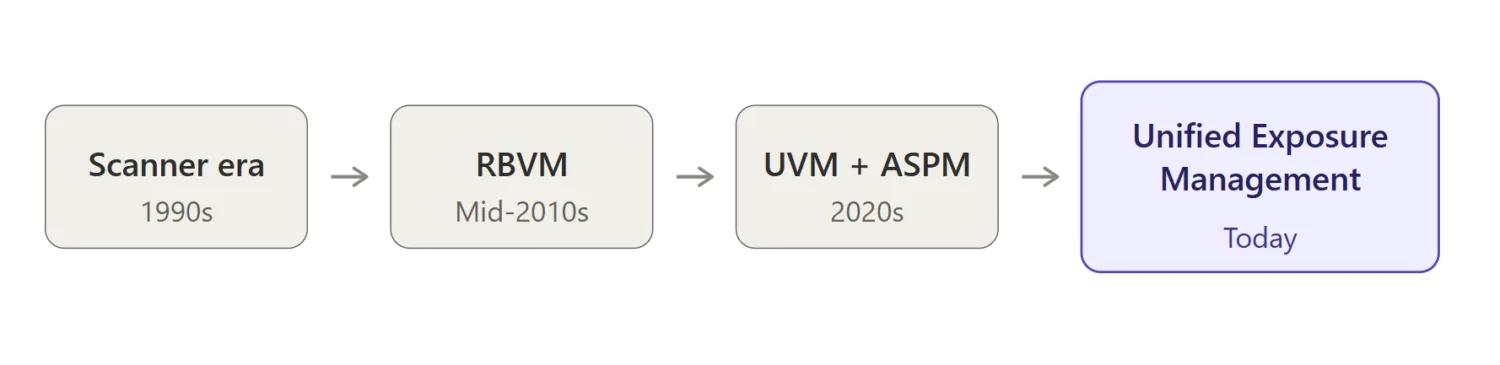
The history of vulnerability management is a story of layering. The scanner era of the 1990s gave defenders their first systematic view of network flaws, but it produced lists, not decisions. Early scanners were essentially automated checklists, running known signatures against known systems and producing reports that landed on a security engineer’s desk for manual triage. The model worked when the asset count was small, and the rate of new vulnerabilities was manageable. It did not survive the transition to cloud, microservices, and continuous deployment.
By the mid-2010s, the industry had moved into Risk-Based Vulnerability Management (RBVM), which added severity scoring, asset weighting, and threat intelligence to help teams decide what to fix first. RBVM was an important step forward because it acknowledged that not every vulnerability deserves equal attention. By layering threat intelligence and asset context on top of raw scan results, RBVM helped teams move from “fix everything” to “fix what matters most.” But RBVM remained tethered to network and infrastructure scanning and rarely extended into application or cloud-native environments. It also struggled with the deluge of findings that emerged as DevOps practices matured and the rate of code change accelerated.
The Rise of UVM and ASPM
The next evolution brought Unified Vulnerability Management (UVM) and Application Security Posture Management (ASPM) into the picture. UVM expanded the aperture to consolidate findings across the entire technology stack, while ASPM brought application-layer signals from SAST, DAST, SCA, secrets detection, and container scanning under a single roof. The driver was simple: tool sprawl had become unmanageable. Security teams were drowning in dashboards, each one producing its own version of the truth, with no normalized way to compare a critical SAST finding against a runtime misconfiguration.
ASPM specifically changed how security teams thought about application risk. Instead of treating each scanner as a standalone source of truth, ASPM platforms correlated findings across tools, deduplicated noise, and added the context of where code lived, who owned it, and how it flowed into production. UVM extended that same idea across the broader infrastructure stack, including cloud posture, network vulnerabilities, and operational technology where relevant. Together, UVM and ASPM acknowledged a truth that had become impossible to ignore: no single scanner sees the full picture, and the value of a security platform is increasingly defined by how well it correlates signals from many sources.
Unified Exposure Management: The Modern Category
This is where Unified Exposure Management arrives as the modern category. Unified Exposure Management takes the UVM and ASPM thesis to its logical conclusion: a single pane of glass that ingests findings from every scanner, normalizes them, correlates them to assets and ownership, and orchestrates remediation across security and engineering teams. ArmorCode is scannerless by design, picking up after discovery to focus where the leverage actually is: prioritization, orchestration, and fixing. The category-level shift is from “what did we find?” to “what are we going to do about it, and how fast?”
The Modern Vulnerability Remediation Process
Step 1: Unified Ingestion
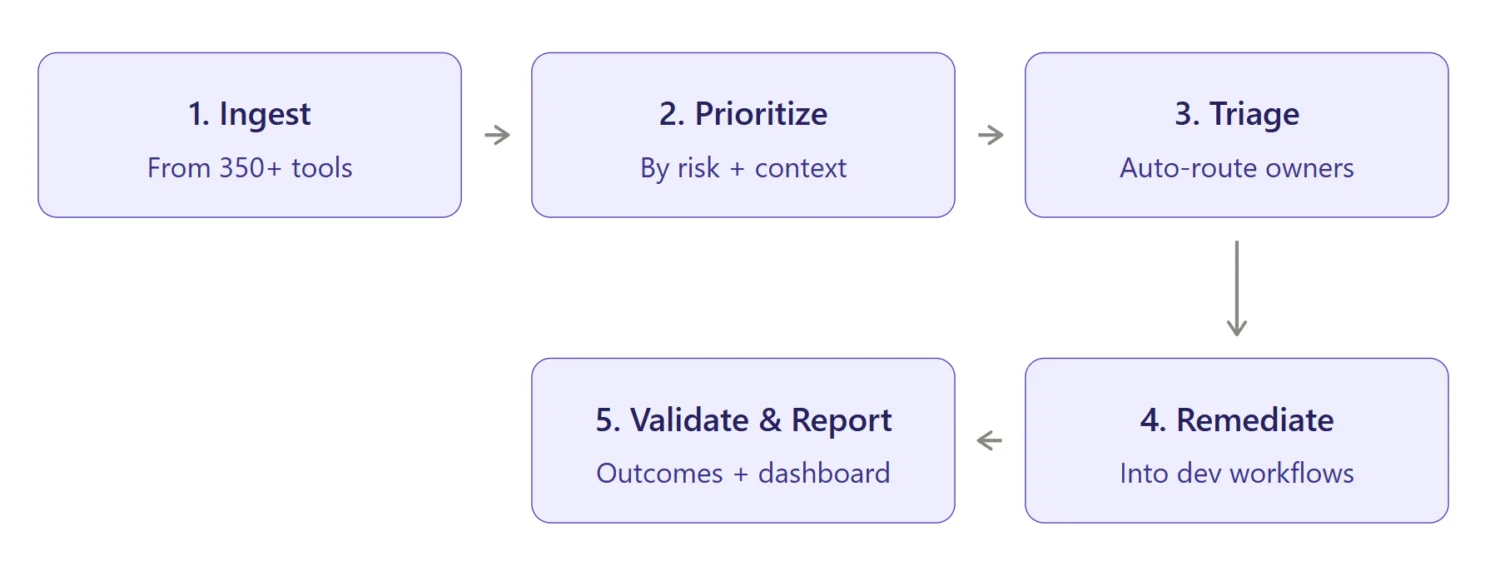
The first step in any modern vulnerability remediation process is unified ingestion. Most enterprises run dozens of security tools, and each one produces findings in its own format, with its own severity model, and its own concept of an asset. If your remediation workflow only sees CVEs, you have a CVE-only blind spot, missing entire categories of risk, such as IaC misconfigurations, exposed secrets, and software supply chain issues. A modern platform pulls in signals from 350+ integrations across SAST, DAST, SCA, cloud, infrastructure, container, and runtime tools, then deduplicates and normalizes them so the rest of the workflow operates on a single source of truth.
Unified ingestion is not just a data engineering problem. It is the foundation that makes every subsequent step possible. Without it, prioritization is fragmented across tools, ownership mapping is incomplete, and reporting is inconsistent. With it, the security team can finally answer a question that is shockingly hard to answer in most organizations: what is the total set of exposures across our environment right now, and which ones actually matter?
Step 2: Business-Aligned Prioritization
CVSS tells you the technical severity of a flaw in isolation. It does not tell you whether the affected asset is internet-facing, whether it processes payment data, or whether the vulnerable code path is actually reachable in production. Modern prioritization layers CVSS with EPSS (which estimates exploitation likelihood), reachability analysis (which determines whether a vulnerable function is actually invoked), and business context such as asset criticality, data sensitivity, and exposure. The result is a far smaller, far more meaningful list of what to fix first.
The shift from CVSS-only to multi-signal prioritization is one of the most important developments in the field. EPSS, maintained by FIRST, provides a probability-based view of whether a given vulnerability is likely to be exploited in the wild, drawing on real attack telemetry rather than theoretical severity. Reachability analysis adds another dimension, answering whether the vulnerable code path is even invoked in the application’s actual execution. When these signals are combined with business context, the result is a prioritization model that aligns engineering effort with actual risk reduction, not theoretical worst-case scenarios.
Step 3: Automated Triage and Ownership Mapping
One of the quiet productivity killers in security is the “Jira jockey” problem: a human spends hours every week figuring out which team owns which microservice, which engineer last touched a vulnerable file, and where to route a ticket. Modern platforms automate this by mining historical commit data, service ownership records, and CMDB relationships to assign findings to the precise engineer or team responsible. Ownership stops being a research project and becomes a lookup.
The downstream impact of automated ownership mapping is significant. When a finding lands in front of the right engineer with the right context on day one, remediation timelines compress dramatically. When ownership has to be researched, escalated, and reassigned, findings sit in queues, age past SLA, and accumulate into the kind of backlog that becomes politically impossible to address. Automated triage is not just a productivity improvement. It is the difference between a remediation program that operates in real time and one that operates in quarterly cleanup cycles.
Step 4: Remediation Orchestration
Once a finding is prioritized and routed, the remediation itself needs to meet developers where they already work, inside ticketing and workflow systems like Jira and ServiceNow. That means delivering each finding into the tools developers already use every day, with the context and rationale they need to act confidently: the affected asset, the proposed fix, the rationale, and the path to closure
The principle behind remediation orchestration is friction reduction. Every step that requires a developer to context-switch, dig for information, or wait on a security review is a step where remediation slows down or stalls. Modern platforms aim to deliver a finding to the developer’s existing workflows with everything needed to act, so engineering teams never have to leave their environment to fix a security issue
Step 5: Validation and Reporting
The last step is often the one that gets skipped. A patch can be reverted, a fix can be incomplete, and a vulnerability can reappear in a redeployed image. True validation means confirming the fix at the source level, ensuring it persists through redeployment, and tracking outcomes in reporting that connects engineering activity back to measurable risk reduction.
Validation is also where many compliance and audit conversations actually get resolved. Auditors and boards increasingly want to see evidence that remediation programs are working, not just that tickets are being closed. Reporting that ties engineering activity to risk reduction, broken down by severity, asset criticality, and time, enables security leaders to demonstrate program effectiveness to executive stakeholders. It also helps the security team itself identify where the program is working and where it is breaking down, so investments can be targeted at the right friction points.
Overcoming Common Remediation Challenges
Combating Alert Fatigue
Alert fatigue is no longer a productivity issue. It is a security issue. Many security teams name false positives as their top detection challenge, which means most analysts spend their day in noise rather than in risk reduction. Context-aware prioritization is the answer. When findings are scored against reachability, exploitability, and asset criticality, the long tail of low-impact noise collapses, and what remains is the small subset of exposures that actually warrant action.
The downstream effect of reducing alert fatigue is not just happier analysts. It is better security outcomes. When teams are constantly triaging noise, they develop a defensive numbness to alerts, and the genuinely important findings get treated with the same low-grade attention as the routine ones. Reducing noise restores the signal value of each remaining finding, which means the team responds faster and with more focus when something actually matters. This is the operational case for context-aware prioritization, and it is also the human case: security teams who spend their days on meaningful work stay in the field longer.
Fixing the Last-Mile Breakdown
Most programs do not fail at discovery. They fail at the last mile, in the long, undocumented gap between a ticket being opened and a fix being merged. Findings stall waiting for ownership, waiting for context, waiting for an engineer to context-switch from a feature sprint. Automated workflows compress that gap by routing, enriching, and following up on findings without human intervention, so remediation does not die in a backlog.
The last-mile problem is often the most underestimated part of a remediation program. Security leaders invest heavily in scanning, prioritization, and dashboards, and then discover that the actual fixes are still moving at the speed of email threads and weekly stand-ups. The fix to the last-mile problem is structural, not motivational. No amount of pressure on engineering teams will make remediation faster if the workflow itself is full of manual handoffs and missing context. Automation is what makes the last mile move at the same speed as the rest of the security program.
Moving Past SLA Theater
Many organizations measure remediation by whether tickets close before their SLA deadline. This is SLA theater. A closed ticket is not the same as a closed exposure, and a fix that hits a 30-day deadline but misses the actual attack path is not risk reduction. The mature metric is validated risk reduction over time, tied to the exposures most likely to be exploited.
The reason SLA theater persists is that it is easy to measure. Counting tickets closed on time is straightforward. Measuring actual risk reduction requires harder work: tracking which fixes addressed which exposures, validating that the fixes held up through redeployment, and correlating those outcomes with changes in attack surface over time. The organizations that have moved past SLA theater are the ones that have invested in the data infrastructure to measure what actually matters, and the result is a remediation program that aligns with what the board, the auditors, and the CISO actually care about: less exploitable risk in the environment.
The Role of Agentic AI in Remediation
From AI Assistants to AI Workers
For most of the last two years, AI in security has meant assistance: a copilot that helps an analyst write a query, summarize an alert, or draft a remediation note. Agentic AI is a different category. The shift is from AI assistants, which wait for human prompting at every step, to AI workers, which are purpose-built, bounded by design, and scoped to specific, high-value workflows the security team already owns.
The implications of this shift are significant. AI-assisted workflows are limited by the speed of the human operator and by the inconsistency of ad hoc prompting. Every engineer prompts a little differently, output varies, and the productivity gains never compound across the team. Purpose-built AI workers solve that by being reusable and governed: the prompt engineering work happens once, the behavior is predictable, and every member of the team gets the same context-grounded output, every time.
Anya Agents in Action
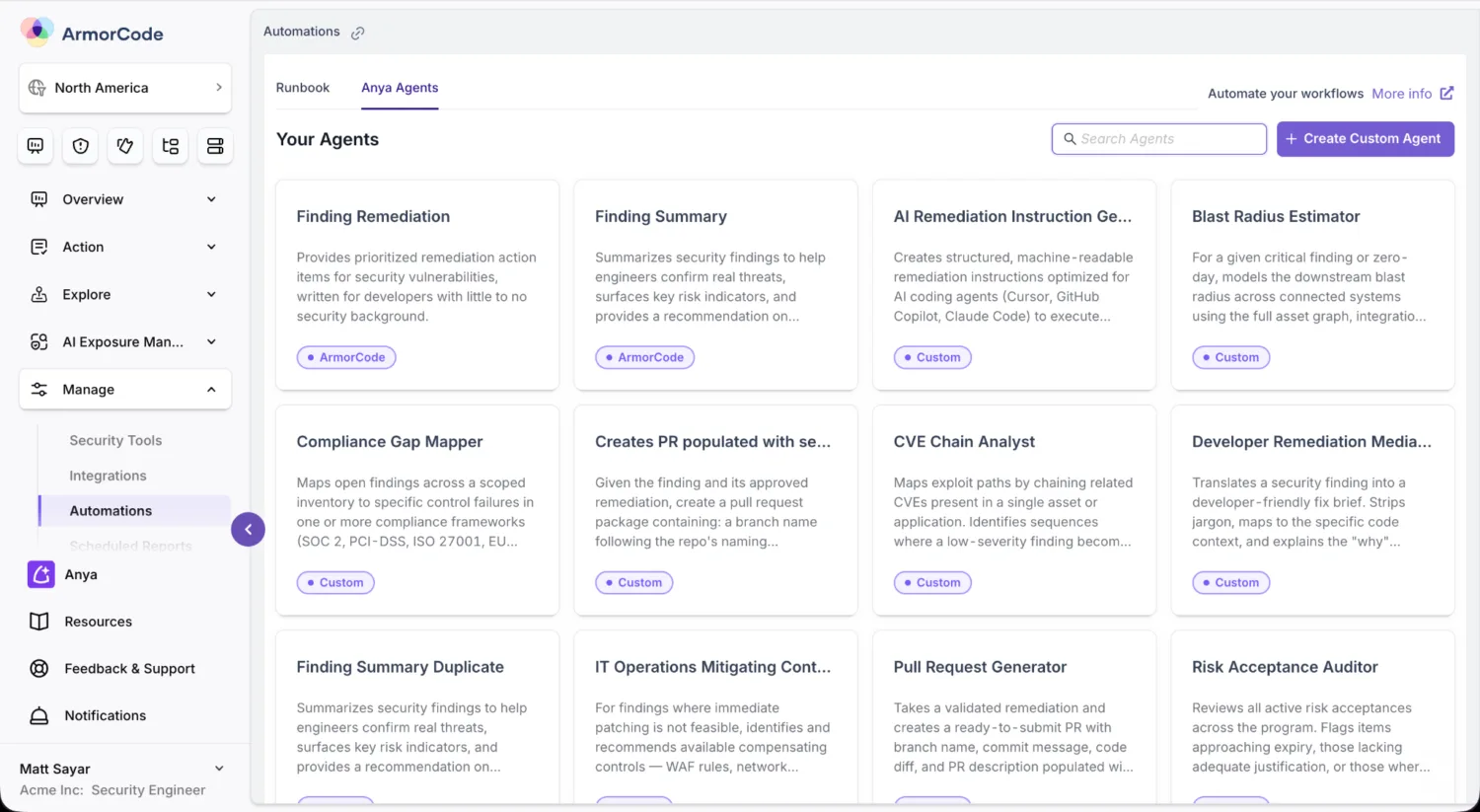
This is where ArmorCode’s Anya Agents operate, as purpose-built AI workers on the ArmorCode Agentic AI Platform. Each Anya Agent is scoped to a single, high-value security workflow, with a defined context and a bounded set of behaviors. The first phase of the framework ships four agents: the Remediation Agent, which generates code-aware remediation guidance for a finding or group of findings; the Zero-Day Exposure Hunting Agent, which assesses organizational impact of a newly disclosed CVE by pulling threat intelligence and correlating it against existing findings and supply chain exposure; the Finding Overview Agent, which summarizes a finding in plain language; and the Risk Analyzer Agent, which explains the “why” behind a risk score for a finding, group, or subgroup.
What separates Anya Agents from public LLMs is grounding. Every agent reasons over ArmorCode’s Context Risk Graph, the unified data model that spans findings, assets, software supply chain data, and threat intelligence drawn from 350+ integrations across the security tool stack. A generic LLM can tell a security team what a CVE is. An Anya Agent can tell them whether their organization is actually exposed to it, because it sees the same data the rest of the platform sees. Agents are also specialized, reusable, role-aware, and governed under the same RBAC controls as the rest of the platform, so AI usage becomes a managed part of the security program rather than an ad hoc, side-of-desk activity.
The design principle is that the agent should do the work that is bounded and well-defined, while the human should make the calls that require context, judgment, or trade-off analysis. A finding that needs a plain-language summary, a remediation guidance draft, or an impact assessment is exactly the kind of work an Anya Agent handles. A decision about whether to take a system offline to patch it, or how to weigh business risk against engineering capacity, is exactly the kind of work a human should make. The platform’s job is to draw that line cleanly, so the team’s attention goes where it is most valuable.
Achieving Security at the Speed of DevSecOps
Modern vulnerability remediation is not a faster version of the old playbook. It is a different playbook. It treats discovery as a solved problem, ingestion as a unification challenge, prioritization as a business problem, and remediation itself as an orchestrated workflow that spans security and engineering. The organizations that adopt this model do not just patch faster. They reduce the exploitable attack surface that adversaries are actively probing, and they do it without burning out their teams.
The throughline across every step of this approach is leverage. Unified ingestion gives the program leverage over fragmented data. Business-aligned prioritization gives the team leverage over noise. Automated triage gives the workflow leverage over manual coordination. Remediation orchestration gives developers leverage over friction. Validation and reporting give security leaders leverage over the conversation with the board. Agentic AI gives the human team leverage over volume. Each layer compounds with the others, and the organizations that put them together end up with remediation programs that operate at a fundamentally different scale than legacy approaches allow.
The goal of any modern security program is to reduce the blast radius of threats while preserving the velocity that engineering teams need to ship. Unified Exposure Management, powered by agentic AI, is how that becomes possible. To see how this comes together in practice, explore the ArmorCode Platform and how it brings unified ingestion, business-aligned prioritization, and agentic remediation into a single workflow.
Frequently Asked Questions (FAQ)
What is the difference between vulnerability management and vulnerability remediation?
Vulnerability management is the overarching framework that includes discovering, classifying, prioritizing, and reporting on security flaws across an organization. Vulnerability remediation is the specific, actionable phase within that framework where the identified flaw is actually fixed, patched, or neutralized to eliminate the risk. Management describes the program. Remediation is where risk actually goes down.
How long does the vulnerability remediation process typically take?
Mean time to remediate (MTTR) varies widely by severity, asset class, and program maturity, and most organizations measure it in weeks or months for critical vulnerabilities. The traditional patch cycle was never designed for the volume or velocity of findings that modern security programs deal with. Organizations that adopt Unified Exposure Management platforms with agentic AI automation can compress this dramatically, often into a window of days for the exposures that matter most.
Why is CVSS alone not enough for vulnerability remediation?
CVSS measures the technical severity of a flaw in isolation, but it has no view into business context. A critical CVSS score on an isolated, internal test server poses far less actual risk than a moderate flaw on a public-facing revenue system. Modern remediation requires combining CVSS with EPSS (likelihood of exploitation), reachability analysis (whether the vulnerable code is actually invoked), and asset criticality (what the asset does for the business).
How does Unified Exposure Management differ from traditional vulnerability management?
Traditional vulnerability management is typically organized around individual scanners and the findings they produce, with each tool operating as its own silo. Unified Exposure Management takes a platform view, ingesting findings from every scanner in the environment, normalizing them into a single data model, and orchestrating the full lifecycle from prioritization through remediation and validation. The difference is structural: traditional approaches optimize each tool in isolation, while Unified Exposure Management optimizes the program as a whole.
What role does agentic AI play in modern remediation programs?
Agentic AI shifts security teams from relying on AI assistants, which require ad hoc prompting and produce inconsistent output, to deploying purpose-built AI workers that are bounded, reusable, and governed. ArmorCode’s Anya Agents, for example, are scoped to specific workflows: generating code-aware remediation guidance, assessing the organizational impact of newly disclosed CVEs, summarizing findings, and explaining risk scores. Each one reasons over ArmorCode’s Context Risk Graph, which spans findings, assets, supply chain data, and threat intelligence drawn from 350+ integrations, so the agent sees the same data the rest of the security program sees. The human role stays focused on the decisions that require judgment, while the repetitive analytical work scales without adding headcount.
Key Takeaways
- Discovery is solved. Remediation is the bottleneck. The gap between a finding being created and a fix being merged is where modern breaches happen. Mature programs measure success by exploitable attack surface reduction, not by ticket volume.
- AI-discovered vulnerabilities have reshaped the curve. Frontier systems like Anthropic’s Claude Mythos and OpenAI’s Daybreak are accelerating discovery at machine speed, while attackers compress exploitation into hours. The 90-day patch cycle is no longer a defensible strategy.
- Unified Exposure Management is the modern category. It takes the UVM and ASPM thesis further by ingesting findings from every scanner, normalizing them, and orchestrating remediation across security and engineering, without adding another scanner to the stack.
- Context-aware prioritization beats CVSS alone. Layering CVSS with EPSS, reachability analysis, and business context cuts through alert fatigue and focuses engineering effort on the small subset of exposures that actually matter.
- Agentic AI means purpose-built AI workers, not chat windows. Anya Agents on the ArmorCode Agentic AI Platform are bounded, reusable, and grounded in the Context Risk Graph, scaling remediation throughput without scaling headcount.