The Mythos AI Threat Isn’t the AI. It’s the People Behind It.


The Mythos AI threat is one of the fastest-rising security searches of the year, and the fear behind it is legitimate. Enterprises are right to ask hard questions about a model capable of discovering vulnerabilities at a scale and speed no human team can match. But the data points to a more uncomfortable truth: the threat isn’t the AI. The threat is the people who will find ways to manipulate it, weaponize it, and use it with malicious intent.
That distinction changes everything about how security leaders should respond. You cannot govern a model. You can govern how AI is deployed, who has access to it, what it touches, and what happens when an agent acts outside the rules. That is the real work of agentic AI security, and it is the line between two camps that are now forming across every industry: those building, deploying, and protecting AI for good, and those who will exploit it for harm.
The Dual Nature of Agentic AI
Agentic AI is not one thing. It is a capability, and capabilities are defined by who wields them. The same agent that hunts down a critical vulnerability before it is exploited can, in the wrong hands, exfiltrate data, alter configurations, or chain together actions no human authorized. This is the dual nature security leaders have to govern. ArmorCode CEO Nikhil Gupta has written about what this inflection point means for security teams, and the short version is this: the volume and velocity of AI-driven discovery is about to outpace every legacy assumption in vulnerability management.
Beyond Chatbots: Agents That Take Action
Generative AI answers questions. Agentic AI executes workflows. That distinction is the entire reason the Mythos AI threat conversation exists.
A chatbot drafts an email. An agent opens a ticket, modifies a configuration, queries a database, deploys code, or coordinates with other agents to complete a multi-step task on its own. The same autonomous capability that allows Claude Mythos to triage findings, correlate exposures, and recommend fixes at machine speed also exists in unauthorized agents that can move laterally through systems, access regulated data, or trigger transactions without oversight.
The capability is neutral. The intent behind its deployment is not.
The Rise of Shadow AI: It is Already Here
Shadow AI is the unauthorized, unmonitored, or simply unaccounted-for use of AI inside the enterprise. And unlike previous waves of shadow IT, it is not something you can wait out, restrict away, or block at the firewall. It is already happening, and it is going to get bigger.
Every employee with a browser has access to frontier models. Every approved SaaS tool is shipping AI features. Every developer can spin up an agent in an afternoon. The question is no longer how to prevent Shadow AI. The question is how to see it, govern it, and convert it from a blind spot into a managed capability.
This is where the line gets drawn. Enterprises that pretend Shadow AI is preventable will keep getting surprised. Enterprises that accept it is inevitable, and build governance around that reality, will be the ones who stay safe.
The Hidden Risk in SaaS-Embedded AI
Most enterprises do not need to go looking for AI exposure. It arrives on its own, through the vendors they already use.
The Trojan Horse of Software Updates
Dozens of AI tools and software now ship as updates to platforms enterprises have already approved. The underlying contract was signed years ago. The security review was completed long before agentic AI entered the picture. And yet, with a single feature toggle or a quiet vendor rollout, powerful AI agents are activated inside the environment.
Because the host platform is trusted, the AI inherits that trust. Formal security reviews are bypassed not through malice but through process. The result is unauthorized AI capability operating with fully sanctioned access. This is exactly the kind of seam threat actors are now learning to exploit, and it is one of the security concerns CISOs have to address head-on as the AI era accelerates.
Permission Sprawl and the Identity Context Gap
Once activated, embedded AI agents inherit the permissions of the humans who use them. One enterprise security team recently discovered 150 distinct Copilot agents operating in their environment within a single week. None had gone through formal review. All had inherited broad access.
This creates the identity context gap. Traditional security tools see a known user accessing files and treat the activity as normal. They cannot distinguish between a human opening a handful of documents over the course of a workday and an AI agent reading 400 files in 15 minutes on that same human’s behalf. The identity is the same. The behavior is not. Without context-aware controls, a malicious operator running an agent under a real employee’s identity blends straight into the noise of legitimate use.
Us vs. Them: The Line Every Security Leader Has to Pick
There is no neutral position on agentic AI anymore. Every enterprise will be on one of two sides of the line that is being drawn this year.
On one side are the defenders: security teams, AI governance officers, vendors, and yes, model builders like Anthropic, all working to make AI safer, more transparent, and more accountable. This camp accepts that AI is here, that Shadow AI is inevitable, and that the only viable response is to govern it with discipline. ArmorCode stands here, alongside our customers and the broader community building AI for good.
On the other side are the threat actors: criminal operators, nation-state groups, insider abusers, and opportunists who will weaponize every ungoverned AI agent they can reach. They do not need to build their own model. They need only to find an enterprise that has lost track of its own.
The Mythos AI threat fear, distilled down, is really a fear of ending up on the wrong side of this line by accident, through inaction, through fragmented controls, through Shadow AI no one mapped in time.
Governing the Mythos AI Threat with ArmorCode
Picking the right side of the line is a values decision. Acting on it requires infrastructure. That is what ArmorCode delivers, and it is also why prioritization matters more than ever: in a world where AI is generating findings at machine speed, the 3% of findings that represent 80% of real risk is what your team should actually be working on.
AI Exposure Management (AIEM) as the System of Action
ArmorCode AI Exposure Management is the system of action for enterprise AI visibility, insight, and control. It is the operational backbone that responsible AI has been missing. AIEM continuously ingests AI usage and governance signals from your existing security infrastructure, including SASE, EDRs, firewalls, identity systems, and cloud platforms, and converts those fragmented signals into owned, policy-driven, and auditable decisions.
You do not need to replace your current stack. You get a governance layer above it. AIEM sits above any individual detection source, aggregates across your heterogeneous environment without vendor bias, and gives security leaders a continuously updated, authoritative inventory of every AI tool, model, API, MCP server, and agentic workflow operating across the enterprise, including the ones no one approved. Every AI asset carries a defined business owner, an approval record, and an accountable risk owner, eliminating the ambiguity that turns an undetected agent into an executive crisis.
Meet Anya Agents: AI Workers on Our Side
Security teams don’t need another AI assistant. They need AI workers. Not every agent is a threat, and the same agentic capabilities that fuel Shadow AI can be harnessed for defense when they are purpose-built and governed correctly.
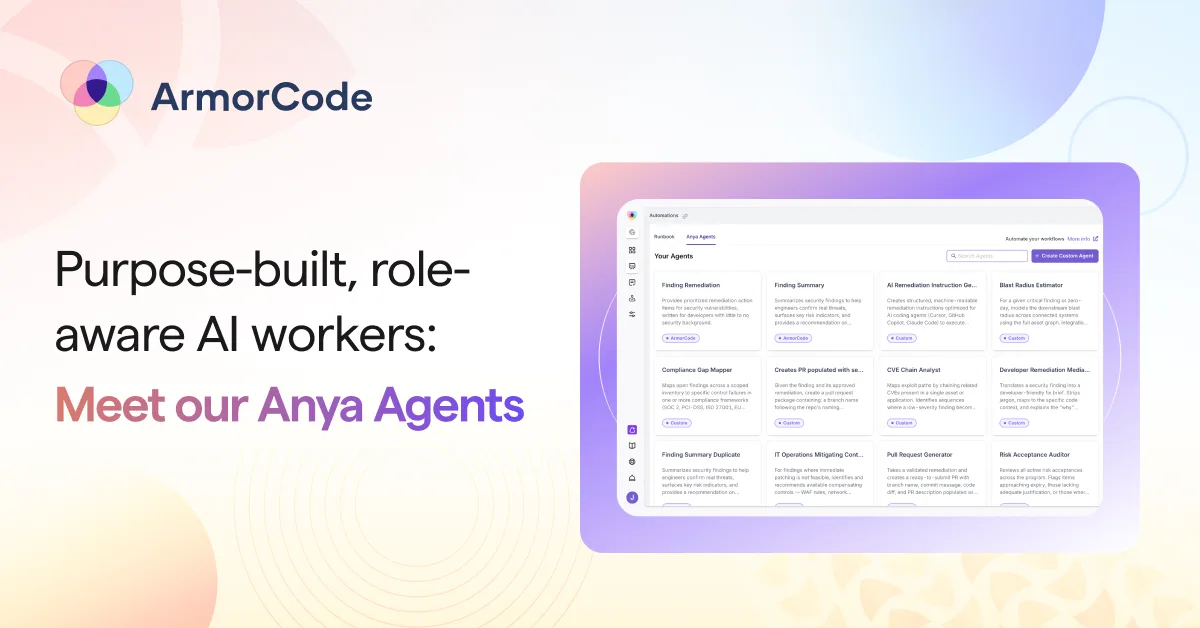
Anya Agents are ArmorCode’s purpose-built, role-aware AI workers, grounded in our Context Risk Graph: findings, assets, software supply chain, AATI threat intelligence, and platform documentation. Four agents anchor the launch: a Remediation Agent that generates code-aware fix guidance, a Zero-Day Exposure Hunting Agent that assesses organizational impact the moment a CVE drops, a Finding Overview Agent that summarizes findings in plain language, and a Risk Analyzer Agent that explains the why behind a risk score.
Anya Agents are what agents look like when they are on the right side of the line: bounded by design, governed by RBAC, role-based defaults, and a full audit trail, and reusable across the security workflows where the work actually happens. That is the future we are building toward, and it is the future we want every enterprise security team in.
Are You Ready for the Mythos Era?
The Mythos AI threat conversation is not going away. It is going to intensify, and the enterprises that come out of the next 18 months in the strongest position will be the ones who picked their side early and built the controls to match.
Find out where your organization stands. Request your free Mythos Readiness Assessment to get a tailored view of your enterprise’s readiness, gaps, and next steps.
Frequently Asked Questions
Q: What is “Shadow AI” and why is it a significant security threat?
A: Shadow AI refers to the unauthorized or unmonitored use of AI models and agents within an enterprise. It is a major threat because these agents often inherit broad user permissions and operate outside the visibility of traditional security tools, creating massive blind spots for data exfiltration or unauthorized actions.
Q: How do SaaS-embedded AI tools complicate enterprise security governance?
A: AI features embedded in existing SaaS platforms like Microsoft 365 or Salesforce often arrive via standard software updates. Because the underlying platform is already approved, these powerful AI agents bypass formal security reviews and immediately inherit the extensive permissions of the users who activate them.
Q: How does ArmorCode’s Anya utilize agentic AI for defensive security?
A: Anya is ArmorCode’s governed agentic AI designed to act as a security champion. She provides a natural language interface for security data, delivering persona-aware intelligence such as summarizing global threats for CISOs or providing targeted code patches for developers, all at machine speed.
Key Takeaways
- The “Mythos AI threat” fear is real, but misdirected: the danger comes from human actors who exploit AI, not from the models themselves.
- Agentic AI has a dual nature: the same capabilities that make it a formidable security tool also make it a novel vector of risk when misused.
- Shadow AI is no longer avoidable. It is already inside every enterprise, embedded in SaaS tools your teams already trust.
- The security industry is splitting into two camps: those who govern AI for good, and those who will manipulate it for harm. There is no neutral ground.
- ArmorCode’s AI Exposure Management (AIEM) and Anya Agents, our purpose-built AI workers, give enterprises the visibility and control to stay on the right side of that line.