

Cybersecurity for Healthcare & Life Sciences
A healthier security posture, stat
ArmorCode delivers cybersecurity for hospitals and health systems to protect patient data and keep care systems running, and helps medical device makers prove the security of everything they ship. One platform unifies findings across clinical applications, hospital IT, cloud, and device software, maps every risk to an owner, and produces the evidence HIPAA and FDA scrutiny demand.
TRUSTED BY THE WORLD’S TOP BRANDS




















Industry Challenges
The highest stakes in security
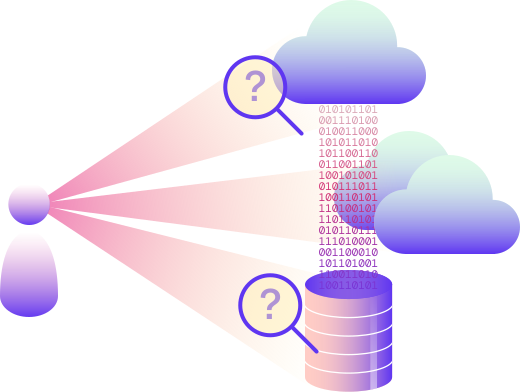
Healthcare has suffered the most expensive breaches of any industry for 14 consecutive years, at 7.42 million dollars on average (IBM, 2025), and 2025 was the worst year on record: 772 large breaches exposing the health information of roughly 139.7 million people (HIPAA Journal, 2026). The Change Healthcare incident showed how one known, unowned gap can cascade into 192.7 million affected individuals and billions in costs. Meanwhile, device makers face FDA Section 524B SBOM requirements in premarket submissions, a biotech cybersecurity reality that only compounds as providers run sprawling fleets of legacy clinical systems that can never simply be patched. Lean security teams cannot triage their way through this by hand.
Customer Testimonials
Trusted where downtime is measured in patients
“ArmorCode offers us a single view on all our application and infrastructure vulnerabilities, with the capability to efficiently prioritize them for swifter remediation. The true essence of our partnership with ArmorCode lies in their dedicated customer attention and clear understanding of our deliverables.”

How ArmorCode Helps
Why is ArmorCode the right cybersecurity for healthcare?
ArmorCode serves both sides of healthcare security. Providers get one prioritized view across clinical apps, hospital IT, and cloud, with ownership mapped across IT and biomed teams. Device makers and health-tech companies get a product security system of record, from component inventory to FDA-ready SBOM.
See Risk Near Every Patient
Patient portals, EHR integrations, telehealth apps, and device software all carry PHI. ArmorCode unifies findings across all of it and weighs prioritization by PHI exposure, so patient-facing systems get attention first.
Protect What Can’t Be Patched
Clinical systems can’t always be taken offline to patch. ArmorCode adds compensating-control context and prioritizes by active exploitation, so lean teams fix what ransomware actually uses first.
Prove Every Device Is Safe
FDA 524B requires an SBOM for every submission, maintained across a decade-long field life. ArmorCode generates composite SBOMs and VEX automatically, and flags end-of-life components before they’re exploited.
Related resources

Frequently Asked Questions
Q: What does cybersecurity for healthcare need to cover that other industries don’t?
A: Cybersecurity for healthcare has to protect some of the most sensitive data that exists, patient health information, while also keeping systems running that patients’ care directly depends on. Healthcare has suffered the most expensive breaches of any industry for 14 consecutive years, averaging 7.42 million dollars per breach (IBM, 2025), and 2025 alone saw 772 large breaches expose the health information of roughly 139.7 million people (HIPAA Journal, 2026). For healthcare organizations, this typically means:
- Unifying findings across clinical applications, hospital IT, cloud, and device software
- Prioritizing by PHI exposure, not just severity score
- Accounting for clinical systems that can’t simply be taken offline to patch
Q: What does cybersecurity for hospitals need to prioritize when systems can’t be patched on demand?
A: Cybersecurity for hospitals has to work around the reality that clinical systems often can’t be taken offline for patching without disrupting patient care. That means prioritization needs compensating-control context alongside active-exploitation data, so a lean security team fixes what ransomware is actually using against similar systems first, rather than working down a severity list that assumes every system can be patched on the same schedule.
Q: How does application security posture management help track PHI exposure?
A: Application security posture management aggregates findings from every scanner, pentest, and assessment across clinical applications, infrastructure, cloud, and device software into one unbiased view, then maps that exposure specifically to where PHI lives. This matters because a vulnerability on a system holding patient data carries different real-world risk than the same vulnerability on an internal tool, and ASPM is what lets a team prioritize by that distinction instead of treating every finding the same.
Q: What is risk-based vulnerability management, and why does active exploitation matter more than severity score in healthcare?
A: Risk-based vulnerability management prioritizes fixes by what’s actually being exploited and what compensating controls already exist, rather than by raw CVSS severity alone, which matters most in healthcare because so many clinical systems can’t be patched the moment a high-severity finding appears. The Change Healthcare incident showed how one known, unowned gap cascaded into 192.7 million affected individuals and billions in costs, illustrating why exploitability and ownership matter as much as severity in deciding what gets fixed first.
Q: What does biotech cybersecurity need to address for medical device makers specifically?
A: Biotech cybersecurity for device makers centers on FDA Section 524B, which requires a software bill of materials for every premarket submission, maintained across a device’s field life that can run a decade or longer. That means tracking end-of-life components in long-lived embedded software and generating composite SBOMs and VEX disclosures automatically, rather than reconstructing that documentation manually each time a submission or a customer request comes in.
Q: How does ArmorCode support FDA SBOM requirements for medical devices?
A: ArmorCode generates composite SBOMs and VEX disclosures automatically for FDA submissions, tracking end-of-life components across a device’s entire field life so device makers aren’t reconstructing that inventory by hand years after a product shipped. Meeting FDA requirements remains the manufacturer’s own regulatory obligation; ArmorCode’s role is producing the SBOM and VEX evidence FDA scrutiny demands, on demand rather than as a one-time compliance exercise.