

Industrial & Manufacturing Cybersecurity
Security built for the factory floor and the field
ArmorCode helps manufacturing cybersecurity for two worlds at once: the enterprise and plant infrastructure that keeps production running, and the software inside products that live in the field for a decade or more. One platform correlates findings across both, maps ownership across plants and business units, and turns EU Cyber Resilience Act obligations into automated workflow.
TRUSTED BY THE WORLD’S TOP BRANDS





















Industry Challenges
Five straight years as the most-attacked industry
Manufacturing has been the most-attacked industry for five consecutive years, drawing 27.7 percent of all incidents, with public-facing application exploitation as the top entry vector (IBM X-Force, 2026). Converged IT and OT estates mean downtime is measured in production lines, not help-desk tickets. Connected products carry security obligations for decade-plus field lives, the EU Cyber Resilience Act is reshaping what manufacturers must prove about shipped software, and supplier software dependency runs deep. Product security is no longer a program. It is a legal duty with a clock on it, and it is redefining cybersecurity for manufacturing companies across the entire supply chain.
Customer Testimonials
Trusted on the line and in the field
“A platform like ArmorCode gives us ability to correlate findings at scale. It gives an engineer a starting point where to look in terms of a solution, not just the problem. Engineers don’t like being given 100 problems to solve—they want to know what needs to be done to fix them. ArmorCode provides that insight.”

“ArmorCode is a really good platform to manage risk pouring in from various sources. The customized reporting and visualization capabilities of the platform make it stand out amongst others.”

How ArmorCode Helps
Why ArmorCode for manufacturing cybersecurity?
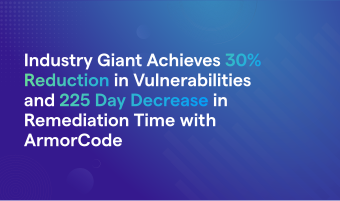
Industrial leaders including Volvo Group, Jaguar Land Rover, Johnson Controls, Carrier, and Wabtec run ArmorCode as the system of record for product and enterprise security. A global equipment manufacturer cut remediation time by 97 percent, from 240 days to hours, and another global manufacturer reduced vulnerabilities by 30 percent while saving 225 days of effort.
One Graph, Plant to Product
Manufacturers secure enterprise and plant infrastructure, plus software shipped inside products for a decade or more. ArmorCode correlates both in one graph, with ownership mapped across plants and BUs.
CRA Compliance, Automated
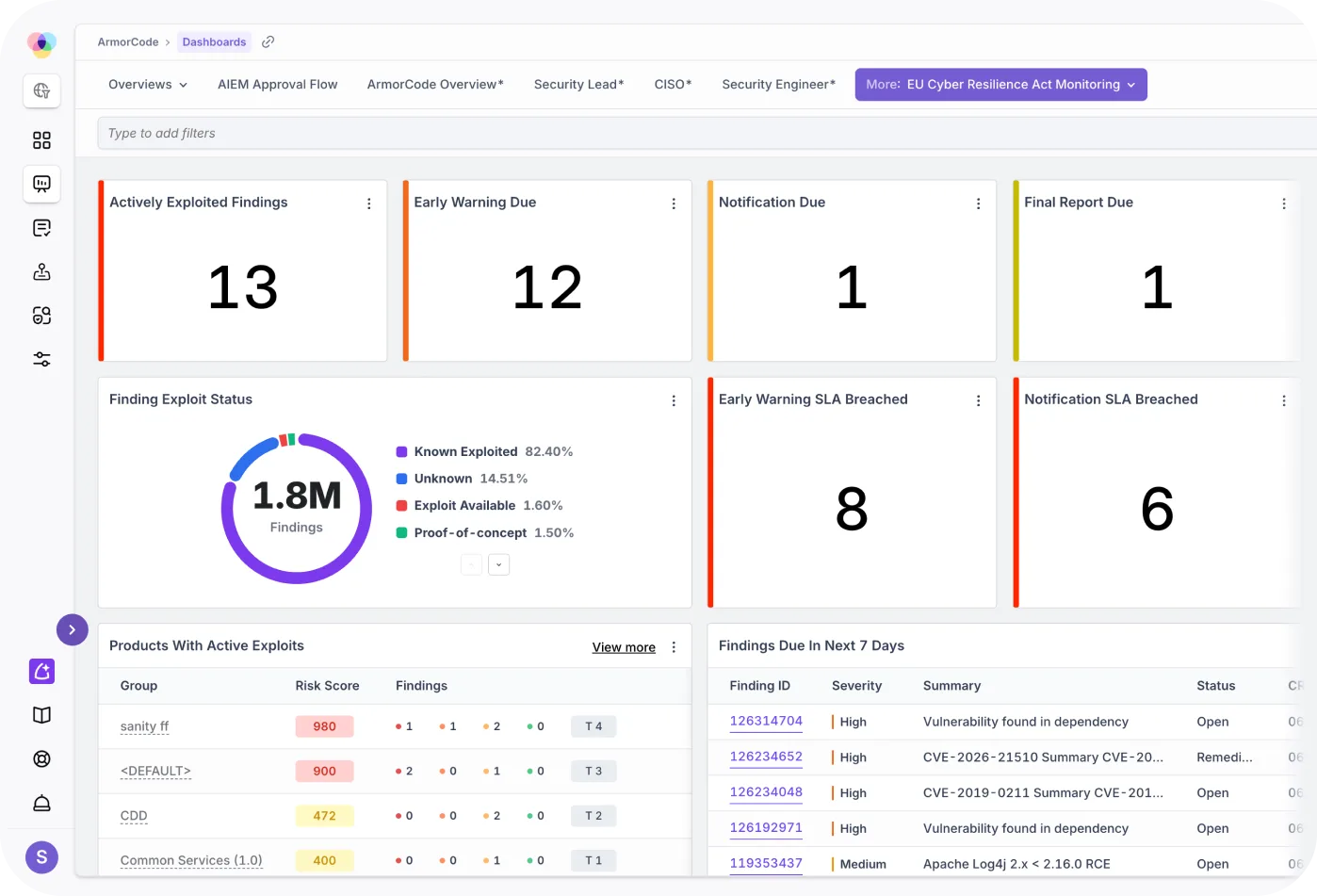
The EU Cyber Resilience Act requires 24-hour vulnerability reporting from September 2026, full SBOM obligations by 2027. ArmorCode generates composite SBOMs and VEX automatically, product by product, version by version.
Patch What Attackers Reach
A production line can’t reboot on a whim, so every patch decision counts. Attack-path analysis shows which low-severity flaws chain into real exploits, so maintenance windows target what matters.
Related resources


Frequently Asked Questions
Q: What is manufacturing cybersecurity, and why has it become a legal requirement rather than just best practice?
A: Manufacturing cybersecurity now covers two connected problems: securing the enterprise and plant infrastructure that keeps production running, and securing the software inside products that stay in the field for a decade or more. Manufacturing has been the most-attacked industry for five consecutive years, drawing 27.7 percent of all incidents (IBM X-Force, 2026), and regulations like the EU Cyber Resilience Act now turn product security into a legal duty with reporting deadlines, not just an internal program. For manufacturers, this typically means:
- Correlating findings across IT, OT, and embedded product software in one view
- Mapping ownership across plants and business units, not just one security team
- Producing SBOM and VEX evidence on demand instead of assembling it per request
Q: What does the EU Cyber Resilience Act actually require from manufacturers, and by when?
A: The EU Cyber Resilience Act requires manufacturers to report actively exploited vulnerabilities within 24 hours, a follow-up notification within 72 hours, and a final report within 14 days of the fix being available, with core reporting obligations taking effect September 11, 2026, and full compliance obligations, including SBOM requirements, phasing in by December 11, 2027. Meeting this cascade is the manufacturer’s own obligation; ArmorCode’s role is generating the composite SBOMs, VEX disclosures, and audit trail the reporting timeline demands, product by product and version by version.
Q: How does manufacturing vulnerability management differ from vulnerability management in other industries?
A: Manufacturing vulnerability management has to account for converged IT and OT estates, where downtime is measured in halted production lines rather than help-desk tickets, and for embedded software that stays in the field for years after a product ships. That means findings need to be correlated across firmware, application, cloud, and infrastructure scanners into per-product-line and per-plant views, with ownership mapped across the business units and geographies that actually own the fix.
Q: What is risk-based vulnerability management, and why does it matter when patch windows are limited to maintenance shutdowns?
A: Risk-based vulnerability management prioritizes fixes by which findings chain into real exploitable paths, not by raw severity score, which matters most where a production line can’t simply reboot to apply a patch. Attack-path analysis shows how low-severity flaws combine into exploitable chains, so the narrow maintenance windows a plant actually has go toward the vulnerabilities attackers can reach, rather than being spread across every finding a scanner reports.
Q: Why is cybersecurity for manufacturing companies harder when supplier and third-party software is involved?
A: Cybersecurity for manufacturing companies increasingly means securing code the manufacturer didn’t write itself, since supplier software dependency runs deep across both plant infrastructure and shipped products. Public-facing application exploitation is already the top entry vector for attacks on the industry (IBM X-Force, 2026), and that exposure compounds when a product’s decade-plus field life means old supplier components stay in use long after the supplier stops patching them.
Q: Can one platform handle both plant-floor security and product security for shipped devices?
A: Yes. A platform built to correlate enterprise, plant, and embedded product findings in one graph can map ownership across plants and business units while tracking end-of-life components in long-lived embedded software separately from IT infrastructure findings. Industrial manufacturers including Volvo Group, Jaguar Land Rover, Johnson Controls, Carrier, and Wabtec run this model as their system of record for both sides of the problem.