

Cybersecurity for Insurance Companies
You assess risk for a living. So do we.
Insurers hold decades of deeply personal data on some of the oldest core systems in financial services, and attackers know it. ArmorCode gives carriers and brokers one risk-prioritized view of cyber exposure across legacy policy administration systems and modern digital channels, with ownership mapped across brokers, TPAs, and acquired books of business, and evidence regulators can trust.
TRUSTED BY THE WORLD’S TOP BRANDS




















Industry Challenges
A sector actively hunted: why cybersecurity for insurance companies can’t wait
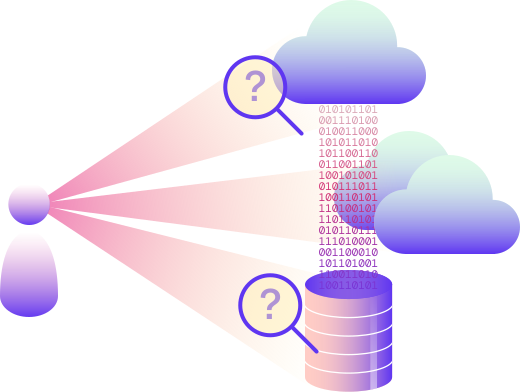
In 2025, threat actors turned their attention squarely to insurers, and one major carrier breach affected 22.6 million people (TechCrunch, 2025). The underlying exposure is structural: decades of underwriting and claims data, vast broker and TPA ecosystems that fragment ownership, and core systems that predate most of the security tools watching them. Regulators are moving too, with NYDFS Part 500, state insurance data security laws, and DORA for EU insurance operations, while the NAIC now expects documented governance of the AI insurers are racing into underwriting and claims.
Customer Testimonials
Coverage you can count on
“Responsible AI requires more than detection; it requires accountability and trust. AI Adoptions are accelerating across the enterprise, often outpacing governance models’ maturity. What’s encouraging is the emergence of platforms like ArmorCode that focus on surfacing accountability for AI activity, assigning ownership, and embedding policy-driven workflows. That’s the direction the industry needs if we are going to enable AI innovation with defensible oversight.”

“I had my “aha” moment today. Once I realized I hadn’t known how many applications & microservices were running in our environment, or how many were either not running or activated, I knew ArmorCode was going to help us transform how we executed our application security program.”
“My experience with ArmorCode has been positive. We have seen remarkable improvements in the security compliance of our applications since implementing the tool. Its functionality has significantly enhanced our ability to manage vulnerabilities.”

How ArmorCode Helps
Why do insurers choose ArmorCode for cybersecurity?
ArmorCode speaks the language insurers already use: risk assessment. This is insurance cybersecurity built to unify vulnerability management across the legacy core and the digital edge, govern the AI entering underwriting and claims decisions, and produce board-ready evidence on demand.
One View, Core to Digital
Insurers run decades-old core systems alongside brand-new digital channels, often built by different teams. ArmorCode unifies findings across both and resolves ownership across brands, business units, and TPAs.
Govern AI in Underwriting
Insurers are aggressive AI adopters in underwriting and claims, right where regulators are watching closest. ArmorCode maintains a governed inventory with an owner and approval on every AI asset.
Know Who Owns the Risk
When a vulnerability sits in software you didn’t build, on a platform a broker or TPA manages, ownership is the whole problem. ArmorCode maps it, and verifies every fix actually happened.
Related resources
Frequently Asked Questions
Q: What does cybersecurity for insurance companies need to cover that other industries don’t?
A: Cybersecurity for insurance companies has to secure decades of underwriting and claims data sitting on some of the oldest core systems in financial services, while also covering the brokers, TPAs, and acquired books of business that fragment ownership across the estate. In 2025, one major carrier breach alone affected 22.6 million people (TechCrunch, 2025), underscoring why insurers have become a specifically targeted sector rather than an incidental one. For carriers and brokers, this typically means:
- Unifying findings across legacy policy administration systems and modern digital channels
- Resolving ownership when a vulnerability sits on a broker or TPA’s platform, not the insurer’s own
- Producing evidence regulators and boards can actually trust, on demand
Q: What are insurance cybersecurity solutions, and how do they handle both legacy cores and digital channels?
A: Insurance cybersecurity solutions need to unify findings from decades-old core systems, often built and maintained by entirely different teams than the ones running newer digital channels, into a single prioritized view of exposure. Rather than treating legacy and digital as separate security programs with separate tooling, a unified approach maps ownership across brands, business units, and TPAs so nothing falls into a gap between systems.
Q: How does insurance cybersecurity address regulatory requirements like NYDFS, NAIC, and DORA?
A: Insurance cybersecurity has to satisfy a regulatory stack that includes NYDFS Part 500, state insurance data security laws, DORA for EU operations, and NAIC’s expectations around documented AI governance in underwriting and claims. Meeting these obligations remains the insurer’s own responsibility; ArmorCode’s role is producing the board-ready evidence and audit trail that documents the risk decisions regulators and examiners expect to see.
Q: What is risk-based vulnerability management, and why does ownership matter so much for insurers?
A: Risk-based vulnerability management prioritizes fixes by actual exposure and business impact rather than raw finding volume, but for insurers the harder problem is often ownership itself: a vulnerability can sit in software the insurer didn’t build, running on a platform a broker or TPA manages. Resolving that ownership question, and verifying the fix actually happened rather than just got assigned, is what turns a finding into a closed risk instead of an open liability.
Q: What is AI exposure management, and why does it matter for underwriting and claims specifically?
A: AI exposure management maintains a governed inventory of every AI asset in use, with an owner and an approval on record, which matters most in underwriting and claims because that’s exactly where insurers have become aggressive AI adopters and where regulators like the NAIC are watching most closely. Without a governed inventory, an insurer can’t answer a basic regulatory question: which AI models are making or influencing decisions, and who signed off on them.
Q: Why are insurers a specifically targeted sector for cyberattacks right now?
A: Insurers sit on decades of deeply personal underwriting and claims data, running on some of the oldest core systems in financial services, which makes them a structurally attractive target rather than an opportunistic one. Threat actors turned their attention squarely to the sector in 2025, and the resulting breaches, including one affecting 22.6 million people (TechCrunch, 2025), reflect exposure built up over years of core systems predating the security tools now trying to watch them.