ArmorCode vs. Nucleus Security: Full Platform Comparison (2026)
Table of Contents
Key Takeaways
- Nucleus Security and ArmorCode both help organizations consolidate security findings and prioritize risk, but they approach exposure management from different starting points. Nucleus is rooted in risk-based vulnerability management, while ArmorCode takes a broader application- and exposure-centric approach.
- Nucleus Security is suited for organizations focused on vulnerability aggregation, risk prioritization, remediation workflows, and exposure management.
- ArmorCode covers all of the above and extends further, unifying, prioritizing, and remediating risk across applications, code, cloud, infrastructure, software supply chains, and AI tools. Like Nucleus, it is scanner agnostic by design. It differentiates through its Agentic AI Architecture and broader exposure surface coverage.
- Organizations looking for a platform that can serve as a long-term foundation for modern security programs will likely find ArmorCode’s broader vision of Unified Exposure Management better aligned with evolving security and development practices.
What is Nucleus Security?
Nucleus Security is an exposure management and risk-based vulnerability management (RBVM) platform that helps organizations aggregate, prioritize, and remediate security findings across applications, infrastructure and cloud environments.
Nucleus Security’s core capabilities include vulnerability aggregation, exposure management, risk-based prioritization, threat intelligence enrichment, remediation orchestration, compliance reporting, and exposure analytics.
With more than 200 integrations across security, cloud, infrastructure, and development tools, Nucleus Security serves as a centralized layer for normalizing and correlating security findings from multiple sources. Its platform enables organizations to consolidate vulnerability data, automate remediation workflows, and improve visibility into enterprise-wide risk.
What is ArmorCode?
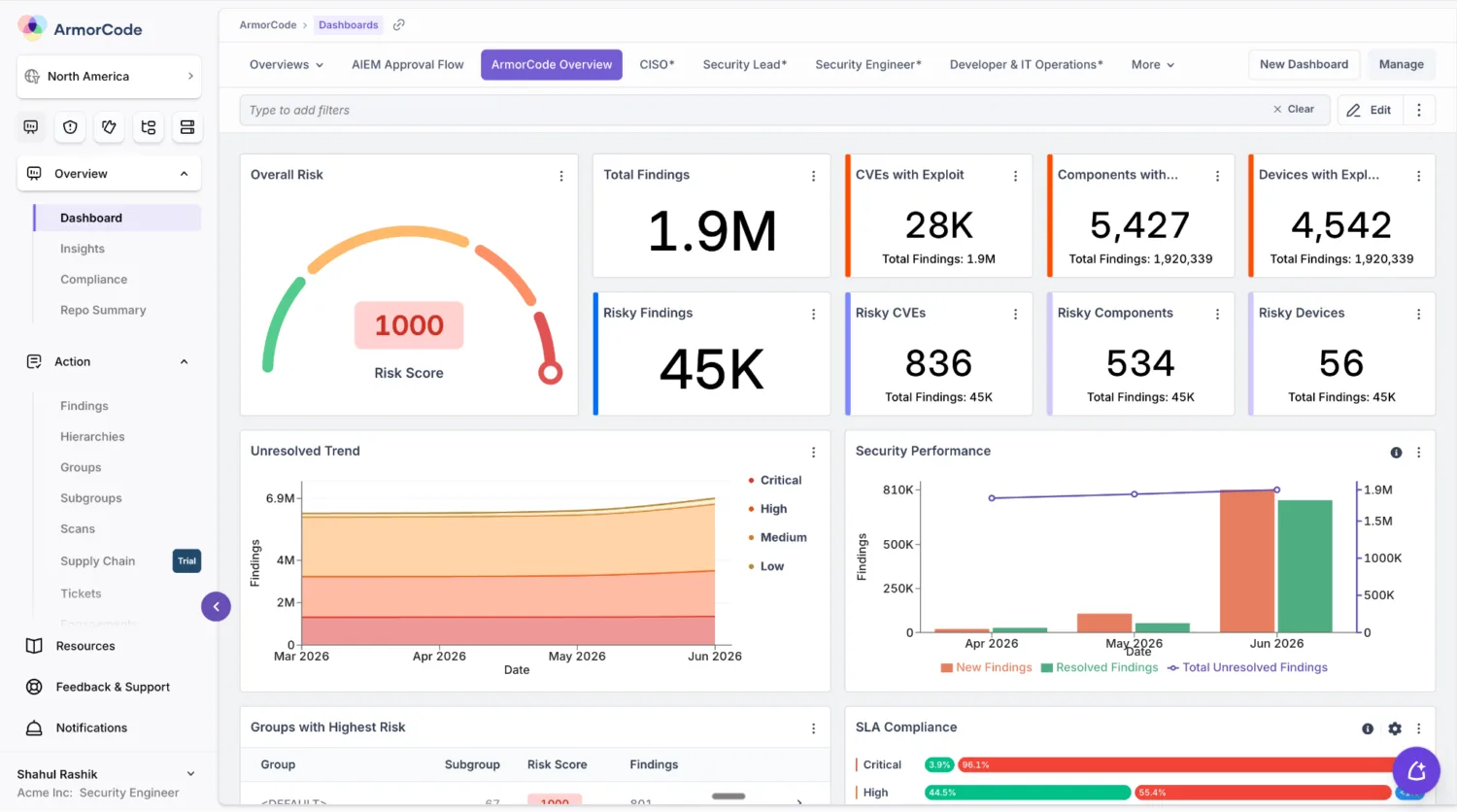
ArmorCode is an independent Agentic Control Plane for Unified Exposure Management that helps enterprises manage security risk across applications, code, cloud, infrastructure, software supply chains, and AI.
ArmorCode provides visibility, insight, and control through four core solution areas: Application Security Posture Management (ASPM), Vulnerability Management, Software Supply Chain Security, and AI Exposure Management (AIEM).
ArmorCode’s scanner-agnostic architecture enables organizations to continue using their existing security tools while gaining a unified view of risk across the enterprise. Processing more than 300 billion security findings annually, ArmorCode helps enterprises consolidate security data, prioritize what matters most, and scale remediation efforts across the organization.
At the core of the platform is the Context Risk Graph, which correlates vulnerability findings with asset inventory, ownership, software supply chain data, threat intelligence, exploitability signals, and business context to create a unified understanding of risk. Built on the Context Risk Graph, Anya Agents turn unified security and business context into purpose-built AI workers. Each agent is configured with predefined prompts, bounded actions, and access to the relevant enterprise context to perform specific security tasks such as vulnerability triage, exposure analysis, remediation guidance, patch orchestration, validation, and compliance.
The platform is trusted by hundreds of global enterprises to reduce risk, improve security governance, scale remediation efforts, and confidently embrace AI and modern software development.
Key Capabilities of ArmorCode vs Nucleus Security Compared
Unified Exposure Management (UEM)
Most enterprises end up with security tools organized the same way their teams are – AppSec owns application scanning, infrastructure teams own network and cloud tools, and AI governance sits somewhere between IT and security. When security systems are organized around siloed teams, different groups end up triaging the same underlying exposures from isolated perspectives, creating fragmented visibility and increasing Mean Time to Resolution (MTTR).
What enterprises need is a Unified Exposure Management platform that can hold the entire exposure surface in one coherent model, reason across it, and drive action. That is what ArmorCode is built to deliver.
As an Agentic Control Plane for Unified Exposure Management, ArmorCode sits above the entire security stack, correlating risk across applications, code repositories, cloud, infrastructure, software supply chains, and AI systems. Security teams understand how individual findings relate to broader exposure scenarios, business risk, and application context rather than evaluating vulnerabilities in isolation. Built on that context, Anya AI agents assist security teams with risk analysis, investigation, prioritization, remediation coordination, and governance workflows.
Nucleus Security approaches exposure management through the lens of risk-based vulnerability management. Its correlation model is asset-centric, which means findings are scored and prioritized within the context of the asset they affect, enriched with threat intelligence and business context, but not mapped across security domains into a connected exposure model.
Application Security Posture Management (ASPM)
ArmorCode’s Application Security Posture Management (ASPM) solution unifies and correlates findings across SAST, DAST, SCA, IaC, API security, cloud security, software supply chain security, and other application security tools into a single, risk-based view. By combining these signals with business context, ownership data, and threat intelligence, ArmorCode helps organizations prioritize and remediate application risk throughout the software development lifecycle. ArmorCode was recognized as a Leader in the IDC MarketScape: Worldwide Application Security Posture Management (ASPM) 2025 Vendor Assessment, validating its capabilities and vision in the ASPM market.
Nucleus Security provides application-level visibility and can aggregate findings from AppSec tools, but its ASPM capabilities are primarily focused on risk aggregation and prioritization. Based on its public positioning, ASPM remains a newer area of focus.
Risk Based Vulnerability Management
ArmorCode plugs right into your existing security stack to bring all your vulnerability data into one unified view. Instead of just ranking issues by generic severity scores, it looks at the bigger picture, combining real-world threat intelligence and active exploit data with your actual business context and asset criticality
To address vulnerabilities that cannot be immediately patched, ArmorCode utilizes patch orchestration and mitigating controls to bridge the gap. This enables security teams to deploy proactive safeguards, such as firewall policies or WAF rules, minimizing the risk of exploitation while a permanent remediation is tested and finalized.
Nucleus applies a multi-dimensional scoring model that considers exploitability, business impact, and exposure context, drawing on EPSS, CISA KEV, and other industry intelligence feeds to move teams beyond CVSS-driven remediation. That correlation, however, stays within the asset layer. Nucleus doesn’t have a cross-domain risk graph, so findings are scored and prioritized within the context of the asset they affect.
Integrations
ArmorCode provides 400+ out-of-the-box integrations spanning application security, cloud security, infrastructure security, software supply chain security, container security, CMDB, CI/CD, ticketing and threat intelligence platforms. For tools that do not have a prebuilt integration, ArmorCode also supports custom connectors, enabling organizations to extend coverage to other sources. This broad integration ecosystem makes ArmorCode well suited for enterprises seeking a vendor-agnostic platform across complex and multi-tool security stacks.
Nucleus Security supports 200+ integrations through its built-in connector library and FlexConnect universal adapter, which allows teams to connect tools that don’t have a native connector. Its integrations span vulnerability scanners, application security tools, cloud security platforms, asset inventories, CMDBs, ticketing systems, and collaboration platforms.
Context Based Risk Prioritization
ArmorCode elevates vulnerability management through context-based prioritization, shifting the focus from theoretical CVSS scores to actual business risk. The platform evaluates asset exposure, data sensitivity, business criticality, exploitability, and threat intelligence to help teams prioritize the exposures that present the greatest organizational risk. This intelligence is powered by ArmorCode’s Context Risk Graph, which correlates security findings, code repositories, cloud resources, network relationships, IAM identities, software supply chain data, and business context into a unified model of organizational risk. Rather than treating vulnerabilities as isolated findings, ArmorCode helps organizations identify exposure chains, understand risk propagation, and prioritize remediation efforts that disrupt the most significant attack paths.
Nucleus Security uses vulnerability severity, asset context, and threat intelligence to prioritize remediation efforts and reduce alert fatigue. Based on publicly available information, Nucleus Security does not offer attack path analysis or vulnerability chaining capabilities.
Software Supply Chain Security
ArmorCode provides dedicated Software Supply Chain Security capabilities, including SBOM visibility, dependency risk analysis, CI/CD posture monitoring, and software supply chain governance. These capabilities help organizations identify, prioritize, and manage risks associated with open-source dependencies, build pipelines, and software delivery processes.
Nucleus Security can ingest and correlate findings from SCA and SBOM tools within its platform. However, based on publicly available documentation, it does not offer a dedicated Software Supply Chain Security solution with native software supply chain governance, product security posture management, or CI/CD supply chain controls.
CI/CD Pipeline Security
ArmorCode allows organizations to define policy-driven security guardrails within CI/CD pipelines. Security controls can be integrated into build workflows as pass/fail criteria, enabling teams to automatically halt releases that violate predefined risk thresholds or security policies. By integrating security controls directly into development workflows, ArmorCode helps organizations reduce the likelihood of high-risk code reaching production
Nucleus Security integrates with CI/CD tools to ingest findings but does not provide native pipeline enforcement or build gating. It is a downstream consumer of CI/CD security data, not a control point within the pipeline itself.
Agentic Framework for Security
ArmorCode provides an Agentic AI framework for security through Anya AI and purpose-built Anya Agents. Anya is an AI-powered security assistant that helps security teams interact with exposure data using natural language. Built on ArmorCode’s Context Risk Graph, Anya enables practitioners to investigate risk, understand exposure context, identify remediation priorities, and retrieve security insights. ArmorCode further extends these capabilities through Anya Agents that support workflows such as risk analysis, prioritization, investigation, and remediation guidance. By leveraging correlated security, asset, application, and business context, these agents help security teams automate repetitive tasks and accelerate risk reduction.
Nucleus does not offer a dedicated agent framework with purpose-built security agents for workflows.
AI Exposure Management
ArmorCode provides a dedicated AI Exposure Management (AIEM) capability that discovers, inventories, and governs AI technologies in use across the organization, including shadow AI deployments that may not be sanctioned by the IT or security team.
Nucleus Security does not offer AI exposure management capabilities. Discovering or governing AI technology usage is outside its scope.
Penetration Test Management
ArmorCode includes a dedicated Penetration Test Management capability that allows organizations to manage penetration testing engagements and findings within the same platform used for exposure management. Nucleus can aggregate and operationalize security findings, but it does not publicly position penetration test management as a dedicated platform capability.
Nucleus can ingest penetration test results alongside other security findings through its connector ecosystem, but does not offer a dedicated penetration test management workflow.
Remediation Intelligence
ArmorCode offers remediation capabilities that help security teams automate workflows, create and track tickets, assign ownership, and coordinate remediation across development, security, and operations teams. ArmorCode also provides AI-driven remediation recommendations through Anya that offers guidance on how to address identified risks.
Nucleus Security also provides remediation orchestration capabilities, enabling teams to automate workflows, create and manage remediation tickets, assign ownership, and track remediation progress across integrated security and IT systems. Nucleus Security further provides AI-powered mitigation guidance through Nucleus Insights, including CVE-level remediation recommendations, MITRE ATT&CK mapping, and threat context.
The key difference is breadth of context. Nucleus Security provides remediation guidance primarily at the vulnerability level, while ArmorCode delivers context-aware remediation recommendations that correlate application, code, cloud, software supply chain, business, and exposure data.
Why Organizations Choose ArmorCode
Context Risk Graph
ArmorCode’s Context Risk Graph continuously correlates security findings, code repositories, cloud infrastructure, network relationships, IAM identities, software supply chain data, and business ownership context into a single unified model. The differentiator is that ArmorCode correlates across security domains and business context, while Nucleus correlates within the vulnerability management layer.
For example, a low-severity finding in an open-source dependency, correlated with a misconfigured cloud resource and an overprivileged identity, can surface as a critical exposure path that neither finding would reveal in isolation. This is the foundation for ArmorCode’s attack path analysis and vulnerability chaining capabilities, connecting dots that asset-level correlation alone cannot reach.
Practitioner-Led Community
ArmorCode helps power the Purple Book Community, a global network of more than 1,000 CISOs, AppSec leaders, security practitioners, researchers, and academics focused on advancing software security. The community provides a forum to compare notes on what’s actually working in their programs, work through emerging challenges together, and share guidance that holds up in practice. ArmorCode also collaborates with members on industry research, including reports such as the State of AI Risk Management 2026, which explores how enterprise security leaders are approaching application security, exposure management, and AI governance.
Agentic AI Architecture
ArmorCode offers an Agentic Control Plane for Unified Exposure Management powered by Anya AI and Anya Agents.
Anya AI is an intelligent security assistant that enables teams to investigate risk, understand exposure context, and get insights using natural language interactions. The platform also delivers role-aware insights tailored to different stakeholders. CISOs can gain visibility into business risk, policy posture, and organizational exposure trends, while AppSec leaders, security teams, engineers, and developers can focus on operational priorities, remediation workflows, and application-specific risk.
ArmorCode has further expanded this capability through Anya Agents, which are designed to automate specific security workflows such as risk analysis, prioritization, investigation, and operational tasks.
Built on ArmorCode’s Context Risk Graph, Anya Agents leverage correlated security and business context from security tools, asset inventories, software supply chain data, vulnerability intelligence, threat intelligence sources, and organizational metadata. This enables the agents to perform security tasks with a deeper understanding of how individual findings relate to applications, assets, business services, and overall organizational exposure.
Together, Anya AI and Anya Agents form the foundation of ArmorCode’s Agentic AI Architecture, helping organizations scale security operations, reduce manual effort, and accelerate risk reduction.
Proven at Enterprise Scale
ArmorCode’s platform is used by hundreds of large enterprises operating complex application and infrastructure environments across financial services, healthcare, technology and retail. Publicly referenced customers include Visa, PayPal, Carrier, Universal Music Group, S&P Global, Johnson Controls, and Fortinet, along with many other Fortune 2000 organizations.
ArmorCode vs. Nucleus Security: Feature Comparison Table
| Feature | ArmorCode | Nucleus Security |
| Scanner Agnostic | Yes | Yes |
| Unified Exposure Management Solution | Yes | Limited |
| ASPM Solution | Yes | Limited |
| Product Security Posture Management Solution | Yes | No Evidence |
| Software Supply Chain Security Solution | Yes | Limited |
| AI Exposure Management Solution | Yes | No Evidence |
| Integrations | 400 | 200 |
| CI/CD Pipeline Security | Yes | No Evidence |
| Penetration Test Management | Yes | No Evidence |
| Agentic Control Plane | Yes | No Evidence |
| Risk Prioritization (Beyond CVSS) | Yes | Yes |
| CVSS Environmental Rescoring | Yes | No Evidence |
| Threat Intelligence Feed | Yes | Yes |
| Compliance Mapping | Yes | Yes |
| Automated Workflows | Yes | Yes |
| Remediation Orchestration | Yes | Yes |
| AI Generated Code Fix | Yes | No Evidence |
| Patch Orchestration | Yes | No Evidence |
| Compensating Controls | Yes | No Evidence |
| Dashboards and Reporting | Yes | Yes |
Guide for choosing between ArmorCode and Nucleus Security
ArmorCode and Nucleus Security both help organizations centralize security findings, prioritize risk, and improve remediation outcomes. The right choice depends on where your security program is today and which operational challenges you are trying to solve.
Organizations that view exposure management primarily as a vulnerability management discipline may find Nucleus Security aligns well with their requirements. It helps teams consolidate scanner data across assets, prioritize by exploit risk, and push remediation tasks to IT and engineering.
However, many security teams are now facing challenges that extend beyond vulnerability management. Modern security programs must govern software supply chains, secure cloud-native applications, manage AI-related risks, correlate findings across disparate security tools, and integrate security controls directly into development workflows. These requirements demand broader visibility and deeper context than vulnerability management platforms were originally designed to provide.
Organizations seeking that broader security operating model will likely find ArmorCode’s platform vision more closely aligned with the direction of modern security programs. Its focus on Unified Exposure Management, application-centric risk context, Agentic AI Framework, and scanner-agnostic architecture positions it as a platform designed not only for today’s exposure management challenges, but also for the evolving security requirements of the future.
ArmorCode is often the stronger choice for organizations looking to unify application security, cloud security, infrastructure security, software supply chain security, and AI exposure management within a single platform. Its application-centric approach helps teams understand how vulnerabilities, misconfigurations, dependency risks, and AI exposures relate to business-critical applications rather than evaluating findings in isolation.
Want to see ArmorCode in action? Request a demo to see how ArmorCode can help your team reduce risk, prioritize critical exposures, and streamline remediation.
Prefer to explore on your own? Take an interactive product tour of the ArmorCode platform.
Frequently Asked Questions: ArmorCode vs Nucleus Security
Q: What is the difference between ArmorCode and Nucleus Security?
A: ArmorCode is a strong choice for organizations seeking a unified platform for managing security risk across applications, code, infrastructure, supply chain, cloud and AI.
Broader Platform Coverage: ArmorCode combines Application Security Posture Management (ASPM), Unified Exposure Management, Software Supply Chain Security, AI Exposure Management (AIEM), and Vulnerability Management in a single platform. Nucleus Security remains primarily focused on vulnerability management and exposure management, with more limited ASPM capabilities.
CI/CD Security Enforcement: ArmorCode enables policy-based guardrails and build gating within CI/CD pipelines. Nucleus integrates with CI/CD tools but does not publicly claim to have build-gating capabilities.
AI Exposure Management: ArmorCode provides AIEM capabilities to discover, inventory, and govern enterprise AI usage, including shadow AI. Nucleus Security does not publicly position itself as an AI Exposure Management platform.
Software Supply Chain Security: ArmorCode includes dedicated capabilities for SBOM management, dependency risk visibility, and CI/CD supply chain posture management. Nucleus Security can ingest and prioritize findings from SCA and SBOM tools, but it does not offer a dedicated Software Supply Chain Security solution.
Application-Centric Governance: ArmorCode correlates risk across applications, code repositories, cloud environments, infrastructure, and development workflows, helping organizations manage risk throughout the software development lifecycle. Nucleus Security is primarily positioned as a risk-based vulnerability management and exposure management platform.
Q: Does Nucleus Security support CI/CD pipeline security?
A: Nucleus Security integrates with CI/CD tools to ingest security findings but does not provide native pipeline enforcement or build gating. It cannot automatically pass or fail a build based on security policy violations. ArmorCode supports CI/CD governance and guardrails, including the ability to enforce security policies that can pass or fail builds and gate releases based on defined security thresholds.
Q: Is ArmorCode a good alternative to Nucleus Security?
A: Yes. ArmorCode is a strong alternative to Nucleus Security. Both platforms help security teams aggregate findings, prioritize risk, automate remediation workflows, and integrate with existing security tools through scanner-agnostic architectures.
However, ArmorCode extends beyond vulnerability management by providing Application Security Posture Management (ASPM), AI Exposure Management (AIEM), Software Supply Chain Security, CI/CD security guardrails, and application-centric risk governance within a unified platform. This makes ArmorCode a compelling choice for enterprises seeking broader visibility, stronger DevSecOps integration, and a more comprehensive approach to managing security risk.
Q: What are the top alternatives to Nucleus Security?
A: Organizations evaluating alternatives to Nucleus Security often consider ArmorCode, Brinqa, Vulcan Cyber (Tenable), and ServiceNow Vulnerability Response. Among these options, ArmorCode stands out for organizations seeking a Unified Exposure Management platform that can unify, prioritize, and help remediate risk across applications, code, cloud environments, infrastructure, software supply chains, and AI systems. ArmorCode is also scanner-agnostic by design, allowing organizations to continue using their preferred security tools while centralizing risk management within a single platform.
Note:
This comparison is based on publicly available sources, including vendor websites, press releases and third-party review platforms. Feature classifications reflect the depth and native availability of capabilities within each platform at the time of writing. Vendor offerings evolve over time, and we cannot guarantee the ongoing accuracy of this information.
If you notice any inaccuracies or have updated information, please contact us.