What is Software Supply Chain Security (SSCS) and SBOM?
Software supply chain attacks are surging in 2026. Here’s what SSCS and SBOM actually mean, how they relate, and what it takes to protect your dependencies and CI/CD pipeline from compromise.
Table of Contents
What is Software Supply Chain Security (SSCS)?
The software you run today is rarely the work of one team. It’s assembled from open source libraries, third-party packages, container images, CI/CD tooling, and increasingly, code suggested by AI coding assistants, each sourced from somewhere outside your organization and maintained, or not, by someone you’ve never met. This whole process of sourcing, building, and shipping software is the software supply chain.
Like a physical supply chain, it’s only as strong as its weakest link. Software Supply Chain Security (SSCS) is the set of practices, tools, and controls that protect that chain end to end, from the first line of code a developer writes to the artifact a customer eventually runs. It covers the code, the people and processes that touch it, and the systems that build, sign, and ship it, with one goal: catching a compromised, vulnerable, or untrustworthy component before it reaches production.
Why are Software Supply Chain Attacks on the Rise?
Three forces are driving the surge.
The volume of third-party code has exploded. Most applications are now made up of 70 to 90% open source and third-party components, and each of those components pulls in its own dependencies, so a single library can quietly introduce dozens more into your environment. Sonatype’s 2026 State of the Software Supply Chain report found more than 454,600 new malicious open source packages across npm, PyPI, Maven, NuGet, and Hugging Face in 2025 alone, a 75% jump year over year, pushing the cumulative total of known malicious packages past 1.23 million.
AI-assisted development has opened a new attack surface. Large language models used for code generation regularly recommend packages that don’t exist, a problem researchers now call slopsquatting. One study of 576,000 AI-generated code samples found that roughly a fifth of the recommended packages were hallucinated. Attackers register those exact names in advance, so the next developer, or the next autonomous coding agent, installs their malware instead of a real library.
Attackers have also shifted from broad-based, opportunistic attacks to targeting the supply chain directly. In March 2026, a single compromised maintainer account turned axios, a JavaScript library with roughly 100 million downloads a week, into a malware delivery vector for several hours. Around the same time, researchers identified Shai-Hulud, the first self-replicating npm malware, which spreads automatically from one compromised package to the next with no further action from the attacker. Malicious code no longer has to reach you directly. It only has to reach something you depend on.
Why is Software Supply Chain Security Important?
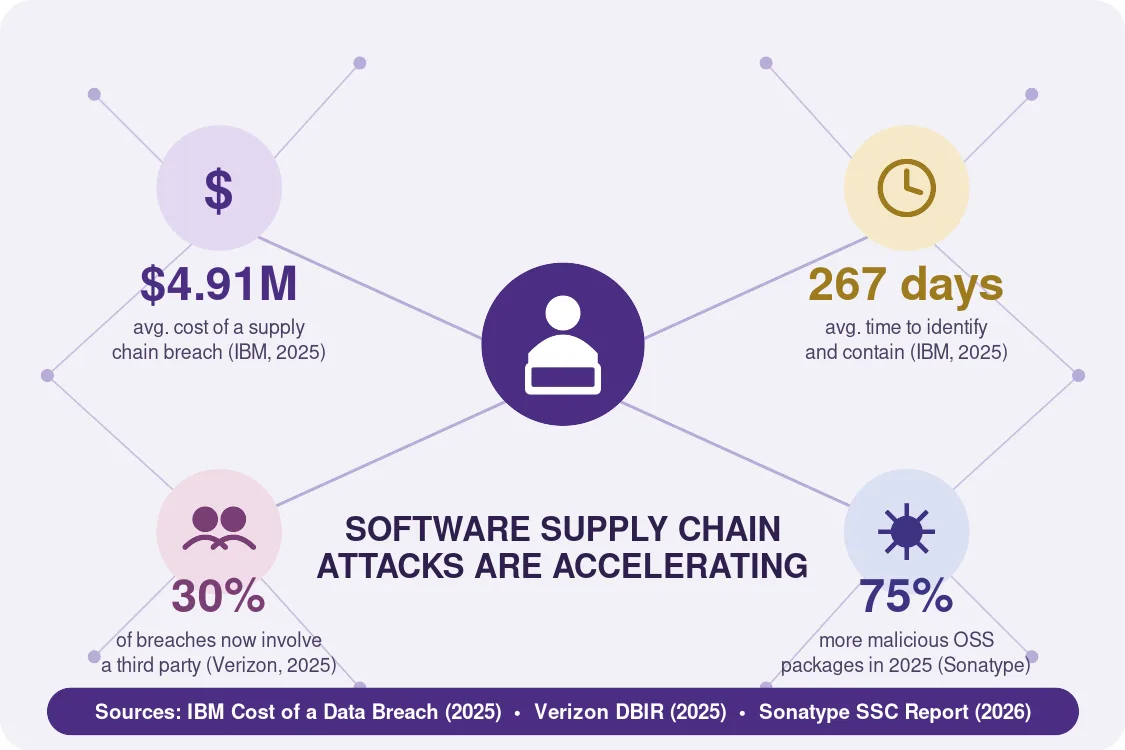
Software supply chain security works like a fortress: the whole structure is only as strong as its weakest point. You have to trust the components that make up your software, but verifying their authenticity and integrity, especially when they come from outside your organization, is hard, and attackers exploit that trust to slip in undetected.
The financial case is no longer theoretical. IBM’s 2025 Cost of a Data Breach report puts the average cost of a supply chain compromise at $4.91 million, with an average of 267 days to identify and contain it, the longest lifecycle of any breach type the report tracks. Verizon’s 2025 Data Breach Investigations Report found that third-party involvement in breaches doubled from 15% to 30% in a single year, the largest single-year jump on record.
High-profile incidents like Log4j, SolarWinds, MOVEit, and the more recent axios and Shai-Hulud attacks show what happens when supply chain security is an afterthought. Log4j alone affected an estimated 35% of organizations worldwide, and the SolarWinds compromise reached more than 18,000 customers, proof that a single vulnerable component can cascade across an entire ecosystem. A single compromised component can give attackers a foothold to steal data, disrupt operations, or move laterally across every application that depends on it. There’s regulatory exposure too: the EU Cyber Resilience Act requires vulnerability reporting starting September 2026 and mandatory SBOMs by December 2027, with fines of up to 15 million euros for noncompliance.
Prioritizing software supply chain security protects customer data and trust, shortens the runway of a costly incident, and keeps you ahead of a regulatory landscape that is only getting stricter.
What are Software Supply Chain Risks and Threats?
Software supply chains are complex and interconnected, which makes them vulnerable to a wide range of threats. The most common ones today include:
- Compromised third-party code: malicious or backdoored code introduced through a trusted library, package, or component, often without the maintainer’s knowledge.
- Typosquatting and dependency confusion: attackers publish packages with names nearly identical to popular ones, or exploit misconfigured package managers so a build pulls from a public registry instead of an internal one.
- Slopsquatting: AI coding assistants sometimes recommend packages that don’t exist. Attackers pre-register those exact names with malicious code, waiting for a developer or an autonomous coding agent to install them.
- Insecure CI/CD pipelines and build systems: weak CI/CD security lets attackers compromise build servers or pipelines and tamper with software before it ever ships.
- Container security gaps: outdated base images, exposed secrets, or unscanned container registries that let a vulnerability ride along into every workload built from that image.
- Open source vulnerabilities: unpatched, unmaintained, or end-of-life dependencies that carry known, exploitable flaws.
- Self-replicating supply chain malware: worm-like packages, such as Shai-Hulud, that spread automatically once a single dependency is compromised, with no further action required from the attacker.
- Social engineering: tricking a maintainer or employee into handing over publishing credentials or build system access.
- Weak authentication and authorization: insufficient controls over who can publish, modify, or approve software packages.
- Lack of visibility: no reliable inventory of what components are in use, where they’re used, or how they got there in the first place.
Understanding these risks is the first step. The next is building the practices that catch them before they reach production.
Software Supply Chain Security Best Practices
Improving SSCS takes a layered approach: internal controls, vendor oversight, and increasingly, verification of anything AI helped write.
Vendor Risk Management
Third-party risk starts before a vendor’s code ever touches your environment.
- Rigorous assessment: before onboarding a vendor, assess their development practices, security controls, and known vulnerabilities. Certifications like SOC 2 or ISO 27001 are a useful signal, not a guarantee.
- Security questionnaires: ask vendors directly about their SDLC practices and how they handle and disclose vulnerabilities.
- Continuous monitoring: move past one-time checks. Monitor your environment and CI/CD pipeline continuously so you can spot the impact of a newly disclosed vulnerability right away.
- SBOM and VEX: maintain a Software Bill of Materials, in a standard format like CycloneDX or SPDX, for every application, and pair it with VEX (Vulnerability Exploitability eXchange) data so you know not just what’s in your software, but whether a given vulnerability actually affects you.
Internal Security Measures
- Least privilege: grant users and software only the access they need. It limits the damage if a compromised component is exploited.
- Secure coding practices: train developers on secure coding, and treat AI-suggested dependencies with the same scrutiny as a stranger’s pull request. Verify the package exists, check who publishes it, and confirm it wasn’t registered last week.
- DevSecOps integration: involve security teams early and test code and dependencies continuously throughout the development lifecycle, not just before release.
- Patch and lifecycle management: keep systems and third-party components current with security patches, and track which components are approaching end of life. An unsupported dependency stops receiving patches long before a new CVE ever gets published against it.
Other Important Strategies
- Digitally sign your software releases and verify signatures before installing updates.
- Track license terms across your open source dependencies. A restrictive or incompatible license can create legal exposure long after the code ships.
- Stay current on emerging attack techniques, including slopsquatting and dependency confusion, through threat intelligence feeds and industry groups.
- Benchmark your program against established frameworks, such as NIST’s Secure Software Development Framework (SSDF) and OWASP’s Top 10 CI/CD Security Risks, and align your SBOM practices with CISA guidance on SBOM minimum elements.
- Disable arbitrary install scripts from open source packages where possible.
- Build a dedicated incident response process for supply chain specific incidents.
Vendor collaboration matters as much as internal controls. Set security expectations early, share vulnerability information in both directions, and treat supply chain security as a continuous practice rather than a project with an end date.
SSCS with AppSec and DevSecOps
Software Supply Chain Security, Application Security (AppSec), Software Composition Analysis (SCA), and DevSecOps solve overlapping but distinct problems, and building secure software takes all of them.
SSCS protects the entire software development ecosystem, from code repositories to deployment environments, covering both internally developed code and every third-party dependency it relies on. AppSec focuses on the application itself: code review, SAST, DAST, and other testing practices that help developers ship secure code and a secure runtime environment. Software Composition Analysis (SCA) is narrower still: it identifies open source components in your code and flags their known vulnerabilities. SSCS builds on SCA’s output by adding SBOM and VEX management, CI/CD pipeline and container security, and license and maintainer risk that SCA alone doesn’t cover. DevSecOps is the connective tissue between development, security, and operations, embedding security checks throughout the CI/CD pipeline instead of bolting them on right before release.
Together, these three disciplines create a security posture that covers your own code, the components you depend on, and the pipeline that ships both.
Automate Software Supply Chain Security
Manual software supply chain security is a losing battle against a threat that moves in minutes, not months. Automation is what makes consistent protection possible at scale.
The core loop looks like this: ingest and enrich your SBOMs continuously, so every component is checked against known vulnerabilities, license terms, and maintenance signals such as the OpenSSF Scorecard. Correlate that data with business context and threat intelligence, such as CISA’s Known Exploited Vulnerabilities (KEV) catalog and EPSS (Exploit Prediction Scoring System) scores, so a vulnerability actively exploited in the wild on a customer-facing application gets prioritized ahead of a theoretical one in an internal tool. This is the difference between dependency management as a compliance checkbox and dependency management as a real risk-reduction practice. And when a new CVE or malicious package makes headlines, automatically check whether you’re affected instead of waiting for a scheduled scan or manually searching through advisories.
Increasingly, that last step is handled by AI agents purpose-built for security workflows: pulling threat intelligence, checking supply chain exposure, and generating an impact report in the time it used to take a team to even confirm the question was worth asking. Automating this loop turns supply chain security from a reactive scramble into a standing capability.
Software Supply Chain Security with ArmorCode
ArmorCode’s Software Supply Chain Security module gives security teams one enriched view of every component they depend on, open source, third-party, and in-house, so they can move from finding supply chain risk to fixing it.
Every component is enriched with CVEs, maintenance signals, license data, and OpenSSF Scorecard trust signals, so teams can tell an actively maintained project from an abandoned one before it becomes a liability. ArmorCode integrates with 400+ security tools, ingesting SBOMs from every scanner and repository in your environment and synthesizing them into a single, application-level SBOM with embedded VEX data, ready to share with customers, auditors, and regulators under frameworks like FedRAMP, ISO 27001, SOC 2, and the EU Cyber Resilience Act. Components approaching end of life get flagged automatically, before they lose patch support and become exploitable.
Risk gets scored by business impact and real-world exploitability, including CISA KEV status and EPSS scores, not just CVSS. Processing more than 400 billion findings annually across customer environments, ArmorCode’s Context Risk Graph surfaces the small fraction of vulnerabilities that represent the majority of real business risk, so a vulnerable library in an internal tool is weighed differently than the same library in a customer-facing application, and remediation effort goes where it actually matters. And when a new zero-day or malicious package hits the headlines, Anya’s Zero-Day Exposure Hunting Agent can tell you in seconds whether you’re affected, pulling threat intelligence, checking your supply chain exposure, and identifying impacted applications and owners without waiting on a scheduled scan.
Improve MTTR, reduce manual effort, and strengthen your security posture with Software Supply Chain Security in ArmorCode’s Unified Exposure Management platform. Schedule a demo to see it in action.
Frequently Asked Questions
What is the difference between SSCS and SCA (Software Composition Analysis)?
SCA tools identify the open source components in your code and flag known vulnerabilities. SSCS is broader: it includes SCA, but also covers CI/CD pipeline security, SBOM and VEX management, license risk, maintainer trustworthiness, and the build and distribution infrastructure that SCA alone doesn’t touch.
What is an SBOM, and do I actually need one?
A Software Bill of Materials is a machine-readable inventory of every component in an application, direct and transitive. You need one if you sell into regulated industries or the public sector, and increasingly you’ll need one regardless: CISA publishes guidance on SBOM minimum elements for U.S. federal suppliers, and the EU Cyber Resilience Act makes SBOMs mandatory for software sold in Europe starting December 2027.
What is VEX, and how does it relate to an SBOM?
VEX (Vulnerability Exploitability eXchange) is a companion document to an SBOM that states whether a known vulnerability in a component actually affects your product. An SBOM tells you what’s in your software; VEX tells you whether it matters.
Is SSCS the same thing as ASPM?
They overlap but aren’t the same. Application Security Posture Management (ASPM) focuses on aggregating and prioritizing findings across your application security tools. SSCS is specifically about the components, dependencies, and build pipeline that make up your software, and increasingly stands on its own as organizations need dedicated SBOM, VEX, and dependency risk capabilities that go beyond what a general ASPM tool provides.