
A ServiceNow Alternative
for Unified Exposure Management
Evaluating ServiceNow Vulnerability Response (VR) or a move to Unified Security Exposure Management (USEM)? Consider ArmorCode before you invest in the transition.
ArmorCode is the independent, agentic control plane that unifies findings, prioritizes risk, and coordinates remediation across applications, infrastructure, cloud, software supply chains, and AI. Reduce noise and accelerate remediation while keeping ServiceNow for CMDB, ITSM, and enterprise workflows.
Trusted by leading enterprises




















LIMITED TIME OFFER
Get 3 Years of ArmorCode for the Price of 2
Eligible ServiceNow VR customers can get a 3-year ArmorCode subscription at the cost of 2.
Before you migrate to USEM, rethink your security architecture
ServiceNow is moving VR customers to its Unified Security Exposure Management (USEM) architecture ahead of their next platform release. The transition involves changes to data models, integrations, workflows, and plugins.
For teams already dealing with the operational complexity of VR, this migration is a natural moment to ask a different question: what if the intelligence, correlation, and prioritization layer sat above ServiceNow, while ServiceNow continued to handle CMDB, ITSM, and enterprise workflows?
Give your team fewer findings to chase
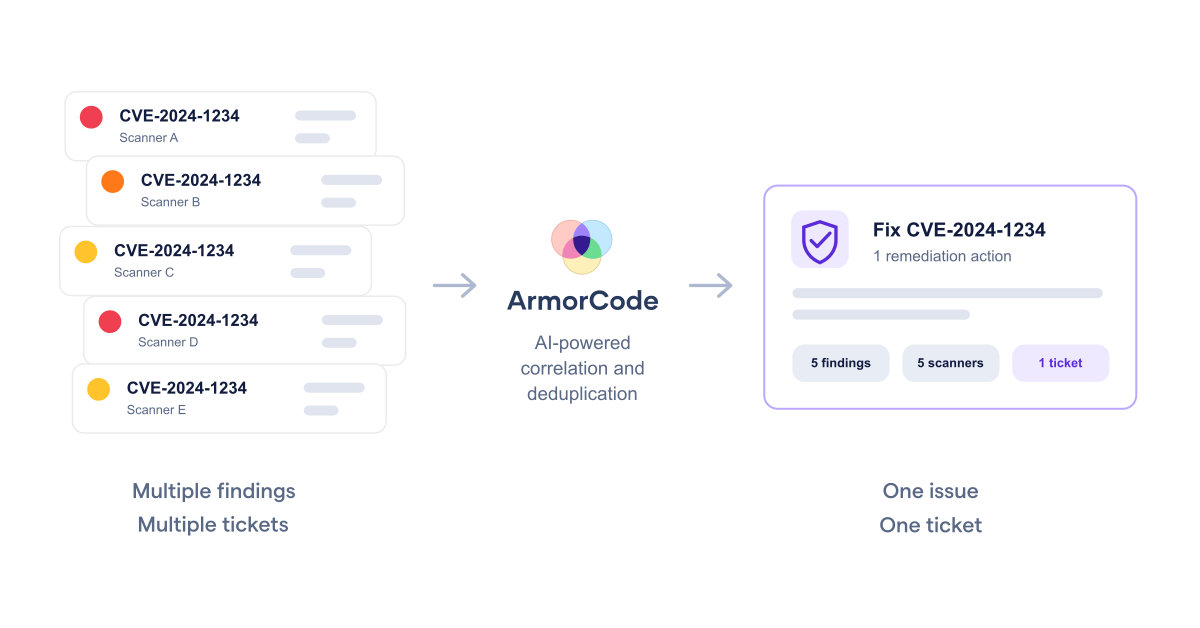
ArmorCode uses AI-powered correlation and deduplication to recognize when multiple findings point to the same underlying issue, grouping them into a single remediation action that the team can actually work on. This cuts down on duplicate tickets and noisy findings, so security and engineering teams have a smaller backlog to manage.

Trace risk from code to cloud
ArmorCode connects vulnerabilities across the different tools and environments in your stack. It can correlate findings across applications, cloud environments, containers, and infrastructure to help teams understand where a risk originated, which assets are affected, and who owns the fix. This gives security teams a clearer path from the initial finding to the root cause and the team responsible for fixing it.
Shorten the path from finding to fix
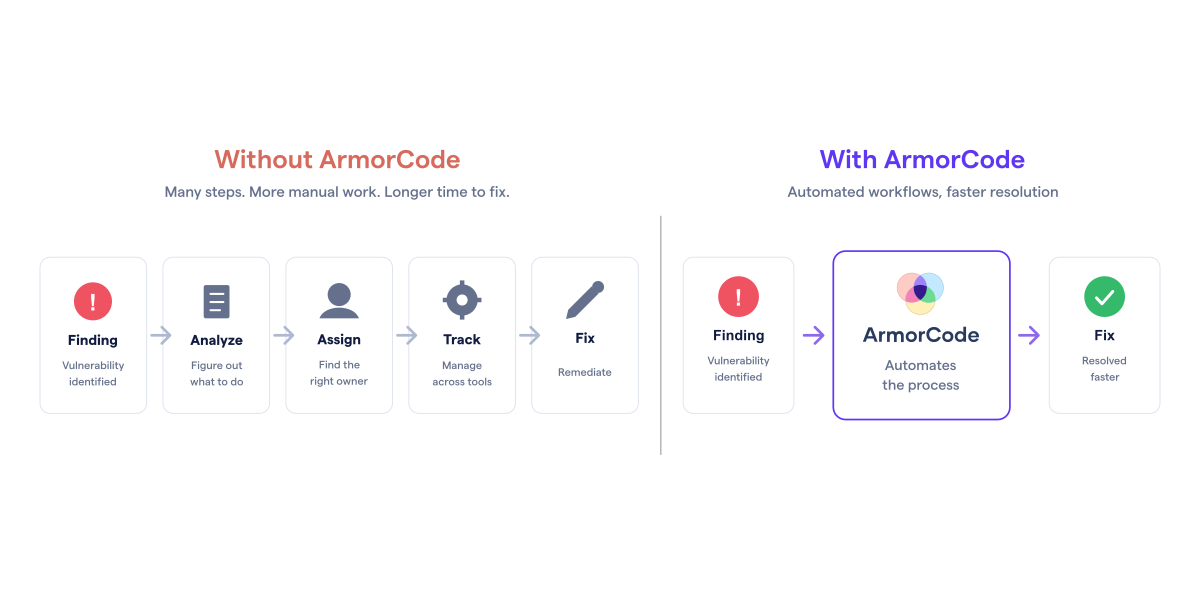
Once a vulnerability needs action, ArmorCode helps move it toward resolution faster. Automated remediation workflows can determine the appropriate action, assign ownership, and orchestrate the fix across the tools and teams involved. The result is less time spent moving vulnerabilities through manual processes and a shorter time from finding to fix.
Loved by security teams
ArmorCode
Gartner Peer Insights
ServiceNow VR
Gartner Peer Insights
ServiceNow Alternative: ArmorCode vs. ServiceNow
| ArmorCode | ServiceNow | |
| Exposure Management Platform | ✓ Yes | ✓ Yes |
| Application Security Posture Management | ✓ Yes | Limited |
| Software Supply Chain Security (SSCS) | ✓ Yes | Limited |
| Scanner-Agnostic | ✓ Yes | No |
| Integrations | 400+ | Not Public |
| Native AI-Powered Correlation | ✓ Yes | Limited |
| Risk Prioritization (Beyond CVSS) | ✓ Yes | ✓ Yes |
| Attack Path Analysis | ✓ Yes | Limited |
| Code-to-Cloud Risk Correlation | ✓ Yes | Limited |
| Scoped Pull Requests | ✓ Yes | No |
| Dashboards and Reporting | ✓ Yes | Limited |
| Automated Remediation Workflows | ✓ Yes | ✓ Yes |
“Without ArmorCode, we would not be able to do what we are doing today. The impact is huge. We have reduced our critical security tech debt by 80%. We are able to automate the creation of grouped tickets in Jira, and we are seeing teams fixing issues because they have that visibility. They see those tickets on their boards, plan remediation, and work on them to resolve the issues and close those tickets.”
Gusti Benawi,
Manager · Application Security · Shutterfly · Inc.
“ArmorCode is an excellent Exposure Assessment Platform! [ArmorCode] has completely transformed our security operations. By unifying dozens of disconnected scanning tools into a single, vendor-agnostic control plane, the platform has provided us with visibility across our entire software and infrastructure ecosystem.”
Gartner Peer Insights,
Engineering Manager · $250M Software Enterprise
“ArmorCode stands out as a distinctive platform that seamlessly connects applications, cloud infrastructure, and intelligence feeds. It functions as a technology designed to integrate various tools effectively.”
Mithun Rajoor,
Global Head of Application & Infrastructure Security (AIS) · S&P Global
“ArmorCode is like a team’s memory—it remembers all the findings, displays things in a format that lets you address the most critical issues, and eases communication with other teams like developers and their leads.”
Paolo del Mundo,
Director of Application Security · The Motley Fool
Proven outcomes with ArmorCode
Reduction in critical security technical debt
Reduction in MTTR with AI-powered remediation guidance
Reduction in open vulnerabilities
240d→hours
Reduced remediation time with automated workflows and risk-based prioritization
Why are teams switching from ServiceNow to ArmorCode?
Security data can become a platform workload
ServiceNow VR is fundamentally built on an ITSM ticketing framework. Ingesting tens of millions of raw, un-deduplicated scanner findings into ServiceNow VR routinely causes database bloat, slow database queries, and platform performance lags.
Limited cross-tool correlation can create duplicate work
Ingesting raw scanner data directly into ServiceNow VR creates millions of individual Vulnerable Items (VITs), flooding operational queues with redundant tickets for the exact same underlying vulnerability.
Security context is tied to CMDB accuracy
ServiceNow relies heavily on CMDB data to connect vulnerabilities with assets and business context. When CMDB records are incomplete, stale, or inconsistent with scanner data, establishing the right security context becomes harder.
Security teams are stuck waiting on IT
ServiceNow VR requires ongoing administration of assignment rules, risk calculators, exception rules, integrations, and other platform configurations. In organizations where ServiceNow is owned by a separate IT team, security teams can become dependent on specialized administrators for changes to their own security workflows.
Security workflows shouldn’t be trapped in the ITSM platform
ServiceNow provides the system of action for vulnerability remediation, but engineering teams often work in Jira, Rally, GitHub, and other developer tools. Routing security work across these environments can introduce additional workflow steps, duplicated records, and fragmented remediation processes.
VR to USEM is a complex migration project
ServiceNow requires customers to plan and run the migration across environments, review existing customizations, resolve conflicts or skipped changes, validate integrations and migration rules, and perform regression testing before production. ServiceNow recommends running the migration in a non-production environment first.
Getting started is simple
Connect your tools
Connect your existing security stack with 400+ integrations, including ServiceNow CMDB and ITSM.
See your risks
ArmorCode automatically ingests, normalizes, correlates, and prioritizes findings across your security stack.
Start fixing
Send prioritized, deduplicated, context-rich findings directly into ServiceNow for remediation, while keeping existing Jira, GitHub, and engineering workflows intact.