EU Cyber Resilience Act News Today: Your 2026 Compliance Summary


Cyber Resilience Act (CRA) compliance is not a 2027 problem. Security and product teams that treated the CRA as a distant deadline now have a hard date on the calendar: September 11, 2026. That’s when mandatory vulnerability and incident reporting kicks in, months before the rest of the regulation takes full effect.
If you’re searching for EU Cyber Resilience Act news today, this is the update that matters: the regulation isn’t waiting for anyone to finish their SBOM program or hire a compliance lead. Manufacturers, software vendors, and anyone shipping products with digital elements into the EU need a working Cyber Resilience Act summary now, not a theoretical one for next year. This piece breaks down what the law actually requires, what changes on September 11, and how ArmorCode helps teams meet the reporting clock without burning out their security staff.
What is the European Cyber Resilience Act? A Brief Overview
The European Cyber Resilience Act (CRA), formally Regulation (EU) 2024/2847, is the first horizontal EU law that sets binding cybersecurity requirements across nearly every category of connected product sold into the bloc. It entered into force on December 10, 2024, and covers what the regulation calls “products with digital elements,” a definition broad enough to include software, IoT devices, industrial control systems, and networked hardware of almost any kind.
Scope is the part people underestimate. The CRA doesn’t care where your headquarters sit. If your product reaches an EU customer, you’re a manufacturer under the law, and the Cyber Resilience Act requirements apply to you the same way they’d apply to a company based in Berlin. That includes vulnerability handling, secure-by-design obligations, technical documentation, and CE marking tied to cybersecurity rather than just physical safety. For any company running a global go-to-market motion, “we’re a US company” is not an exemption clause.
The Cyber Resilience Act Timeline: Key Dates for 2026 and Beyond
Two dates matter here, and conflating them is the single most common mistake teams make. Full application of the CRA, covering essential requirements, conformity assessment, and CE marking, arrives on December 11, 2027. That’s the date most compliance roadmaps are built around, and it’s still the finish line for the regulation as a whole.
But it’s not the first checkpoint. That distinction belongs to September 11, 2026. On that day, the CRA’s vulnerability reporting obligations go live, more than a year ahead of full enforcement. Manufacturers who become aware of an actively exploited vulnerability or a severe incident in a product already on the EU market have to report it, through ENISA’s Single Reporting Platform, to the relevant national CSIRT and to ENISA itself. This applies to legacy products shipped years ago, not just new launches.
The EU Cyber Resilience Act effective date for reporting isn’t a soft deadline you can absorb with a policy update. It requires infrastructure: a way to detect that a vulnerability is being actively exploited, a way to know which products and components are affected, and a workflow that can produce a report inside the mandated window. Teams that wait until 2027 to build that infrastructure will be building it under a live deadline instead of ahead of one.
Critical Cyber Resilience Act Compliance Requirements
The CRA’s essential requirements cover the full product lifecycle rather than a point-in-time check. Products need secure-by-default configuration, no hard-coded credentials, a minimized attack surface, and documented processes for handling vulnerabilities from the design phase through decommissioning. None of this is optional guidance. It’s the baseline for placing a product on the EU market at all.
The EU Cyber Resilience Act SBOM requirement sits at the center of this. Manufacturers have to produce and maintain a software bill of materials identifying the components inside their products, including open source dependencies. The formal SBOM mandate falls under the December 2027 deadline, but the practical need for it arrives earlier. You cannot meet the September 2026 reporting obligation without already knowing what’s in your software. If a vulnerability surfaces in a library three layers deep in your dependency tree, you need to know that instantly, not after a week of manual investigation. SBOM readiness on paper may be a 2027 milestone, but building the underlying visibility is what gets you through 2026.
This is where Cyber Resilience Act compliance stops being a documentation exercise and starts being an operational one. Most security programs are still built around periodic scanning and reactive patching: something breaks, someone opens a ticket, a team eventually gets to it. The CRA assumes continuous, real-time visibility into your exposure instead. That’s a different operating model, and organizations that don’t shift toward it before the deadline will find out the hard way that quarterly vulnerability reviews don’t satisfy a 24-hour reporting clock.
The 24-Hour Rule: Navigating CRA Vulnerability Disclosure
Here’s the requirement that keeps security leaders up at night. Once a manufacturer becomes aware that a vulnerability in one of its products is being actively exploited, it has 24 hours to submit an early warning, followed by a more detailed notification within 72 hours, and a final report within 14 days of a fix. The clock starts the moment you have actual knowledge, not the moment you finish confirming it internally.
Cyber Resilience Act vulnerability management under this rule is a different discipline than most teams have practiced. Twenty-four hours sounds workable until you map out what actually has to happen inside that window: identify the vulnerability, confirm it’s being actively exploited rather than just theoretically exploitable, determine which products and versions are affected, pull together the technical detail the report requires, and route it through the right internal approvals before it goes to ENISA and the national CSIRT. Do that manually, across a portfolio of products built on hundreds of shared components, and 24 hours evaporates fast.
The problem compounds because this obligation stacks on top of existing reporting duties. NIS2 and GDPR both carry their own notification clocks, and a single security incident can trigger all three simultaneously. Teams that rely on spreadsheets, email threads, and tribal knowledge to track exposure will not clear this bar consistently. The organizations that will are the ones that have already unified their vulnerability data across scanners, cloud environments, and application layers into a single source of truth, so the 24-hour clock starts with information already in hand rather than a scramble to gather it.
How ArmorCode Accelerates Cyber Resilience Act Readiness
This is precisely the gap the ArmorCode Agentic Control Plane is built to close. Rather than bolting a CRA module onto a generic GRC tool or relying on an SBOM point solution that stops at inventory, ArmorCode models the CRA’s core artifacts natively, on top of the same risk context that already powers exposure management across the SDLC. Every product and sub-product gets classified by PDE type (Default, Important Class I, Important Class II, or Critical) and tracked through its lifecycle, from in development through end of life, so that classification gets reused across disclosure, SBOM, and audit workflows instead of being rebuilt in a spreadsheet every time an inspector asks for it.
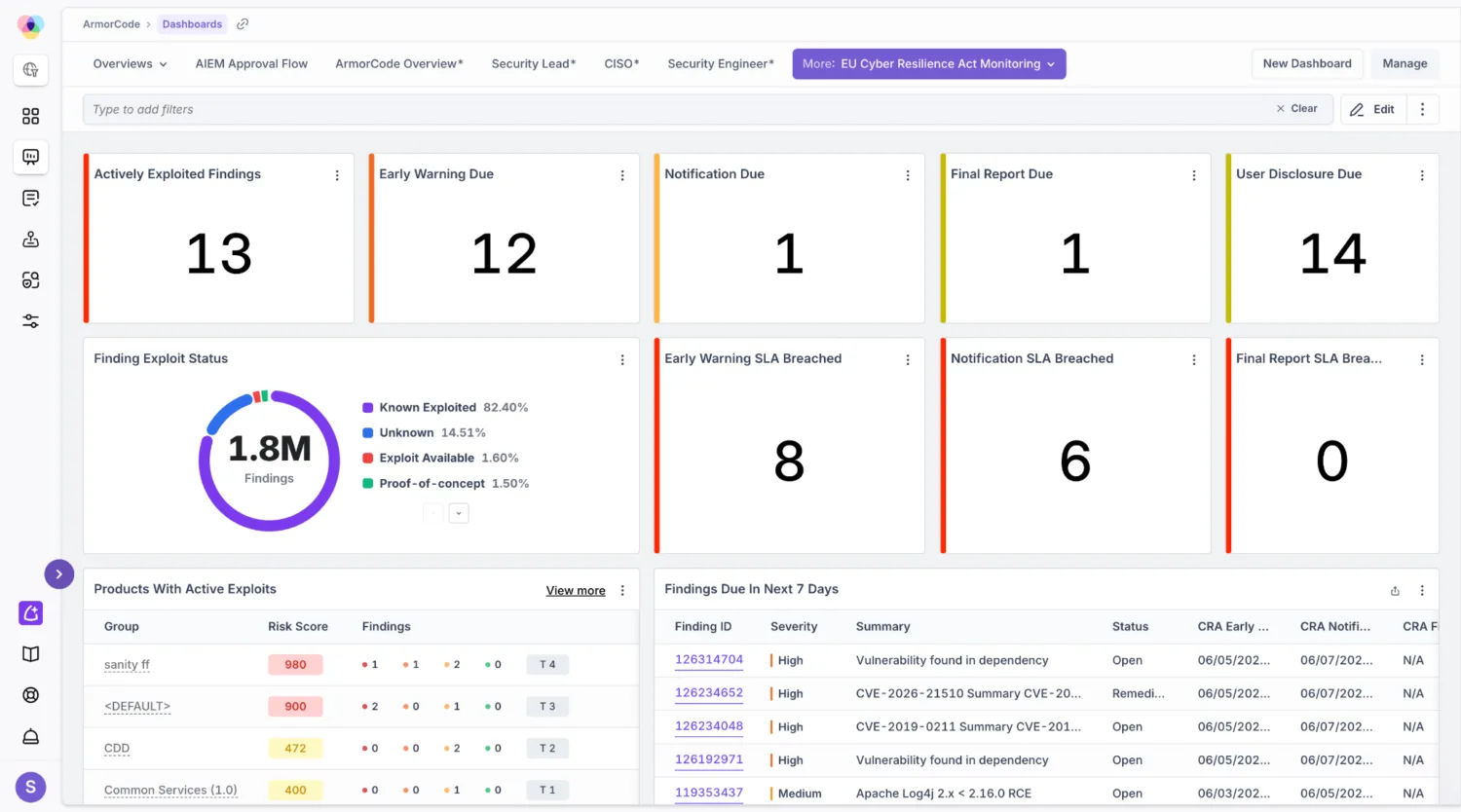
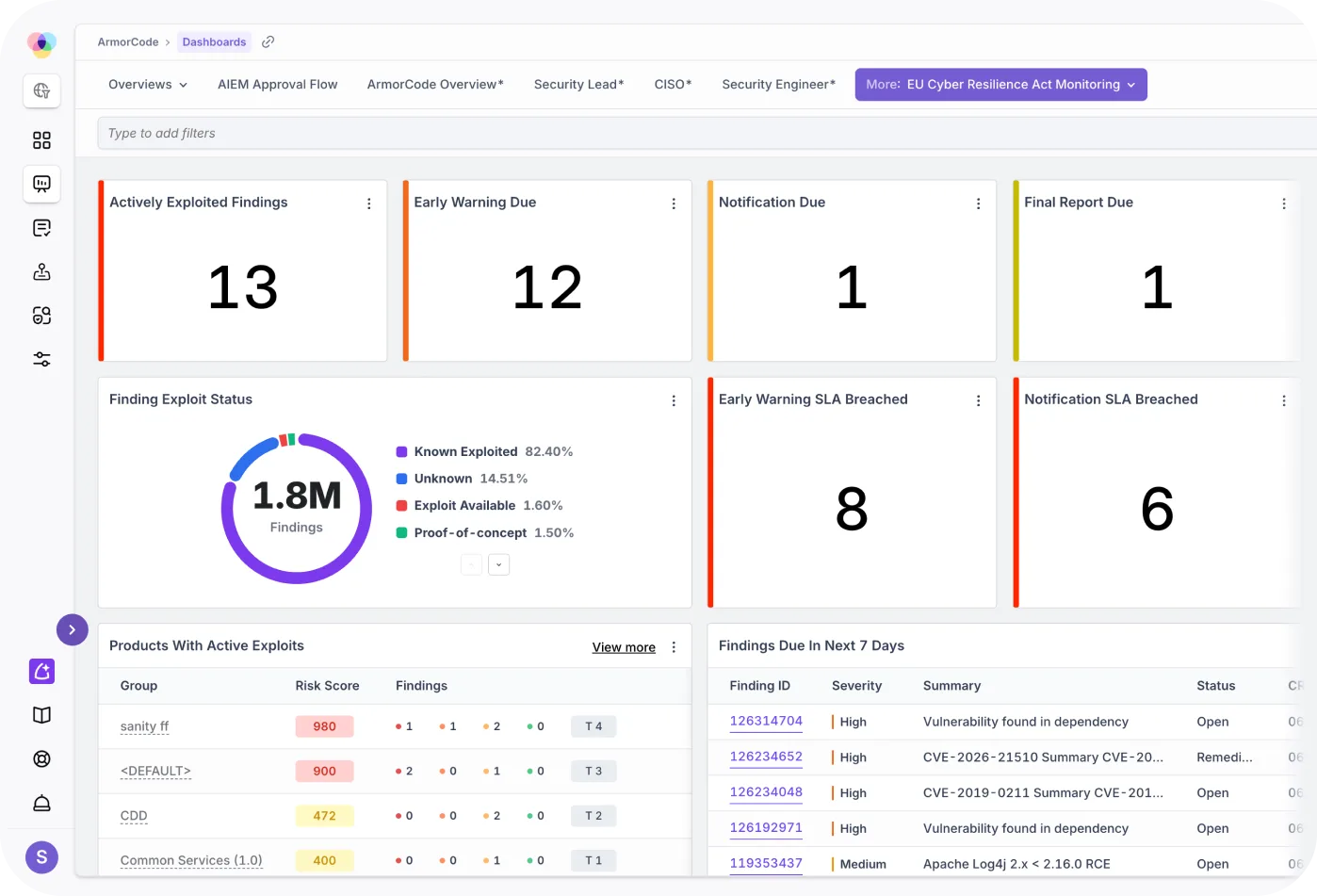
Prioritization runs on the same exploit-awareness the CRA itself is built around: a dedicated Exploit Status field, ranging from Unknown to Actively Exploited, extends ArmorCode’s existing risk framework of EPSS, CISA KEV, and CVSS environmental rescoring, and only the Actively Exploited status starts the 24-hour ENISA clock.
The disclosure workflow itself is tracked as data, not a calendar reminder. ArmorCode’s CRA Notification Status field moves each finding through the full lifecycle, from pending review to early warning released, vulnerability notified, and final report released, with due dates calculated automatically off the moment exploitation was confirmed, and an Evidence of Remediation field that flows straight into the notification and final report instead of getting reconstructed after the fact. None of this auto-files with ENISA; manufacturers still own the submission.
What ArmorCode removes is the manual work of assembling the picture, tracking the clock, and proving the timeline held. Across the platform, ArmorCode already processes over 300 billion findings across 400+ integrations, and customers using its agentic prioritization have cut vulnerability remediation time from 240 days down to just hours. Teams that build that foundation now will meet the deadline calmly. Teams that don’t will be assembling it in the middle of their first incident report.
Discover how ArmorCode helps you meet Cyber Resilience Act requirements faster here. You can also check if you are CRA-ready with the ArmorCode CRA Readiness Scorecard.
Frequently Asked Questions on Cyber Resilience Act Compliance
Who is impacted by the Cyber Resilience Act?
The CRA impacts any manufacturer, developer, or distributor of hardware and software products with digital elements that are placed on the European Union market, regardless of where the company is headquartered.
What are the penalties for Cyber Resilience Act non-compliance?
Non-compliance can result in severe financial penalties, including fines up to €15 million or 2.5% of the offender’s total worldwide annual turnover for the preceding financial year, whichever is higher.
How can organizations prepare for the 24-hour vulnerability disclosure requirement?
Organizations must implement automated, unified exposure management platforms like ArmorCode to rapidly aggregate, prioritize, and route vulnerability data across their entire technology stack, ensuring they can identify and report critical issues within the mandated timeframe.
Key Takeaways
September 11, 2026 is the deadline that bites first. Full CRA compliance isn’t due until December 2027, but mandatory 24-hour vulnerability and incident reporting to ENISA starts more than a year earlier, and it applies to products already on the market, not just new launches.
You can’t report what you can’t see. The 24-hour clock starts at the moment of awareness, which means SBOM visibility and exploit-status tracking have to be operational before September 2026, not built in response to the first incident.
CRA readiness is an operating model, not a document. Manufacturers need continuous, exploit-aware risk data and an auditable disclosure trail, not a quarterly compliance review, to consistently meet the 24-hour, 72-hour, and 14-day reporting windows.
Sources