
What Is Vulnerability Prioritization?
A practical guide to ranking vulnerabilities by real business risk, moving beyond CVSS to combine exploitability, asset context, and threat intelligence.
Table of Contents
CVE volume has more than doubled in five years. Published CVE records increased from 18,375 in 2020 to 48,244 in 2025, a 163% increase. And the pace is accelerating. FIRST now projects roughly 66,000 CVEs in 2026 after disclosures ran 46.3% above its original forecast.
No team, no matter how well staffed, triages that volume by severity score alone. Yet the pattern holds up consistently: roughly 3% of findings represent 80% of the real business risk an organization carries once business context gets applied. That gap between raw volume and real risk is why vulnerability prioritization exists as its own discipline, separate from scanning and remediation.
This page covers what vulnerability prioritization means, why CVSS by itself leads teams astray, the seven inputs that make up a mature prioritization process, and how to turn those inputs into a framework your team can run every week without drowning in exceptions.
What Is Vulnerability Prioritization?
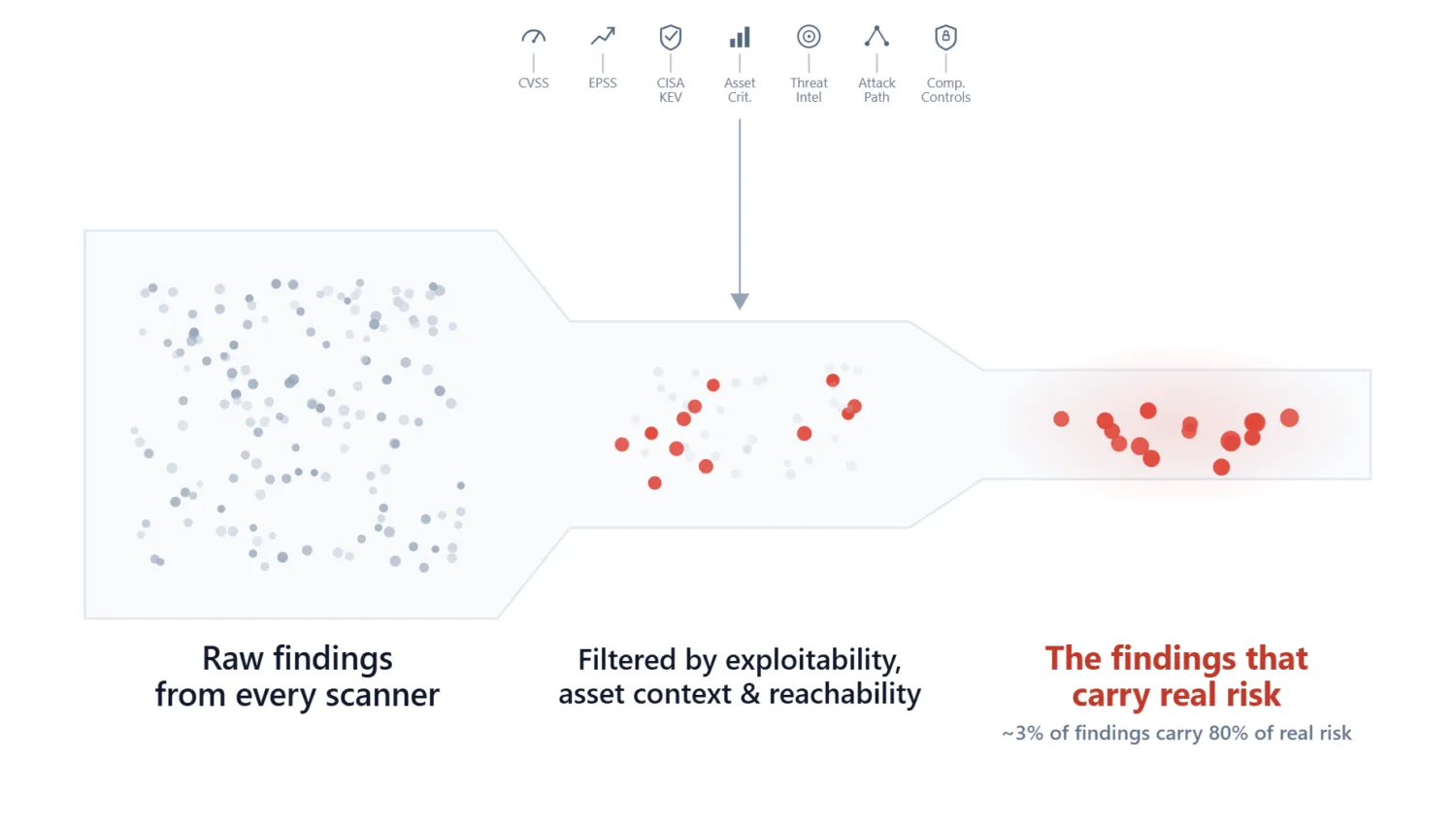
Vulnerability prioritization is the process of ranking security vulnerabilities by the actual risk they pose to your organization, not by technical severity alone. It sits between two other stages of a mature security program: detection, where scanners and code analysis tools surface findings, and remediation, where engineering teams fix them. Without prioritization, those two stages just get bolted together, and the result is predictable. Security teams fix whatever looks loudest on a dashboard rather than what an attacker would actually go after, and vulnerability triage devolves into working the queue in whatever order a scanner spits it out.
That distinction matters because volume and risk are not the same thing. A finding queue with 40,000 open items isn’t 40,000 problems of equal weight. It’s a handful of genuinely dangerous exposures buried under a much larger set of findings that carry real severity scores but negligible practical risk. Vulnerability prioritization is the mechanism that separates the two. It takes the raw output of every scanner in your stack and asks a harder question than “how severe is this technically”: how likely is this to be exploited, does it sit on something that matters to the business, and can an attacker even reach it?
The industry’s shift here has been gradual but consistent. For years, CVSS was treated as a de facto prioritization tool because it was the only standardized number available. Practitioners increasingly recognize that CVSS measures severity in isolation, and severity in isolation is a poor substitute for risk. Risk-based vulnerability prioritization layers exploitability data, business context, and threat intelligence on top of the CVSS baseline instead of stopping there.
Vulnerability Prioritization vs. Vulnerability Management
These two terms get used interchangeably, and that’s a mistake worth correcting early. Vulnerability management is the full lifecycle: discovery, triage, prioritization, remediation, and verification. It’s the entire program, start to finish.
Vulnerability prioritization is one stage inside that lifecycle, specifically the point where findings get ranked so remediation teams know what to work on first and how urgently. It’s not something you do once and file away. Prioritization feeds directly into remediation workflows, into the SLAs your team commits to, and into how tickets get routed to the right engineering group. A vulnerability management program without a strong prioritization stage tends to default to CVSS-only triage, which is exactly the failure mode this page is arguing against.
Vulnerability prioritization is also a core stage of Continuous Threat Exposure Management (CTEM). CTEM treats prioritization as an ongoing discipline rather than a periodic sorting exercise. Unified Exposure Management provides the architecture to operationalize that model across application, infrastructure, cloud, software supply chain, and AI exposures, carrying risk-based priorities through to remediation.
Why CVSS Alone Is Not Enough
CVSS is not wrong. It is a severity framework, not a complete risk model. CVSS was designed to measure the technical severity of a vulnerability: how it affects confidentiality, integrity, and availability if exploited, how complex the attack is, and what privileges an attacker needs. None of that tells you whether the vulnerability actually poses meaningful risk to your specific organization.
Here’s the structural problem in plain terms. CVSS doesn’t account for asset criticality. A CVSS 9.8 finding on an isolated internal development server carries less organizational risk than a CVSS 6.5 finding on an internet-facing, revenue-generating API, but a severity-only view would tell your team to fix the 9.8 first every time. CVSS also doesn’t reflect active exploitation. It has no mechanism for knowing that a vulnerability is currently being used in ransomware campaigns, which is exactly what the CISA Known Exploited Vulnerabilities catalog exists to capture. It doesn’t predict the probability that a given CVE will actually be exploited, which is the specific gap EPSS was built to fill. And it says nothing about compensating controls: a vulnerability sitting behind a properly configured WAF and network segmentation is not the same risk as the identical vulnerability sitting exposed.
Put those gaps together, and you get the case for multi-factor prioritization. CVSS supplies the technical severity baseline. Everything else on this page is about layering additional signal on top of that baseline until the ranking reflects actual organizational risk rather than a lab-condition severity score.
The CVSS Scoring Problem in Practice
The theory is one thing. In practice, CVSS limitations show up in a few specific, recurring ways. Scores are frequently assigned by the vendor disclosing the vulnerability, often before anyone outside that vendor has full visibility into how it might actually be exploited in a live environment. That score then rarely gets revisited. A CVSS score assigned at disclosure stays attached to that CVE indefinitely, even as context, patches, and exploit availability shift around it.
The critical/high/medium/low bucketing compounds the problem. It creates a false sense of urgency at scale: if 20% of your backlog is scored “critical,” that reads as 20% of your backlog demanding immediate attention, when in reality only a sliver of those criticals are ever exploited in the wild. Live 2026 tracking data shows that only about 0.2% of CVEs published this year have ever appeared on the CISA KEV catalog, which is a useful gut check against treating “critical” as synonymous with “urgent.” This is the analytical core of why prioritization needs more inputs than a single number, and it’s the argument the rest of this page builds on.
The Inputs for Risk-Based Vulnerability Prioritization
A mature prioritization process doesn’t replace CVSS. It combines CVSS with six additional signals, each of which corrects for something CVSS structurally can’t see. Here’s what a composite view actually looks at.
1. CVSS (Severity Baseline)
Start with CVSS, because it’s still the right technical baseline. It’s the industry-standard way to describe how severe a vulnerability is in isolation, and every prioritization framework should use it as an input rather than discard it. The current version, CVSS v4.0, moved past the older base-score-only model by adding a dedicated Threat metric group along with supplemental metrics like Automatable, Safety, and Recovery, which give you more dimensions to reason about than CVSS 3.1 offered. Even with those additions, CVSS v4.0 still doesn’t close the business-context gap. It tells you how bad a vulnerability could be in the worst case. It doesn’t tell you how likely that worst case is for your environment, which is exactly why it needs the inputs below.
2. EPSS (Exploitation Probability)
EPSS, the Exploit Prediction Scoring System maintained by FIRST, estimates the probability that a given CVE will actually be exploited in the wild within the next 30 days. It’s a machine-learning model trained on real exploitation telemetry, and it publishes a score between 0 and 1 along with a percentile ranking, updated daily. The reason EPSS matters so much for exploitability scoring is that most CVSS-critical vulnerabilities are never exploited at all. EPSS is the signal that separates the critical findings actively being targeted from the much larger pool of criticals that will likely sit unexploited indefinitely. A vulnerability with a moderate CVSS score but a high EPSS percentile, especially one with public proof-of-concept code already circulating, often deserves faster attention than a higher-CVSS finding with a near-zero EPSS score.
3. CISA KEV (Known Exploitation)
The CISA Known Exploited Vulnerabilities catalog lists CVEs that CISA has confirmed are being actively exploited, based on direct evidence rather than probability modeling. If a vulnerability shows up on the KEV list, treat it as an immediate priority regardless of its CVSS score. As of August 2026, the catalog holds 1,674 entries and continues to grow as CISA confirms new exploitation activity. It’s worth knowing that the federal remediation mandate tied to the KEV catalog changed this year. CISA’s original directive, BOD 22-01, established mandatory remediation timelines for vulnerabilities in the KEV catalog, with deadlines based largely on when vulnerabilities entered the program.. In June 2026, CISA replaced it with BOD 26-04, which scores each vulnerability-asset combination against four risk variables, including whether the asset is publicly exposed and whether exploitation can be automated, and sets remediation deadlines that range from three days for the highest-risk combinations to 60 days for lower-risk ones. The directive only binds federal civilian agencies directly, but the same logic- treat KEV status as a hard signal and layer exposure and automatability on top of it- is exactly what private-sector prioritization frameworks should be doing too.
4. Asset Criticality and Business Context
This is the input most organizations still struggle to operationalize well. Asset criticality answers a simple question that’s surprisingly hard to answer at scale: how important is the affected asset to the business? A finding on a production e-commerce checkout API is not the same risk as the identical finding on an internal dev sandbox, even when the CVSS score, EPSS percentile, and KEV status are identical.
Business context extends beyond a binary production-versus-dev label. It includes revenue impact if the asset goes down, the sensitivity of the data it touches, regulatory exposure tied to frameworks like SOC 2, PCI-DSS, or FedRAMP, whether the asset is customer-facing, and what else in the environment depends on it. This is genuinely difficult to maintain manually because business context changes as fast as the business does. It’s also where a Context Risk Graph becomes essential, because it correlates findings with asset context automatically instead of relying on a spreadsheet someone updates quarterly.
5. Threat Intelligence
Active threat intelligence tells you whether a vulnerability is being targeted in current attack campaigns, which is a different question than whether it’s merely capable of being exploited. This input covers whether public exploit code exists, whether the vulnerability is actively being used in the wild, whether specific ransomware groups have adopted it, and whether it maps to threat patterns specific to your industry. Threat intelligence is what turns a static CVSS score into something dynamic. A finding that was low priority last quarter can become urgent overnight the moment a working exploit starts circulating on underground forums, and your prioritization process needs to reflect that shift the same day it happens, not weeks later during the next scheduled review. This is the layer ArmorCode’s Advanced Threat Intelligence (AATI) feeds directly into composite scoring, rather than treating threat intel as a separate lookup step analysts run by hand.
6. Attack Path and Reachability Analysis
Attack path analysis asks whether a vulnerability is actually reachable by an attacker, through the network, through identity and access paths, or through the application layer. This is the most advanced input on this list, and arguably the most consequential.
Reachability is what separates a theoretical vulnerability from an exploitable one in your specific environment. Two organizations can have the identical CVE, identical CVSS score, identical EPSS percentile, and land on completely different priority rankings because their network topology and identity architecture expose that finding differently. This is a deep enough topic that it deserves its own treatment.
7. Compensating Controls
The last input is the one most prioritization frameworks skip entirely: existing security controls that mitigate a vulnerability’s practical exploitability even when a patch isn’t available yet. A web application firewall, endpoint detection and response tooling, network segmentation, and tightly scoped IAM policies can all reduce the effective risk of a finding without eliminating the underlying vulnerability. A mature prioritization process accounts for this instead of treating every unpatched finding as equally exposed. Ignoring compensating controls tends to push teams toward over-prioritizing findings that are already reasonably contained, at the expense of findings that have no mitigating control in place at all.
Building a Vulnerability Prioritization Framework
Knowing the seven inputs is one thing. Turning them into a process your team actually runs week over week is the harder part, and it’s where most programs stall. A working framework needs six pieces in place.
- Define risk tiers based on a composite score, not CVSS alone. Critical, High, Medium, and Low should reflect the combined weight of severity, exploitability, asset context, and reachability, not a single input.
- Set SLAs by tier rather than a single blanket deadline for every “critical” finding. A vulnerability that’s immediately exploitable and sits on a business-critical asset might warrant a 7-day SLA, while a high-severity finding on an internal asset with no external exposure can reasonably sit at 30 days.
- Automate the scoring itself. Combine CVSS, EPSS, KEV status, asset context, and threat intelligence into a single adaptive risk score, because doing this manually across thousands of monthly findings simply doesn’t scale.
- Route findings automatically based on asset ownership. Once a finding is scored, it should go straight to the correct team rather than relying on a security analyst to manually triage where a ticket belongs.
- Track mean time to remediate by tier, not as a single blended average. A blended MTTR number hides whether your critical-tier work is actually moving faster than everything else.
- Review and adjust the framework quarterly. Asset criticality, threat landscape, and organizational priorities all shift, and a framework that was accurate in January can be stale by summer.
Vulnerability Prioritization Challenges at Scale
The framework above sounds straightforward on paper. In practice, six structural challenges make it hard to sustain, especially as an organization grows.
- Scale. Enterprise security teams routinely manage thousands of open findings sourced from dozens of scanning tools, and that volume alone defeats manual triage long before you even get to the harder questions about business context.
- Data silos. Infrastructure teams, AppSec teams, and cloud security teams each tend to run their own prioritization process on their own tooling, which means the same underlying risk gets scored three different ways depending on which team is looking at it.
- Stale context. Asset criticality isn’t fixed. A system that was purely internal six months ago might now sit behind a customer-facing integration, and if your prioritization data doesn’t reflect that change, you’re scoring risk against an outdated picture of your own environment.
- Lack of automation. Manual prioritization simply cannot keep pace with a disclosure rate that averaged 315 new CVEs a day in July 2026 alone, and this is the challenge that makes all the others worse.
- Tool sprawl. Every scanner in your stack tends to apply its own severity scoring logic, which means a “critical” finding from one tool and a “critical” finding from another aren’t necessarily comparable.
- Organizational friction. Security teams and development teams frequently disagree on what counts as urgent, and without a shared, defensible prioritization methodology, that disagreement turns into delay.
Vulnerability Prioritization Best Practices
None of the challenges above are solved by working harder inside the old model. They’re solved by changing the model. These five practices are what separate programs that keep pace with disclosure volume from ones that fall further behind every quarter.
1. Combine Multiple Risk Signals, Not Just CVSS
Use CVSS as your baseline, then layer EPSS, CISA KEV status, asset criticality, threat intelligence, and attack path analysis on top of it. No single signal is sufficient on its own, and treating any one of them as the whole answer recreates the exact problem this page opened with. The composite view is what actually reflects organizational risk, and it’s why the 3%-of-findings, 80%-of-risk pattern shows up so consistently once business context gets applied.
2. Automate Prioritization with Business Context
Manual prioritization cannot scale past a certain finding volume, full stop. The fix is a platform that automatically correlates findings with asset criticality, exposure, and business context rather than relying on someone updating a spreadsheet. A Context Risk Graph does exactly this by mapping findings to the assets, code repositories, cloud resources, and business context they actually touch, which is the single biggest lever for making automation trustworthy rather than just fast.
3. Set Risk-Based SLAs
Move away from blanket SLAs that treat every “critical” the same way. A finding that’s immediately exploitable and sits on a business-critical asset deserves a tight SLA, something like seven days. A high-severity finding on an internal asset with limited exposure can reasonably sit at 30 days without meaningfully increasing risk. Track mean time to remediate by tier and report it to leadership broken out that way, not as a single blended figure that obscures where the program is actually performing.
4. Use Threat Intelligence Continuously
Threat intelligence isn’t a one-time enrichment step you run when a finding first appears. It changes daily, sometimes within hours. A finding that was low-risk yesterday can become urgent the moment a public exploit gets published or a ransomware group starts incorporating it into active campaigns. Continuous monitoring of CISA KEV updates, EPSS score changes, and active campaign intelligence is what keeps a prioritization program honest about current reality instead of relying on a snapshot taken weeks earlier. ArmorCode’s Anya Agents include a Zero-Day Exposure Hunting Agent built specifically for rapid impact assessment when new threat intelligence emerges, so teams aren’t waiting on a manual review cycle to react.
5. Account for Attack Paths and Reachability
A vulnerability an attacker literally cannot reach is a lower priority than one sitting in the open, even at an identical CVSS score. Attack path analysis maps how an attacker could actually chain findings, identity weaknesses, and network paths together to reach a vulnerable component, and it’s the most differentiated, most advanced input on this list. See the August blog on attack path analysis for a concrete walkthrough of how this plays out in a real environment.
Vulnerability Prioritization with ArmorCode
ArmorCode operationalizes everything covered above through the Agentic Control Plane: the Context Risk Graph as the data plane that models risk with business context, and Anya Agents as the agentic workforce that acts on it. That combination is what turns the seven inputs on this page from a checklist into a running system, rather than something an analyst reconstructs by hand every time a finding comes in.
Context Risk Graph for Adaptive Risk Scoring
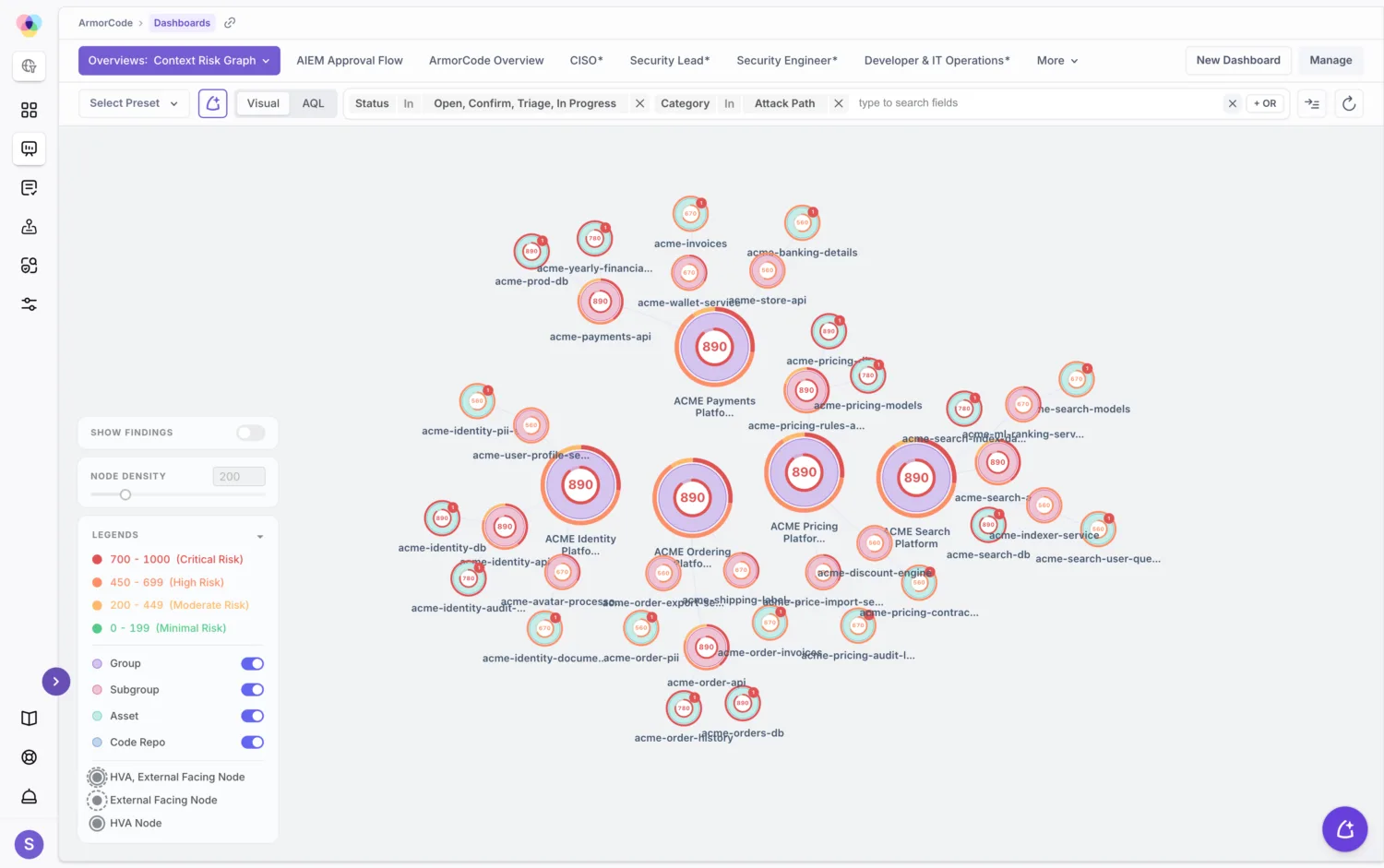
The Context Risk Graph correlates findings with assets, code repositories, cloud resources, identities, network topology, threat intelligence, business context, and ownership in a single connected model. That correlation is what makes Adaptive Risk Scoring possible in practice rather than in theory. It combines all seven inputs covered on this page, CVSS, EPSS, CISA KEV, asset criticality, threat intelligence, attack paths, and compensating controls, into a single prioritization signal that reflects the actual risk an organization carries, not just the technical severity of an isolated finding. This is the mechanism behind the pattern referenced earlier on this page: roughly 3% of findings representing about 80% of real business risk once that context gets applied, and it’s what lets teams cut alert volume by up to 90% without cutting corners on what actually gets missed.
Anya Agents for Prioritization and Zero-Day Response
Anya Agents extend that scoring into active response. The Risk Analyzer Agent explains the factors behind a finding’s risk score and prioritization, helping teams understand why an exposure matters and how urgently it should be addressed.. The Zero-Day Exposure Hunting Agent is built for the moment a new vulnerability or active exploit hits the wild, correlating affected components and findings and generating an impact report in minutes rather than days. Both agents are grounded in the Context Risk Graph rather than operating on isolated data, which is what keeps their output trustworthy instead of just fast, and they sit alongside a broader Anya roster, including the Remediation Agent and Vulnerability Researcher, that carries prioritized findings through to a verified fix.
400+ Integrations for Unified Prioritization
Prioritization is only as good as the data feeding it. ArmorCode consolidates findings from 400+ security tools into a single source of truth, so every finding gets scored on the same scale, using the same business context, regardless of which scanner originally surfaced it. That unified pipeline processes hundreds of billions of findings annually, and it’s the foundation that makes cross-team, cross-tool prioritization possible instead of aspirational. Customers using this approach have accelerated remediation by 97%, moving mean time to remediate from roughly 240 days down to just 7 on the exposures that actually matter, compressing a find-to-fix cycle that used to run in months down to hours, which is the practical payoff of prioritizing correctly instead of prioritizing loudly.
Take a self-guided tour of ArmorCode Vulnerability Management to see how 400+ tools and hundreds of billions of annual findings become a single, context-driven prioritization signal your team can actually act on. Ready to see it on your own environment? Request a demo.
Frequently Asked Questions
Q: What is vulnerability prioritization?
A: Vulnerability prioritization is the process of ranking security vulnerabilities by the actual risk they pose to an organization, not by technical severity alone. It combines CVSS severity scores, EPSS exploitation probability, CISA KEV known-exploitation data, asset criticality, threat intelligence, attack path reachability, and compensating controls into a single view. The goal is to focus remediation on the small percentage of findings, often cited around 3%, that represent the majority of real business risk.
Q: Why is CVSS not enough for vulnerability prioritization?
A: CVSS measures technical severity on a 0-10 scale, but it doesn’t account for business context. A CVSS 9.8 finding on an isolated internal server poses less organizational risk than a CVSS 6.5 finding on an internet-facing, business-critical API. CVSS also doesn’t reflect whether a vulnerability is being actively exploited, how likely it is to be exploited, or whether an attacker can actually reach it. Relying on CVSS alone tends to produce alert fatigue while real risks sit unaddressed further down the queue.
Q: What is the difference between vulnerability prioritization and vulnerability management?
A: Vulnerability management is the full lifecycle, covering discovery, triage, prioritization, remediation, and verification. Vulnerability prioritization is one stage within that lifecycle, the point where findings get ranked by business risk to determine what gets fixed first and how urgently. It’s not a standalone activity; it feeds directly into remediation workflows, SLAs, and team routing.
Q: How does ArmorCode help with vulnerability prioritization?
A: ArmorCode’s Agentic Control Plane enables context-driven vulnerability prioritization through the Context Risk Graph, which correlates findings with assets, code repositories, cloud resources, identities, network topology, and business context to produce an Adaptive Risk Score. Anya Agents, including the Risk Analyzer Agent and the Zero-Day Exposure Hunting Agent, help teams assess risk and respond to new exposures faster. The platform consolidates findings from 400+ security tools and has helped customers accelerate remediation by 97%, moving mean time to remediate from roughly 240 days to 7.
Q: What is a vulnerability prioritization framework?
A: A vulnerability prioritization framework is a repeatable process for ranking vulnerabilities by business risk. A mature framework combines CVSS, EPSS, CISA KEV, asset context, threat intelligence, attack paths, and compensating controls, defines risk tiers with matching SLAs, automates scoring and routing, and tracks mean time to remediate by tier. It should be reviewed and adjusted regularly as threat intelligence, asset context, and exploitability data all shift over time. The goal is moving from reactive, severity-driven patching to proactive, risk-driven remediation focused on the exposures most likely to cause real business impact.
Key Takeaways
- Vulnerability prioritization ranks findings by actual business risk, not CVSS severity alone. CVSS tells you how bad a flaw could be in theory; it says nothing about whether your organization is actually exposed.
- Roughly 3% of findings drive 80% of real business risk. The gap between raw finding volume and real risk is the entire reason prioritization exists as its own discipline, separate from scanning and remediation.
- A mature framework combines seven inputs: CVSS, EPSS, CISA KEV, asset criticality, threat intelligence, attack path reachability, and compensating controls, not any single score.
- Manual triage breaks down at current CVE volume. With disclosure rates now averaging 300+ CVEs a day in peak months, prioritization has to be automated and tied to live business context, not run off a quarterly spreadsheet.
- Risk-based SLAs beat blanket deadlines. Tiering remediation windows by composite risk, not treating every “critical” the same, is what actually moves mean time to remediate.