What to Consider Before Building Your Own Exposure Management Solution
Insights from security and technology leaders on the shift to continuous, pre-emptive exposure management.
Understanding the true cost of building with Frontier AI.
What you’ll learn
The paper walks through how to decide what to build, what to buy, and what it costs to own the difference:
- When building is the right call, and what changes once a prototype becomes a platform others depend on
- Why reliable data, correlation, and business context are harder than the dashboard makes them look
- How to keep scanner and AI model choices open as both keep changing
- What tokenomics means for agentic workflows, and why repeated work drives up cost per verified resolution
- Why a closed ticket isn’t the same as a verified fix
- 10 questions your security, engineering, and finance teams can use to evaluate an internal build and commercial alternatives side by side
Why this matters:
Frontier AI has made building your own vulnerability management tools a practical option. Your team knows your environment, and it can now turn that knowledge into working software faster and at lower cost. For a specific, well-defined problem, building can be the right investment.
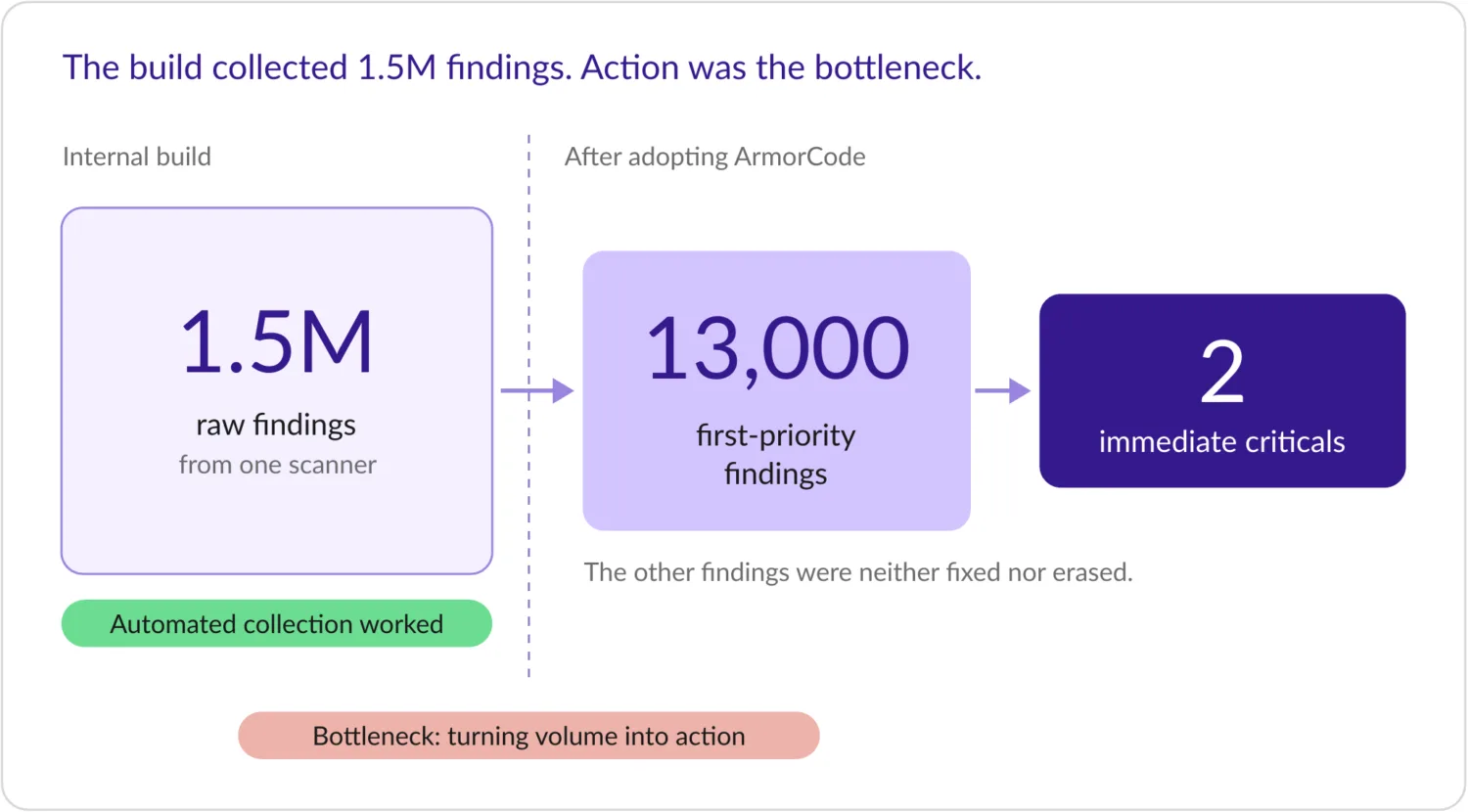
The commitment changes when a useful tool becomes a platform. Connectors break when scanner APIs change. Correlation has to hold up across tools. Ownership, exceptions, and verified fixes need a system behind them. One ArmorCode customer spent roughly two years building a system that collected 1.5 million findings from a single scanner. Collection worked. Turning that volume into action did not.
The decision isn’t AI versus no AI. It’s how much of the system your team should own, and where a commercial platform can save ongoing work.
How ArmorCode aligns with this shift
Build and buy aren’t mutually exclusive. Here’s how the platform fits alongside your own engineering.
An independent Agentic Control Plane: ArmorCode connects vulnerability management and remediation across applications, infrastructure, the software supply chain, and AI. Because it sits apart from the tools that supply findings, your risk policies, ownership, and workflows carry forward when scanners change.
Context that turns findings into priorities: The Context Risk Graph links findings to assets, owners, and business context. One customer used it to move from 1.5 million raw findings to roughly 13,000 in a first-priority queue, with two immediate criticals. (Customer reported, not independently audited.)
Anya Agents that do the follow-through: Anya Agents use that context to explain risk, assess newly disclosed vulnerabilities, and develop remediation guidance, with approval for consequential actions.
Room to build on top: The ArmorCode MCP server gives your custom agents and AI assistants access to shared security intelligence. Your team builds the capabilities specific to your business while ArmorCode maintains the platform, integrations, and automated workflows underneath.