Software Supply Chain Security: A Strategic Guide to SCA, SBOMs, and Risk Prioritization

Software supply chain security (SSCS) is the practice of securing every third-party dependency, open-source component, and build pipeline that touches your applications before they reach production. For enterprise security leaders, that means moving beyond basic software composition analysis (SCA) toward a strategy that operationalizes SBOMs (Software Bills of Materials) and prioritizes vulnerabilities by actual business risk rather than severity scores alone.
Third-party involvement in breaches doubled from 15% to 30% in a single year, according to Verizon’s 2025 Data Breach Investigations Report (the largest single-year shift the report has ever recorded). Relying on SCA scanning alone leaves teams buried in alerts and slow to remediate. This guide walks through how DevSecOps teams can ingest SBOMs from multiple sources, enrich component data, generate composite SBOMs, and use VEX (Vulnerability Exploitability Exchange) reports to spend less time finding risk and more time fixing it.
What Is Software Supply Chain Security and Why Is It Critical Today?
The software supply chain is everything that goes into building and shipping an application that your team didn’t write itself: open-source libraries, container base images, CI/CD tooling, third-party SDKs, and the build infrastructure that stitches it all together. In most modern applications, the majority of the codebase by volume comes from outside the organization. Traditional application security (code review, SAST, DAST on proprietary code) was never built to cover that surface, which is exactly why attackers have moved there.
Two incidents made that risk impossible to ignore. A single logging library was embedded so deep in the Java ecosystem that most security teams didn’t know they were exposed until the alerts started. A year earlier, the SolarWinds attack showed the same dynamic from the vendor side: attackers compromised the build system for SolarWinds’ Orion platform and used it to push trojanized updates to fewer than 18,000 customers, including federal agencies and Fortune 500 companies, all through a single trusted software update.
Both incidents share the same root cause: a single compromised link, multiplied across every organization that trusted it. Traditional application security tooling wasn’t built to catch either one. SAST and DAST test the code your developers write, not the thousands of external packages and container images that code depends on to run.
The Anatomy of a Supply Chain Attack
Most supply chain attacks follow a predictable path. An attacker compromises a widely used open-source package, whether through a hijacked maintainer account, a typosquatted package name, or a dependency-confusion trick that tricks a build system into pulling a malicious package instead of the internal one it meant to reference. From there, the payload rides along with every legitimate install, spreading through CI/CD pipelines into production systems that never directly interacted with the attacker. The same pattern shows up one layer down in container security, where a single compromised base image can propagate a vulnerability into every downstream service built on top of it, often without anyone realizing the base image was ever updated.
OWASP’s Top 10 CI/CD Security Risks captures why build pipelines specifically have become such an attractive target: they typically hold broad, long-lived credentials, run with elevated privileges, and are monitored far less closely than production environments. Compromising the pipeline once is often more efficient for an attacker than compromising a single application.
The scale of the target makes this approach efficient. The npm registry alone has grown to more than 4 million packages published over its history, with roughly 2 million actively maintained today. Most organizations have no reliable way to see which of their dependencies fall into which category, let alone which ones are quietly introducing risk. That blind spot, multiplied across every open-source ecosystem in use, is what makes the software supply chain the preferred entry point for both opportunistic and nation-state attackers.
How Does Software Composition Analysis (SCA) Fit Into the Security Posture?
SCA tools are the starting point for supply chain visibility, and they do that job well. They scan manifests and lockfiles, walk the dependency tree down through transitive dependencies most teams have never manually reviewed, identify known CVEs in open-source components, and flag license conflicts before code ships. Some extend into container security, scanning base images and layers for the same class of known vulnerabilities.
The problem shows up at scale, not in any single scan. Most enterprises run several SCA tools across different teams, business units, and pipelines, and each one has its own scoring system with zero awareness of what any other tool found or what actually matters to the business. A component that shows up as “critical” in one tool and “low” in another isn’t a data quality problem. It’s the predictable result of every scanner working from its own isolated view. The result is thousands of disconnected alerts with no way to tell which ones actually matter, which is why SCA findings need to land in an independent control plane for application security rather than staying siloed in each scanner’s own dashboard.
Overcoming Alert Fatigue from Traditional SCA Tools
Alert fatigue isn’t just a productivity drag. It’s a security risk in its own right, because exhausted analysts stop distinguishing real threats from noise. Industry research examined by SecurityWeek found that up to 75% of identified exposures are dead ends: findings that sit on assets nothing can reach, or that no attacker would ever bother chasing. Legacy vulnerability management treats all of them with the same urgency, which is precisely the workflow organizations are being asked to upgrade from as they move toward Continuous Threat Exposure Management. The fix isn’t another scanner. It’s an aggregation layer that deduplicates findings across every SCA tool in use and applies one consistent prioritization model on top.
How Do You Operationalize an SBOM (Software Bill of Materials)?
Generating an SBOM satisfies a growing list of compliance mandates, including guidance from the Cybersecurity and Infrastructure Security Agency (CISA) and the NIST Secure Software Development Framework. But an SBOM on its own is just an inventory list: a static snapshot of components that goes stale the moment a new CVE is published or a developer bumps a dependency version. The real value shows up only after generation, when that inventory gets continuously ingested, enriched, and monitored against live threat intelligence. That operational layer is what turns an SBOM management program from a compliance checkbox into an active security control.
Ingesting and Enriching SBOM Data
Most enterprises already produce SBOMs from multiple SCA tools, often in different formats: CycloneDX from one pipeline, SPDX from another. The first operational step is ingesting all of them automatically, regardless of format, into a single system. From there, each component gets enriched with context a raw SBOM doesn’t include on its own: deprecation status, how actively the source repository is maintained, and open-source health signals like OpenSSF Scorecard results. That enrichment is what separates a component that merely appears in an inventory from one a security team actually understands.
Generating Composite SBOMs
Modern applications rarely map cleanly to a single SBOM. Microservices, shared libraries, and multiple build pipelines mean the same organization can be maintaining dozens of individual SBOMs across different teams and products. Generating a composite SBOM means combining those individual inventories into one unified view that mirrors how the application delivery pipeline is actually structured, so security teams get full visibility instead of a fragmented set of documents that each only tell part of the story.
What Is VEX and How Does It Transform Vulnerability Management?
A Vulnerability Exploitability Exchange (VEX) report answers a question an SBOM can’t: is this specific vulnerability actually exploitable in this specific product? An SCA tool might flag a component as containing a known CVE, but if the vulnerable function is never called, or the vulnerable code path is never reachable in the way the application uses that library, the finding is a false positive in practice. VEX, a format that CISA has helped standardize, lets vendors and internal teams communicate exactly that status (affected, not affected, fixed, or under investigation) for a given component in a given product. For teams drowning in SCA alerts, VEX is often the single fastest way to cut the list down to what genuinely needs attention.
How Do You Implement Risk-Based Prioritization for the Supply Chain?
CVSS scores measure technical severity in a vacuum. They say nothing about whether a vulnerability sits on an internet-facing system holding customer data or an isolated test server nobody uses. Risk-based prioritization replaces that flat ranking with layered context: threat intelligence feeds like the CISA Known Exploited Vulnerabilities (KEV) catalog, which flags CVEs with confirmed real-world exploitation, and the Exploit Prediction Scoring System (EPSS), which estimates the probability a given CVE will be exploited in the near term, combined with internal signals like asset criticality, exposure, and ownership. A critical CVE with a low EPSS score sitting on an isolated system is a very different conversation than a moderate CVE with an active KEV listing sitting on an internet-facing production service, even though a CVSS-only queue would rank them identically.
This is the operating model behind Continuous Threat Exposure Management (CTEM) for the software supply chain, a Gartner-defined framework built around five stages (scoping, discovery, prioritization, validation, and mobilization) that treats every package, container, and build artifact as a live part of the attack surface rather than a row reviewed once a quarter. In practice, that means correlating supply chain findings with the same context graph used across the rest of the security program: which assets a component touches, who owns the fix, and what an attacker could actually reach from there. ArmorCode’s Context Risk Graph applies that model across customer environments and consistently surfaces the roughly 3% of findings that represent 80% of real business risk, turning a queue of thousands of alerts into a handful that genuinely warrant a security team’s time.
How Can Agentic AI Accelerate Software Supply Chain Security?
Most “agentic AI” in security today is a chat window with a marketing label: useful for asking what a CVE is, useless for answering whether your organization is exposed to it. Answering that second question requires grounding in an organization’s actual findings, assets, supply chain data, and threat intelligence, not a general-purpose model guessing from public information.
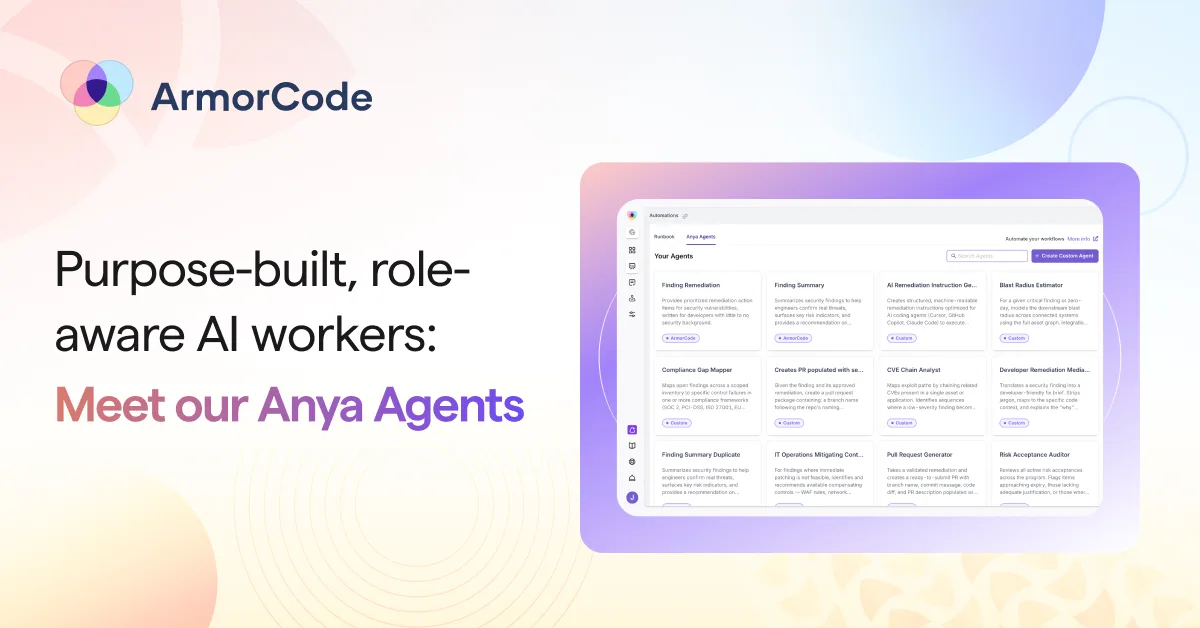
That’s the gap ArmorCode’s Agentic Control Plane is built to close with Anya Agents, purpose-built, role-aware AI workers, each scoped to a single high-value workflow and grounded in the same Context Risk Graph that powers the rest of the platform, spanning 400+ integrations across the security tool stack:
- Remediation Agent generates code-aware remediation guidance for a finding or group of findings.
- Zero-Day Exposure Hunting Agent assesses organizational impact the moment a new CVE is disclosed: pulling threat intel, identifying affected components, checking supply chain exposure, and producing a full impact report.
- Finding Overview Agent summarizes a finding in plain language, surfacing the context a security team actually needs.
- Risk Analyzer Agent explains the reasoning behind a risk score, so leaders understand the “why,” not just the number.
For software supply chain security specifically, the Zero-Day Exposure Hunting Agent is the clearest example of what changes: instead of a security team manually cross-referencing a new advisory against every SBOM, dependency tree, and running application, the agent answers “are we affected?” in minutes rather than days, and hands off directly into a remediation workflow instead of a spreadsheet.
None of this replaces the judgment of a security team. It removes the repetitive analytical work that used to stand between a new advisory and a confident answer. Each agent operates under the same role-based access controls as the rest of the platform, so administrators control which agents run and where, and AI stops being a side-of-desk activity and becomes an auditable part of the security program itself.
Software supply chain security isn’t a tool category you buy once. It’s an operating discipline that has to keep pace with an ecosystem that changes daily. The teams getting ahead of it are the ones treating SBOMs, VEX, and risk-based prioritization as a continuous workflow rather than a compliance exercise, with the questions below covering where most teams get stuck first.
Frequently Asked Questions
Q: What is the difference between SCA and software supply chain security? A: Software Composition Analysis (SCA) is a tool category focused on identifying open-source components and their known vulnerabilities. Software supply chain security is the broader strategic discipline that encompasses SCA, but also includes securing build pipelines, managing SBOMs, analyzing third-party risk, and prioritizing remediation across the entire application lifecycle.
Q: Why is generating an SBOM not enough for security? A: Generating an SBOM is simply creating an inventory list. Without a platform to ingest, aggregate, and enrich that data with threat intelligence and exploitability context like VEX, an SBOM is a static compliance document rather than an actionable security asset, and it goes stale within days as new CVEs are published.
Q: How do VEX reports improve vulnerability management? A: VEX reports provide context on whether a specific vulnerability in a component is actually exploitable in the context of the final product. This helps security teams filter out false positives and focus remediation effort on real, exploitable risk instead of every theoretical CVE match.
Q: How can organizations reduce alert fatigue from SCA tools? A: Organizations can reduce alert fatigue by aggregating findings from multiple SCA scanners into a single platform, deduplicating overlapping alerts, and prioritizing what’s left using business context and active threat intelligence rather than raw CVSS scores.
Q: What role does AI play in securing the software supply chain? A: Purpose-built AI agents (like ArmorCode’s Anya Agents) help security teams automate triage, instantly answer “are we affected?” when a new zero-day is announced, generate code-aware remediation guidance, and explain the reasoning behind risk scores, shifting the team’s time from manually finding vulnerabilities to fixing them.
Don’t let alert fatigue and unmanaged SBOMs slow down your development pipelines. ArmorCode’s Platform provides the independent control plane you need to ingest SBOMs automatically, enrich component data, and prioritize risk effectively with Anya Agents. Request a demo today to see how you can remediate less and reduce risk faster.
Key Takeaways
- SCA alone can’t keep pace with third-party risk. Third-party involvement in breaches doubled from 15% to 30% in a single year (Verizon 2025 DBIR), yet most enterprises run multiple SCA tools that each score risk differently with no shared context, leaving thousands of disconnected alerts and no clear priority list.
- An SBOM is only as useful as what happens after it’s generated. Compliance mandates require producing an SBOM, but it’s a static inventory that goes stale the moment a new CVE drops. The real security value comes from ingesting, enriching, and continuously monitoring that data, plus using VEX reports to confirm which flagged vulnerabilities are actually exploitable in context.
- Risk-based prioritization turns noise into a short, actionable list. Layering CISA KEV data, EPSS scores, and asset context on top of raw CVSS rankings lets teams separate real threats from dead ends. This is the CTEM approach applied to the supply chain, and it’s how ArmorCode’s Context Risk Graph narrows thousands of findings down to the roughly 3% that represent 80% of actual business risk.