ArmorCode vs. ServiceNow: Exposure Management Comparison (2026)
Table of Contents
Key Takeaways
- ServiceNow Vulnerability Response (VR) is ServiceNow’s vulnerability-management application within SecOps.
- ArmorCode is an Agentic AI platform for Unified Exposure Management where AI agents help security teams correlate, triage, and remediate vulnerabilities across infrastructure, cloud, supply chain, apps, and AI.
- ServiceNow works well as the system of record and remediation engine; ArmorCode adds an independent Agentic Control Plane that can sit in front of ServiceNow when organizations need to correlate and deduplicate findings across multiple third-party security tools.
- ServiceNow works within its own vulnerability, CI, and CMDB data model. ArmorCode correlates findings across the broader security environment, connecting vulnerabilities with assets, code, cloud resources, ownership, business context, and network relationships.
- ArmorCode can complement ServiceNow VR or, where appropriate, replace the VR layer while ServiceNow continues to serve as the ITSM and system-of-record platform.
What is ServiceNow Vulnerability Response (VR)?
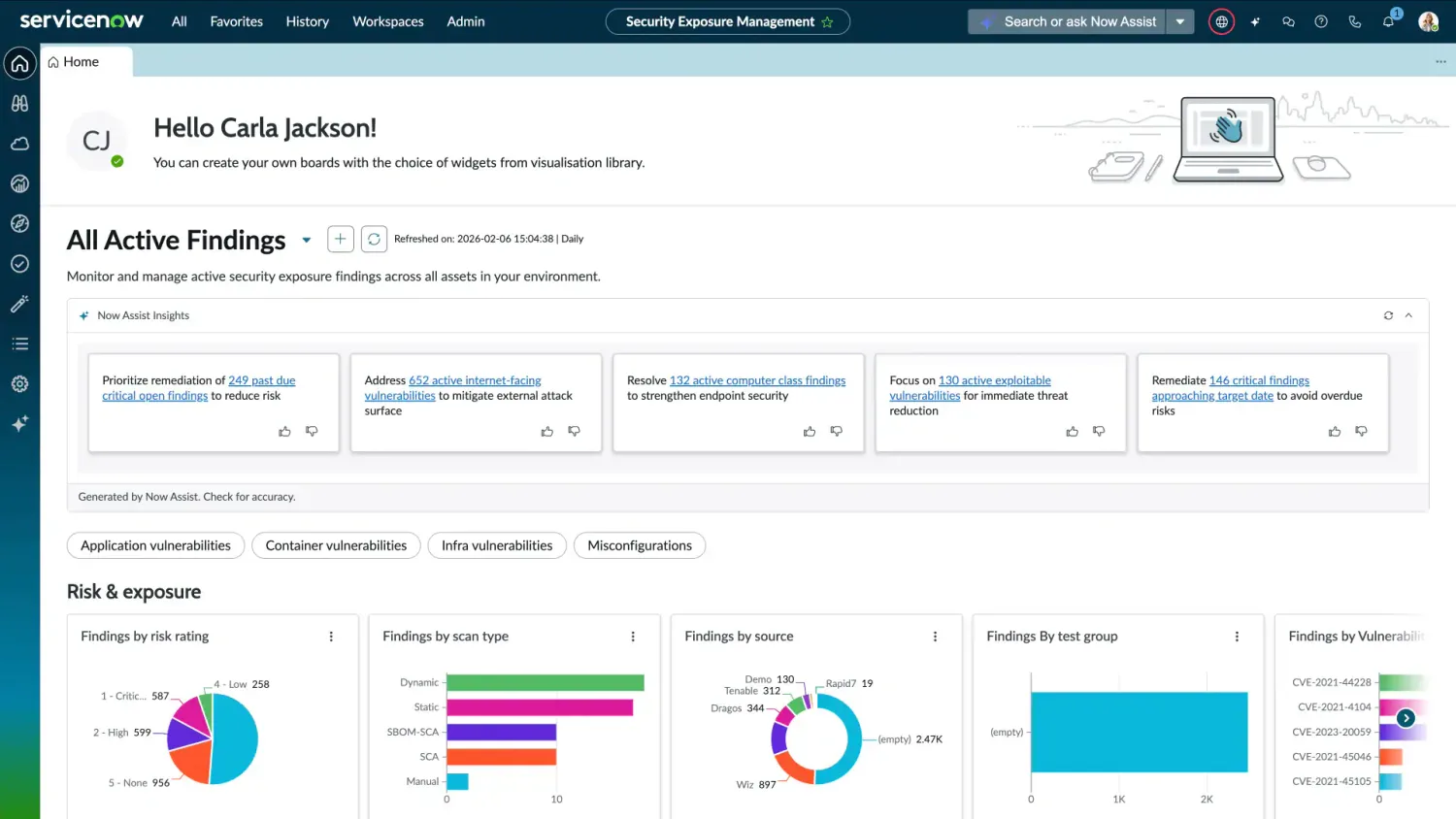
ServiceNow Vulnerability Response (VR) is ServiceNow’s vulnerability-management application within Security Operations (SecOps). VR ingests findings from third-party vulnerability scanners such as Qualys, Tenable, and Rapid7 and associates those findings with vulnerable items, configuration items, and CMDB context.
ServiceNow is now transitioning towards Unified Security Exposure Management (USEM), which it describes as the next evolution of Vulnerability Response. USEM v30.x was released in December 2025 and brings VR, AVR, CVR and other exposure capabilities into a more unified architecture.
The forced move from VR to USEM adds migration complexity
ServiceNow describes the move to USEM as a major architectural change involving data models, integrations, workflows, plugins, and configuration.
With the Brazil platform release, USEM becomes the required version of VR. Customers that have not migrated beforehand will be moved as part of the platform upgrade and will then need to complete the VR-to-USEM migration. ServiceNow recommends migrating earlier to allow enough time for testing and validation.
The migration requires customers to test in a non-production environment, validate data and customizations, check integrations, and resolve conflicts. Third-party integrations and scheduled jobs also need to be deactivated and restored. Once upgraded to USEM, the instance cannot be rolled back.
This can be more complicated for heavily customized environments, where assignment rules, CI lookup rules, auto-close rules, dashboards, and other configurations may require review after migration. Existing VR customers need to account for the additional cost, effort, and operational risk of moving to a new architecture.
What the Armis Acquisition Changes for ServiceNow
ServiceNow completed its $7.75 billion acquisition of Armis on April 20, 2026, bringing Armis’ cyber asset discovery and exposure-management capabilities into the ServiceNow platform.
Armis Centrix remains available as a standalone solution, and ServiceNow says deeper integration between the two platforms is expected over time.
ServiceNow is also bringing Armis intelligence into USEM through capabilities such as Early Warning and Fix Intelligence. Early Warning adds intelligence about vulnerabilities that threat actors are preparing to exploit, while Fix Intelligence uses normalized fix information from Armis Centrix to help customers remediate vulnerabilities by fix rather than addressing individual findings.
There are still integration considerations. For example, a ServiceNow Community discussion with a ServiceNow technical architect described the out-of-box Armis VIPR integration as one-way. Sending remediation-status updates from ServiceNow back to Armis required custom APIs and flows. VIPR and Centrix have separate dashboards and user administration, which means teams may need to work across both platforms.
ArmorCode takes an independent control-plane approach. It can sit above ServiceNow and Armis, correlate and deduplicate findings across the broader security stack, and send the resulting remediation actions into ServiceNow or other systems.
This creates a complementary architecture rather than a rip-and-replace proposition. ServiceNow can remain the system of record and workflow engine, Armis can provide asset and threat intelligence, and ArmorCode can act as the prioritization and remediation orchestration layer across the environment.
What is ArmorCode?
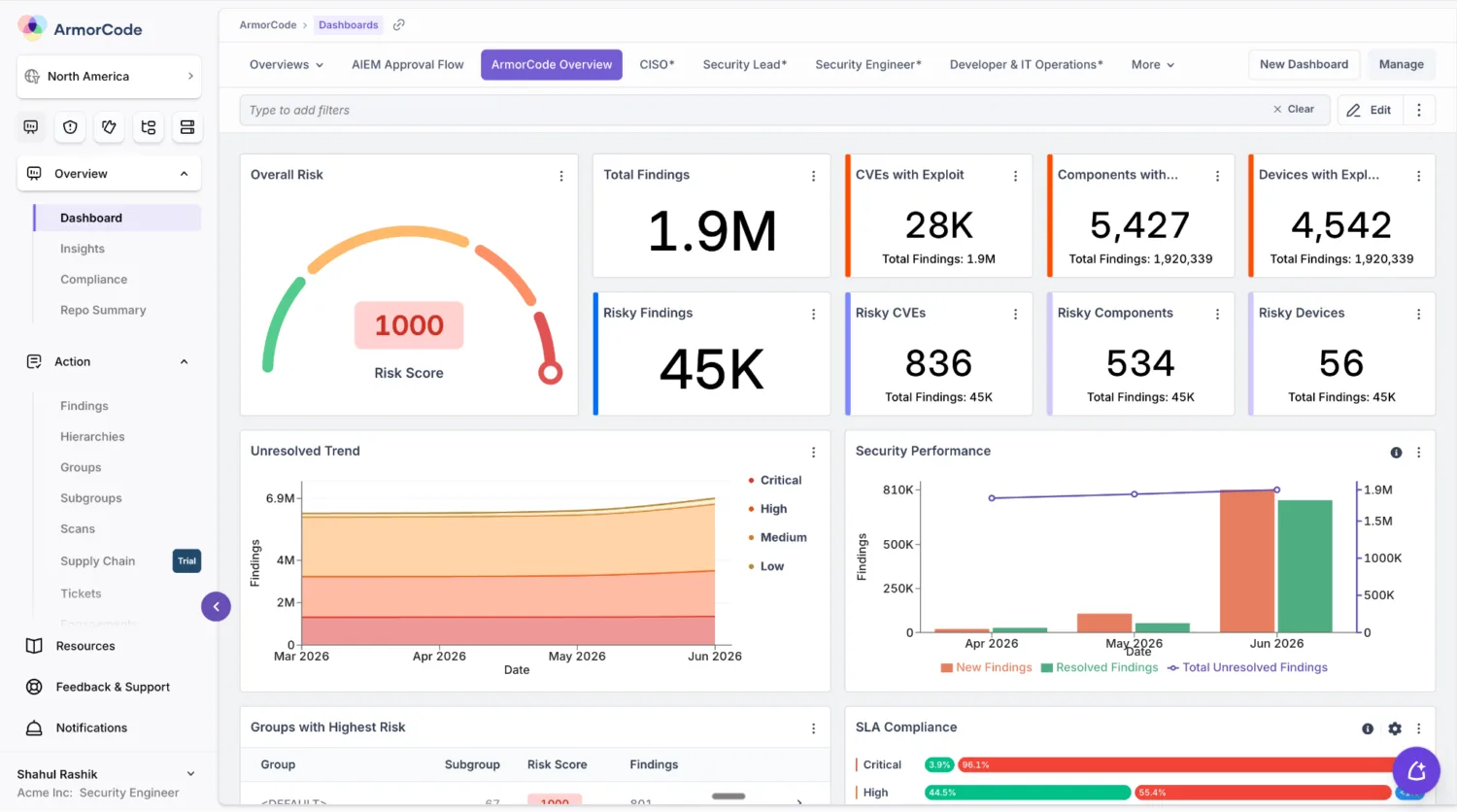
ArmorCode is an independent Agentic Control Plane for Unified Exposure Management where AI agents help security teams correlate, triage, and remediate vulnerabilities across infrastructure, cloud, supply chain, apps, and AI.
The platform delivers visibility, insight, and control through four core solution areas: Application Security Posture Management (ASPM), Vulnerability Management, Software Supply Chain Security, and AI Exposure Management (AIEM).
ArmorCode’s scanner-agnostic architecture enables organizations to continue using their existing security tools while gaining a unified view of risk across the enterprise. It connects with 400+ security and development tools across application, infrastructure, cloud, container, and AI security tools. Processing more than 400 billion security findings annually, ArmorCode helps enterprises consolidate security data, prioritize what matters most, and scale remediation efforts across the organization.
At the core of ArmorCode is the Context Risk Graph, which connects security findings with assets, code repositories, cloud resources, identities, network topology, business context, and ownership to create a comprehensive understanding of risk. This shared intelligence layer powers Anya Agents, ArmorCode’s purpose-built AI workers. Grounded in unified security and business context, Anya Agents are configured with predefined prompts, bounded actions, and enterprise-specific context to perform tasks such as vulnerability triage, exposure analysis, remediation guidance, code fixes, validation, and compliance support.
The platform is trusted by hundreds of global enterprises to reduce risk, improve security governance, scale remediation efforts, and confidently embrace AI and modern software development.
Where ArmorCode Fits in a ServiceNow Environment
ArmorCode can complement ServiceNow
Many organizations use ArmorCode and ServiceNow together as complementary components of their vulnerability management and remediation programs.
ArmorCode operates as the independent Agentic Control Plane, aggregating, correlating, deduplicating, and prioritizing findings across security tools. ServiceNow serves as the system of action, managing ticketing, workflow automation, ownership, and remediation tracking. By combining the two, organizations can transform fragmented security findings into a prioritized set of remediation actions. ArmorCode provides the risk context and remediation intelligence, while ServiceNow drives execution through operational workflows.
1. Reducing Security Noise Before It Reaches ServiceNow
ArmorCode ingests findings from security, cloud, infrastructure, and application security tools, then normalizes and deduplicates the data while using AI-powered correlation to identify related findings across scanners. Findings are enriched with business context and risk-based prioritization before being routed into ServiceNow as remediation records. ServiceNow receives a consolidated set of prioritized findings instead of large volumes of raw scanner output, reducing duplicate tickets and operational noise.
When the same underlying issue is identified by multiple tools, ArmorCode correlates those signals into a single finding before it reaches ServiceNow. For example, a vulnerable open-source dependency reported by one scanner and a running container associated with the same risk identified by a separate cloud security tool can be linked and presented as one remediation item. The result is a more accurate representation of risk and a more efficient remediation workflow.
2. Native Store Integration
ArmorCode has native applications in the ServiceNow Store for Vulnerability Response, Application Vulnerability Response, and Container Vulnerability Response.
The integrations let organizations keep ServiceNow as the system where remediation work is managed, while ArmorCode aggregates findings from across the security stack. ArmorCode normalizes and deduplicates related findings, adds risk and asset context, and sends the relevant vulnerability data into ServiceNow for remediation.
This gives teams a way to keep their existing ServiceNow workflows while handling some of the challenges that come with having multiple security tools feeding findings into ServiceNow. ArmorCode handles the cross-source correlation and deduplication before the findings are sent into ServiceNow.
3. Remediation via ITSM, VR, AVR, and CVR
Once a finding is normalized, correlated, and prioritized, ArmorCode pushes it into ServiceNow either as a standard ITSM incident or as a Vulnerable Item created bi-directionally in the VR, AVR, or CVR modules. Instead of creating a separate ticket for every raw scanner finding, ArmorCode correlates related findings and routes them into a single remediation record for the owning team. The approach reduces duplicate tickets, minimizes alert noise, and allows ServiceNow users to focus on remediation rather than triage.
4. Governance via IRM
For risk exceptions, ArmorCode integrates with ServiceNow’s Integrated Risk Management (IRM) module. Teams can create an exception in ServiceNow for a specific ArmorCode finding, and once that exception is approved, the finding’s status updates automatically back in ArmorCode, so exception handling doesn’t require maintaining parallel records across both systems.
5. Bidirectional Sync with ServiceNow
Status changes, comments, and reassignments sync in both directions between the two platforms. When a ticket is closed in ServiceNow, ArmorCode marks the corresponding finding “Resolved,” but the loop isn’t considered permanently closed until a subsequent scan confirms the fix. If a later scan detects the vulnerability again, ArmorCode automatically reopens the existing ServiceNow ticket rather than creating a duplicate. The approach preserves historical context and helps prevent the vulnerability-count inflation that often occurs when the same issue generates multiple tickets over time.
Together, these capabilities transform ServiceNow from a destination for raw scanner output into an execution layer focused on remediation. Security teams receive a smaller set of correlated, prioritized findings, while remediation teams continue to work within familiar ServiceNow workflows. The result is a more scalable path from fragmented security data to actionable remediation.
ArmorCode can also replace the ServiceNow VR layer
ArmorCode can take over the vulnerability-management layer by correlating findings across security tools, deduplicating them across sources, adding broader risk context, prioritizing remediation, and orchestrating remediation workflows. ServiceNow can remain the system of record for assets, IT workflows, and enterprise change management.
1. AI-Powered Correlation and Deduplication
ServiceNow Vulnerability Response (VR) does not deduplicate Vulnerable Items (VIs) across separate third-party scanner integrations. For example, if an organization uses both Qualys and Rapid7, VR treats findings from each integration separately. A finding from Qualys therefore cannot be deduplicated against a matching finding from Rapid7. For organizations using multiple scanners, this can result in the same underlying vulnerability being represented separately in VR. Security teams then have more vulnerability records to reconcile and manage across their different scanner sources.
“Third-party integrations are treated separately. If more than one third-party integration application is in use in your environment there is no vulnerable item deduplication across integrations.”
2. Reduce Dependency on Perfect CMDB Data
ServiceNow Vulnerability Response (VR) relies on accurate CI-to-CMDB matching to understand where a vulnerability exists and who or what is responsible for it. Findings are matched using ordered lookup rules that combine scanner-provided attributes with fields in the CMDB. When the identifiers from a scanner do not line up with the corresponding CMDB records, the vulnerability context can be incomplete or the finding may remain unmatched. Resolving these cases often requires additional lookup logic, and creating and maintaining custom lookup rules typically requires ServiceNow and VR expertise.
The underlying challenge is that CMDB data is not always complete or accurate enough to give security teams the context they need. In a YouGov survey of 213 senior IT professionals, 56% of organizations reported CMDB accuracy of 85% or lower.
This CMDB dependency is one of the practical challenges we hear from ServiceNow customers. Getting VR to work well often starts with getting the CMDB into good shape. Assets need to be discovered, scanner identifiers need to match CMDB records, ownership and relationships need to stay current, and lookup rules need to be configured and maintained.
ArmorCode uses rule-based partial hostname matching, IP correlation, and multi-attribute mapping to connect findings to the right assets, including cases where the available identifiers do not match perfectly.
This means ArmorCode can work alongside the existing asset system without requiring the CMDB to contain every piece of security context. Its Context Risk Graph connects findings with assets, ownership, code repositories, cloud resources, business context, and other relationships, giving security teams a broader view of the risk associated with each finding.
3. Trace Exposures From Runtime Back to the Source
ServiceNow has dedicated workflows for infrastructure, application, and container vulnerabilities. VR manages infrastructure findings, AVR processes application vulnerabilities, and CVR manages container vulnerabilities and adds runtime context. Each model has its own records and matching logic. AVR, for example, compares imported application data against application records in the CMDB to create Application Vulnerable Items, while CVR uses container images, Kubernetes entities, cloud metadata, and other runtime data to establish ownership and risk.
The practical challenge is connecting those layers when the location of the vulnerability is different from the location of the fix. A vulnerability discovered in a running container may ultimately need to be fixed in a source repository, dependency, or base image. ServiceNow can capture substantial container and runtime context, but the customer still has to establish the relationships and configure the appropriate data models, lookup rules, and assignment logic across these workflows.
ArmorCode is designed around that code-to-cloud connection. Its AI Correlation brings together findings from code and runtime tools, allowing a production or cloud finding to be correlated back toward its source code, repository, and development owner. ArmorCode’s platform connects security findings with code repositories, cloud resources, assets, ownership, and network relationships, creating a connected view of how an exposure moves from code into production.
This matters because the place where a vulnerability is detected is not necessarily where it should be fixed. A cloud or runtime finding may ultimately require a code change, dependency update, or base-image fix. ArmorCode is built to identify that upstream remediation path and route the issue toward the owner of the underlying fix, rather than stopping at the asset where the vulnerability was discovered.
Key Capabilities of ArmorCode vs. ServiceNow VR Compared
Unified Exposure Management (UEM)
As an Agentic Control Plane for Unified Exposure Management, ArmorCode sits above the entire security stack, correlating risk across applications, code repositories, cloud, infrastructure, software supply chains, and AI systems. Security teams understand how individual findings relate to broader exposure scenarios, business risk, and application context rather than evaluating vulnerabilities in isolation. Built on that context, Anya AI agents assist security teams with risk analysis, investigation, prioritization, remediation coordination, and governance workflows.
ServiceNow has evolved beyond traditional Vulnerability Response with Unified Security Exposure Management (USEM), bringing infrastructure, application, container, and configuration exposures into a common architecture and workspace. USEM ingests findings from multiple scanners, correlates them to CMDB assets, applies business-context risk scoring, and supports unified remediation workflows. ServiceNow describes USEM as a major architectural upgrade to its previous Vulnerability Response applications.
For existing VR customers, ServiceNow describes the move to USEM as a complex migration that can involve changes to data models, plugins, integrations, and workflows. The migration also requires compatibility checks, conflict resolution, and validation after the migration is complete.
Application Security Posture Management (ASPM)
ArmorCode’s Application Security Posture Management (ASPM) solution unifies and correlates findings across SAST, DAST, SCA, IaC, API security, secrets detection, container security, cloud security, and other application security tools into a single, risk-based view. By combining these signals with business context, ownership data, and threat intelligence, ArmorCode helps organizations prioritize and remediate application risk throughout the software development lifecycle. ArmorCode was recognized as a Leader in the IDC MarketScape: Worldwide Application Security Posture Management (ASPM) 2025 Vendor Assessment.
ServiceNow AVR aggregates application security findings and supports remediation workflows, but ServiceNow does not position AVR itself as an ASPM platform. Its approach is centered on vulnerability and exposure management. AVR can ingest and remediate application vulnerabilities, while the newer Unified Security Exposure Management (USEM) architecture brings application security together with infrastructure, container, cloud, and configuration exposures.
Risk Based Vulnerability Management
ArmorCode plugs right into your existing security stack to bring all your vulnerability data into one unified view. Instead of just ranking issues by generic severity scores, it looks at the bigger picture, combining real-world threat intelligence and active exploit data with your actual business context and asset criticality.
To address vulnerabilities that cannot be immediately patched, ArmorCode utilizes patch orchestration and mitigating controls to bridge the gap. This enables security teams to deploy proactive safeguards, such as firewall policies or WAF rules, minimizing the risk of exploitation while a permanent remediation is tested and finalized.
ServiceNow provides configurable risk scoring for Vulnerability Response. Its default risk calculator can consider factors such as vulnerability severity, exploit information, CI criticality, external exposure, and EPSS. Customers can customize the weighting and rules based on their organization’s priorities. ServiceNow can also use CMDB attributes, such as whether a CI is internet-facing, as inputs to the risk calculation.
Integrations
ArmorCode provides 400+ out-of-the-box integrations spanning application security, cloud security, infrastructure security, software supply chain security, container security, CMDB, CI/CD, ticketing and threat intelligence platforms. For tools without a prebuilt integration, ArmorCode also supports custom connectors, allowing organizations to connect additional security sources. This makes ArmorCode a fit for enterprises that use multiple security tools and want a vendor-agnostic platform to bring those sources together.
ServiceNow Vulnerability Response (VR) supports integrations with major vulnerability scanners such as Qualys, Rapid7, Tenable, and Microsoft Defender.
Context Based Risk Prioritization
ArmorCode prioritizes vulnerabilities based on their broader business context, rather than relying on CVSS scores alone. The platform considers factors such as asset exposure, data sensitivity, business criticality, exploitability, and threat intelligence to help teams prioritize the exposures that present the greatest organizational risk. ArmorCode also offers CVSS Environmental rescoring to adjust the severity of a vulnerability based on the characteristics of the specific environment in which it exists.
Instead of treating each vulnerability as an isolated finding, ArmorCode can identify how risk can move across connected assets and systems. Teams can then prioritize remediation based on the exposures and attack paths that present the greatest risk.
ServiceNow VR’s current risk calculators can incorporate vulnerability severity, exploit information, CI criticality, external exposure, and EPSS, with configurable weights. ServiceNow also allows customers to create custom calculators based on factors such as business impact, CI class, and vulnerability age. Risk scores are recalculated when relevant vulnerability or CI data changes.
Software Supply Chain Security
ArmorCode provides dedicated Software Supply Chain Security capabilities, including SBOM visibility, dependency risk analysis, CI/CD posture monitoring, and software supply chain governance. These capabilities help organizations identify, prioritize, and manage risks associated with open-source dependencies, build pipelines, and software delivery processes.
ServiceNow has integrations with SCA, SBOM for software supply chain security visibility. But, It doesn’t generate SBOMs natively, the capability comes through Store-listed partner apps which ingest and enrich SBOM data inside the VR module. ServiceNow offers limited native CI/CD security posture management and places less emphasis on software-delivery-lifecycle risk correlation across code, dependencies, build systems, artifacts, pipelines, and runtime environments.
Dashboards & Reporting
ArmorCode provides customizable dashboards and reports for different security and business audiences. Security leaders can track risk reduction and trends, while AppSec and engineering teams can use views that are more relevant to their responsibilities. ArmorCode also supports customizable reporting and role-based access, so different stakeholders can focus on the security and compliance data that matters to them.
ServiceNow has dashboard and reporting capabilities through Platform Analytics. Customers can create dashboards using data visualizations, widgets, filters, and interactive drill-downs.
Remediation and Ticketing Workflow
ArmorCode is designed to reduce the amount of security work that reaches remediation teams. It correlates and deduplicates findings across security tools, groups related vulnerabilities around a common remediation action, and can create a single enriched vulnerability item instead of sending separate records for each underlying scanner finding. ArmorCode also supports ownership tracking, SLA enforcement, AI Remediation Guidance, and ticketing integrations across systems including ServiceNow, Jira, and others.
ServiceNow provides native remediation workflows once vulnerability data is in the platform. VR, AVR, and CVR can group Vulnerable Items into remediation tasks, assign those tasks to remediation teams, and keep task and vulnerability states synchronized. ServiceNow also supports bi-directional integration with Jira.
Agentic AI Framework
ArmorCode provides an agentic AI framework through Anya and purpose-built Anya Agents. Anya Agents are specialized AI workers for security workflows such as risk analysis, prioritization, investigation, and operational tasks. Each agent operates with preconfigured prompts, defined context, and bounded actions to produce consistent outcomes.
ArmorCode offers the following agents: Remediation Agent (generates remediation guidance grounded in metadata, code context, and environmental risk factors), a Zero-Day Exposure Hunting Agent (correlates threat intelligence, software supply chain data, and affected assets to assess exposure to newly disclosed CVEs), a Finding Overview Agent (summarizes findings in plain language with operational and business context), Risk Analyzer Agent (explains the reasoning behind risk scores and prioritization decisions), a Vulnerability Researcher (investigates the real-world exploitability of a CVE within an organization’s specific environment), a Mitigation Engineer (works with existing compensating controls, including WAF rules and EDR policies, to contain risk until a permanent fix is applied), a Cloud Security Engineer (evaluates cloud misconfigurations and exposures for meaningful business impact), and a Patch Orchestrator (plans and sequences patch rollouts across affected systems).
They are grounded in ArmorCode’s Context Risk Graph, which correlates findings from security and development tools with assets, software supply chain data, threat intelligence, business context, ownership, and network relationships. This gives the agents a common security context from which to investigate exposure, prioritize risk, and recommend or coordinate remediation. Organizations can use these prebuilt agents directly, invoke them through ArmorCode’s APIs and MCP server integrations, or build custom agents through the Anya harness for their own workflows
ServiceNow has introduced its own agentic capabilities through Now Assist and Agentic Workflows for Vulnerability Response and Unified Security Exposure Management (USEM). These agents can retrieve vulnerability data, assess exposure, analyze remediation status, and answer natural-language questions through Security Exposure 360. Users can ask questions about vulnerabilities, remediation progress, and exposure data and receive responses grounded in the findings stored within ServiceNow.
CI/CD Pipeline Gating
ArmorCode integrates with developer pipelines such as Jenkins, GitLab CI, and Harness to enforce release gates. Teams can use security policies to block builds in real time when those policies are violated, helping prevent security issues and technical debt from moving into production.
ServiceNow also supports deployment gates that can determine whether a deployment should proceed or be stopped, including GitHub Deployment Gates. Its DevOps Vulnerability Integrations can bring SAST, DAST, and SCA results from CI/CD tools into ServiceNow. Those security results can then be used to change policies and automation conditions.
Organizational Hierarchy and Ownership
ArmorCode lets security teams organize risk around how the business is structured. Its Hierarchies capability supports N-level, parallel, and overlapping structures across applications and infrastructure, including business units, product lines, geographies, and ownership groups.
In ServiceNow VR, vulnerability ownership is closely tied to its CI and CMDB model. Findings need to be mapped to the appropriate CI so ServiceNow can apply risk, assignment, and remediation workflows. ServiceNow provides lookup rules, field matching, and custom scripts to make those associations, and describes CI matching as a critical function. Creating custom lookup rules requires advanced VR/USEM expertise. Keeping scanner data, CIs, ownership, and organizational relationships aligned can become an operational burden, particularly in environments where assets and ownership change frequently.
AI Exposure Management
ArmorCode provides a dedicated AI Exposure Management (AIEM) capability that discovers, inventories, and governs AI technologies in use across the organization, including shadow AI deployments that may not be sanctioned by the IT or security team.
ServiceNow offers AI Security Exposure Management as part of its Unified Security Exposure Management platform. It provides visibility into AI vulnerabilities, validation findings, and AI posture findings, including AI assets such as models and agentic AI components. It also supports integrations with third-party AI security tools.
Why Organizations Choose ArmorCode
Scanner Agnostic
ArmorCode is scanner agnostic by design. It does not sell or require its own vulnerability scanner. Instead, ArmorCode connects to the security tools an organization already uses and ingests and normalizes findings across application security, infrastructure, cloud, container, software supply chain, and other security technologies. This allows organizations to add or change scanners without having to rebuild their vulnerability-management processes around a specific vendor.
ServiceNow continues to support third-party vulnerability scanners, but its architecture is moving beyond a purely vendor-neutral aggregation model. With the acquisition of Armis in April 2026, ServiceNow now has its own cyber asset discovery and exposure-management platform spanning IT, OT, IoT, medical devices, physical AI, code, and cloud. This gives ServiceNow a first-party source of asset intelligence and cyber exposure data alongside the findings it receives from third-party scanners.
Context Risk Graph
ArmorCode’s Context Risk Graph continuously correlates security findings, code repositories, cloud infrastructure, network relationships, IAM identities, software supply chain data, and business ownership context into a single unified model.
For example, a low-severity finding in an open-source dependency, correlated with a misconfigured cloud resource and an overprivileged identity, can surface as a critical exposure path that neither finding would reveal in isolation. This is the foundation for ArmorCode’s attack path analysis and vulnerability chaining capabilities, connecting dots that asset-level correlation alone cannot reach.
Practitioner-Led Community
ArmorCode powers the Purple Book Community, a global network of more than 1,000 CISOs, AppSec leaders, security practitioners, researchers, and academics focused on advancing software security. The community brings together security leaders to share real-world experiences, discuss emerging threats, and exchange proven practices for building and scaling effective security programs. ArmorCode also partners with community members on industry research, including the State of AI Risk Management 2026 report, which explores how enterprises are managing application security, exposure management, and AI-related risk.
Proven at Enterprise Scale
ArmorCode’s platform is used by hundreds of large enterprises across financial services, healthcare, technology, and retail. Publicly referenced customers include Visa, PayPal, Carrier, Universal Music Group, S&P Global, Johnson Controls, and Fortinet. ArmorCode is often deployed alongside ServiceNow, with the two platforms serving complementary roles in risk prioritization and remediation workflows.
ArmorCode vs. ServiceNow VR: Feature Comparison Table
| Feature | ArmorCode | ServiceNow VR |
| Scanner Agnostic | Yes | No |
| Unified Exposure Management Solution | Yes | Yes |
| ASPM Solution | Yes | Limited |
| Product Security Posture Management Solution | Yes | No Evidence |
| Software Supply Chain Security Solution | Yes | Limited |
| AI Exposure Management Solution | Yes | Yes |
| Integrations | 400+ | Not Public |
| AI Correlation | Yes | No Evidence |
| CI/CD Pipeline Gating | Yes | Limited |
| Penetration Test Management | Yes | Yes |
| Agentic AI Framework for Security | Yes | Yes |
| Risk Prioritization (Beyond CVSS) | Yes | Yes |
| CVSS Environmental Rescoring | Yes | No Evidence |
| Native Threat Intelligence Feed | Yes | No Evidence |
| Compliance Mapping | Yes | Yes |
| Automated Workflows | Yes | Yes |
| Remediation Orchestration | Yes | Yes |
| AI Generated Code Fix | Yes | No Evidence |
| Patch Orchestration | Yes | Yes |
| Compensating Controls | Yes | Yes |
| Dashboards and Reporting | Yes | Yes |
| Exception Management | Yes | Yes |
| AI Remediation Guidance | Yes | No Evidence |
Guide for choosing between ArmorCode and ServiceNow Vulnerability Response (VR)
ServiceNow Vulnerability Response was designed around a structured vulnerability-management workflow: ingest findings from scanners, match them against the CMDB, create vulnerability records, apply risk and assignment logic, and route remediation through ServiceNow workflows. This model works well for organizations that want vulnerability management tightly connected to their ServiceNow asset, ownership, and ITSM processes.
The model becomes more demanding as exposure data expands across application security, cloud, containers, software supply chain, and other security domains. ServiceNow’s newer Unified Security Exposure Management (USEM) architecture brings Vulnerability Response, Application Vulnerability Response, Container Vulnerability Response, and Configuration Compliance together. The question is how effectively USEM can correlate and prioritize that data across a heterogeneous environment.
ServiceNow VR may be sufficient for organizations with a strong company-wide ServiceNow mandate, a predominantly infrastructure-focused vulnerability program, relatively limited security-tool fragmentation, and mature CMDB, ownership, and remediation processes. In these environments, keeping exposure management within ServiceNow can simplify governance and preserve the existing operating model.
Organizations managing multiple scanners and large volumes of application, infrastructure, cloud, container, software supply chain, and other security findings may benefit from a security correlation layer that works across those sources. The value is not just reducing the number of findings. It is determining when findings from different tools represent the same underlying exposure, connecting those findings to the right asset and ownership context, and prioritizing remediation based on the broader security environment.
That is where ArmorCode can fit alongside ServiceNow. ArmorCode can act as the security correlation and governance layer, consolidating and prioritizing findings before sending actionable, context-rich work into ServiceNow ITSM and other downstream workflows. Organizations can retain ServiceNow for CMDB, ITSM, change management, and other enterprise workflows without replacing the broader ServiceNow platform.
ArmorCode can also support a different architectural approach by replacing the ServiceNow Vulnerability Response layer while retaining ServiceNow where it continues to add value. In this model, ArmorCode becomes the orchestration layer, while ServiceNow remains the system of record for CMDB and ITSM processes where required.
Want to see ArmorCode in action? Request a demo to see how ArmorCode can help your team reduce risk, prioritize critical exposures, and streamline remediation.
Prefer to explore on your own? Take an interactive product tour of the ArmorCode platform.
Note:
This comparison is based on publicly available sources, including vendor websites, press releases, and third-party review platforms. Feature classifications reflect the depth and native availability of capabilities within each platform at the time of writing. Vendor offerings evolve over time, and we cannot guarantee the ongoing accuracy of this information.
If you notice any inaccuracies or have updated information, please contact us.