What Are Application Security Vulnerabilities?
A comprehensive guide to understanding, detecting, prioritizing, and remediating application security vulnerabilities in modern enterprise environments.
Table of Contents
Application security vulnerabilities are the weaknesses that turn code into a liability. Every application your company ships, whether it’s a customer-facing product, an internal tool, or an API three teams depend on, carries flaws in its code, its configuration, or its dependencies. Attackers don’t need to find every one of them. They need to find one that matters, and they’re getting faster at it every year.
The scale of the problem is no longer theoretical. FIRST, the Forum of Incident Response and Security Teams now projects that 2026 will close out near 66,000 published CVEs, a surge driven largely by AI tools that have started hunting for software flaws on their own. That’s not just more disclosures. It’s a preview of what happens once vulnerability discovery itself gets automated. Most of those vulnerabilities will never be exploited. A small number will cause a breach. The entire discipline of application security vulnerability management exists to tell the difference, fast enough to matter.
This page covers what application security vulnerabilities are, how they differ from other categories of risk, why the volume keeps climbing, and how mature organizations run the full vulnerability management lifecycle from discovery through verification. It closes with the best practices that separate teams who stay ahead of their backlog from teams who drown in it.
What Are Application Security Vulnerabilities?
Application security vulnerabilities are weaknesses or flaws in software code, design, or configuration that an attacker can exploit to compromise the confidentiality, integrity, or availability of an application. They live at the application layer: in the code your developers write, in the open-source components that code depends on, in the APIs that connect your services, and in the way the application is configured to run.
That’s a different problem than a missing patch on a server operating system. Application security vulnerabilities are introduced during development and change every time code ships, which for most engineering organizations means daily or even hourly. They can’t be found by a single scan type, because a SQL injection flaw, a vulnerable open-source library, and a misconfigured API gateway don’t show up the same way or in the same tool.
The OWASP Top 10:2025 remains the standard taxonomy for categorizing these vulnerabilities, and it’s worth understanding as a baseline even though the real landscape has grown well beyond it.
Types of Application Security Vulnerabilities
Broken access control now tops the list, and it’s stayed a top-tier risk for years because it’s structurally hard to get right. Authorization checks that can be bypassed, insecure direct object references, and privilege boundaries that don’t hold under manipulation all let an attacker act with more permission than they should have. Security misconfiguration follows close behind: a cloud storage bucket left open, a default credential never rotated, unnecessary services left running, all failures of setup rather than code.
Software supply chain failures have become significant enough to earn their own category, folding in vulnerable and outdated components, unvetted dependencies, and compromised build pipelines into one risk area. That’s a direct reflection of how much of a modern application’s code comes from somewhere else, and how often the weak link is a package or pipeline nobody on the team wrote or fully audited. Cryptographic failures round out the infrastructure-adjacent risks: weak or missing encryption, hardcoded keys, and improper certificate validation that expose data in transit or at rest.
Injection remains a familiar name, though it’s fallen from the top spot as other risk categories have caught up. SQL injection, command injection, and cross-site scripting all exploit the same basic mistake: an application trusts input it shouldn’t. Insecure design is the newer, harder-to-fix cousin: flaws baked into the architecture itself, where no amount of clean coding fixes a system that was never threat-modeled in the first place. Authentication failures cover the identity side of the equation, from session tokens that don’t expire to password policies that don’t hold.
The final three categories reflect how much visibility and resilience now matter as much as prevention. Software or data integrity failures cover unsigned or unverified updates and deserialization of untrusted data. Security logging and alerting failures mean an intrusion goes unnoticed for months instead of caught in hours, because the system failed silently instead of raising a flag. Mishandling of exceptional conditions, the newest addition, covers the failures that show up when an application hits an edge case, an error, or an unexpected input and responds in a way that opens a door instead of closing one gracefully. None of this is exotic. It’s the standard attack surface of a modern application, and it changes shape every time the OWASP Top 10 gets updated.
How Application Security Vulnerabilities Differ from Infrastructure Vulnerabilities
Application security vulnerabilities exist inside the application itself: the code, the dependencies, the APIs, the business logic. Infrastructure vulnerabilities exist a layer down, in the operating system, the network, or the cloud services the application runs on top of. A missing OS patch and a SQL injection flaw are both vulnerabilities in the technical sense, but they’re found by different tools, owned by different teams, and remediated through completely different workflows.
In practice, the two categories aren’t separate problems so much as two inputs into the same program. An attacker doesn’t care whether the weakness they exploit sits in your code or in your cloud configuration; they care whether it gets them in. That’s why the organizations with the most mature programs don’t manage application and infrastructure vulnerabilities as parallel tracks. They fold both into a single, unified exposure management approach that gives security teams one view of risk across the entire stack.
Why Are Application Security Vulnerabilities Growing?
Five forces are driving the growth in application security vulnerabilities, and none of them are slowing down.
The first is development velocity. Teams that once shipped quarterly now ship daily, sometimes hourly. Every deployment is a new opportunity to introduce a flaw, and the faster the release cycle, the less time there is for security review before code reaches production.
The second is dependency on open-source software. Free and open-source software makes up an estimated 70 to 90 percent of the code in a typical modern application. That’s not a criticism of open source; it’s an accurate description of how software gets built now. But it means your application’s security posture is only as strong as the weakest link in a dependency tree you probably haven’t fully mapped, let alone audited.
The third is attack surface expansion. APIs, microservices, and containers have replaced the monolith, and each of those architectural shifts multiplied the number of places a vulnerability can hide. An application that used to be one deployable unit is now dozens of services talking to each other over networks, each with its own configuration and its own blast radius.
The fourth, and the one that changes the calculus most, is how fast attackers move once a vulnerability becomes public. The gap between disclosure and exploitation keeps shrinking. Log4Shell showed the world what mass exploitation of a single dependency vulnerability looks like at internet scale. The wave of npm supply chain incidents that followed showed that attackers don’t need a novel technique when they can poison a package thousands of applications already trust. Recurring CVE spikes, driven partly by the sheer volume of software being written and partly by more aggressive disclosure practices, mean security teams are triaging a moving target that gets bigger every year.
The fifth, and the one reshaping the other four in real time, is AI, and it’s working both sides of the problem at once. On the discovery side, autonomous AI agents are now hunting for flaws in existing codebases faster than human researchers ever could, which is a meaningful part of why FIRST is projecting a jump toward 66,000 CVEs in 2026. On the creation side, AI-generated code is introducing new vulnerabilities into applications at a pace security teams haven’t had to handle before. Georgia Tech’s Vibe Security Radar tracked 35 new CVEs directly attributable to AI-generated code in March 2026 alone, more than all of 2025 combined. Vibe coding didn’t invent injection flaws or broken access control. It just made it possible to ship a lot more of them, a lot faster, with fewer human eyes on the code before it reaches production.
Put those five forces together, and you get a straightforward conclusion: application security vulnerability management can’t be a periodic exercise. It has to be continuous, because the software, the dependencies, and the attackers are all moving continuously too.
The Vulnerability Management Lifecycle
Application security vulnerability management is a cycle, not a project. It has five stages, and skipping or under-investing in any one of them undermines the rest.
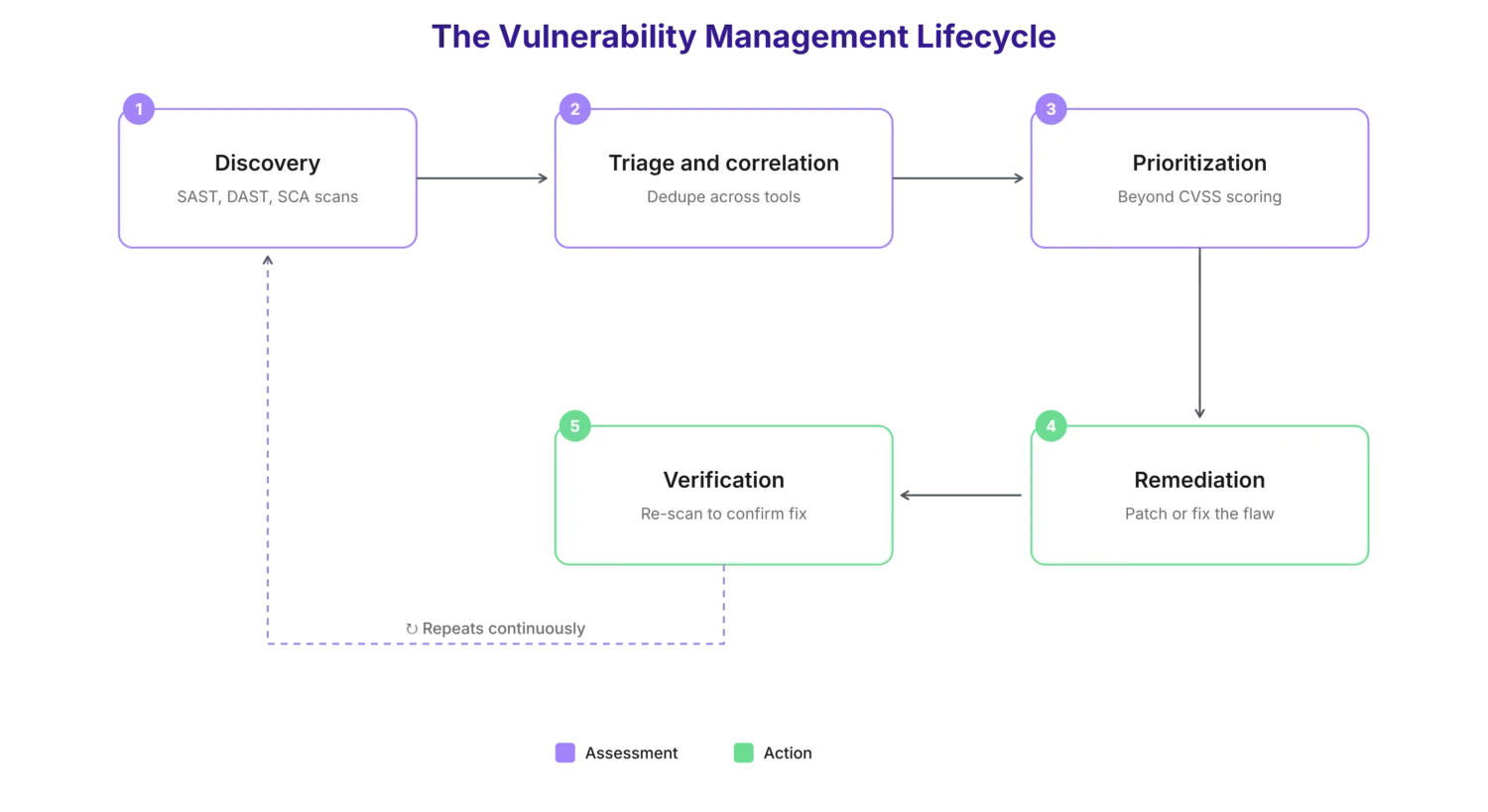
1. Discovery: Finding Vulnerabilities Across the SDLC
Discovery starts with testing, and no single test finds everything. Static Application Security Testing (SAST) analyzes source code without running it, catching flaws like injection vulnerabilities and insecure coding patterns before the application ever executes. Dynamic Application Security Testing (DAST) does the opposite: it tests a running application from the outside, the way an attacker would. Interactive Application Security Testing (IAST) sits between the two, combining static and dynamic analysis to catch what either approach alone would miss.
Software composition analysis (SCA) covers the dependency problem directly, scanning third-party and open-source components for known vulnerabilities. Penetration testing and manual code review add human judgment that automated tools can’t replicate, particularly for business logic flaws that don’t look like a vulnerability to a scanner. API security testing has become its own discipline as APIs have become a primary attack surface in their own right.
The practical challenge isn’t running these tools. It’s that every tool produces its own findings, in its own format, with its own severity scale, and none of them talks to the others. That’s the gap ASPM platforms exist to close: aggregating findings across every testing tool into a single, coherent picture of where vulnerabilities actually live in your codebase.
2. Triage and Correlation: Making Sense of Findings
The same vulnerability rarely shows up once. A flaw in a widely used library might get flagged by your SCA tool, your container scanner, and your SAST tool, each with a different finding ID, a different severity score, and no indication that they’re describing the same underlying problem. Multiply that across dozens of tools and thousands of findings, and you get the alert fatigue that defines most AppSec programs.
Triage and correlation is the discipline of deduplicating and normalizing those findings into a single record per real vulnerability. Without it, a security team isn’t managing risk; they’re managing noise, and every hour spent chasing a duplicate finding is an hour not spent on a real one. This is where unified vulnerability management earns its name: it takes the fragmented output of a dozen scanners and turns it into one dataset a team can actually act on.
3. Prioritization: Moving Beyond CVSS
CVSS tells you how severe a vulnerability is in a vacuum. It doesn’t tell you whether that vulnerability sits on an internet-facing system holding customer data, or in a dev sandbox nobody’s touched in a year. That distinction is the entire game, and it’s why CVSS alone was never designed to drive remediation priority on its own.
Risk-based vulnerability management (RBVM) layers additional signal on top of the CVSS baseline. EPSS estimates the probability that a given vulnerability will actually be exploited in the next 30 days, based on real-world data rather than theoretical severity. The CISA Known Exploited Vulnerabilities (KEV) catalog tells you which vulnerabilities are being actively exploited right now, which is about as concrete a prioritization signal as exists. Asset criticality, exposure level, and threat intelligence fill in the business context that severity scores can’t: what does this system actually do, who can reach it, and is anyone currently trying to exploit vulnerabilities like this one?
The payoff for combining these inputs is dramatic. Roughly 3% of findings represent 80 percent of real business risk once business context gets applied. Teams that prioritize on CVSS alone are, in effect, guessing at which 3 percent that is.
4. Remediation: Fixing What Matters
Vulnerability remediation covers the actual fix: patching a dependency, correcting a line of code, changing a configuration. When a full fix isn’t immediately possible, teams turn to compensating controls, mitigations that reduce exposure without resolving the underlying flaw, while a proper fix gets scheduled. Knowing when to remediate versus when to mitigate is itself a judgment call, and getting it wrong in either direction either burns engineering time on low-risk fixes or leaves a genuinely dangerous flaw exposed for longer than it should be.
Mean time to remediate (MTTR) is the metric that captures whether any of this is working. It’s also where AI-assisted remediation is starting to change what’s possible. Code-aware remediation agents that can generate a fix in context, rather than just flagging a problem and handing it to a developer, are compressing timelines that used to be measured in months down to days.
5. Verification: Closing the Loop
A fix that hasn’t been verified is a fix you’re hoping worked. Verification means re-scanning after remediation to confirm the vulnerability is actually gone, not just that a ticket got closed. It sounds obvious, and it’s also the stage most programs shortcut when they’re under time pressure.
The deeper issue is that point-in-time scanning, even when it’s done well, only tells you about risk as of the moment you scanned. Continuous monitoring is what catches the vulnerability that didn’t exist yesterday but does today, because a dependency you rely on just had a new CVE disclosed against it. That continuous posture is also what connects vulnerability management to the broader discipline of Continuous Threat Exposure Management (CTEM), which treats exposure as something to monitor constantly rather than assess periodically.
Common Challenges in Application Security Vulnerability Management
Alert fatigue is the challenge every security leader recognizes immediately. When dozens of tools each produce their own stream of findings, teams end up with thousands of alerts and no reliable way to tell which ones matter. The result isn’t more security. It’s teams that start ignoring alerts altogether, which is worse than having no alerts at all.
Siloed teams compound the problem. AppSec, SecOps, and cloud security teams often work from different tools, different dashboards, and different definitions of severity, which means a vulnerability that spans application and infrastructure layers can fall into the gap between teams instead of getting owned by either one.
Lack of business context turns prioritization into guesswork. A critical CVSS score on an isolated test system and the same score on a production database holding customer records are not the same risk, but without asset and exposure context, they look identical on a dashboard.
Remediation cycles remain slow across the industry. Critical-severity vulnerabilities sat unaddressed for an average of 164.7 days as of late 2025, and low-severity vulnerabilities took nearly 300 days to identify and resolve. That gap between disclosure and fix is exactly the window attackers are counting on, and it’s growing more dangerous as the time between disclosure and exploitation shrinks.
Compliance reporting adds a layer of overhead on top of the technical work. Frameworks like SOC 2, PCI-DSS, ISO 27001, and FedRAMP each want evidence of vulnerability management in their own format, and manually assembling that evidence pulls security engineers away from actual remediation work.
Tool sprawl underlies almost every challenge on this list. Most enterprise AppSec programs run a dozen or more scanning tools by the time you count SAST, DAST, SCA, cloud security, container scanning, and infrastructure tools. Each one is individually reasonable to adopt. Collectively, they’re the reason unified data and correlation aren’t optional extras; they’re the precondition for everything else on this page working.
Application Security Vulnerability Best Practices
1. Unify Vulnerability Data Across All Scanners
Prioritization is guesswork without a single source of truth. Aggregating findings from SAST, DAST, SCA, cloud security, and infrastructure scanners into one dataset, then deduplicating and normalizing what comes in, is the foundation everything else in this list depends on. Skip this step, and you’re not managing vulnerabilities; you’re managing whichever tool’s dashboard happens to be open.
2. Prioritize Using Business Context, Not Just Severity
Move past CVSS-only scoring and combine it with EPSS, CISA KEV, asset criticality, exposure, and threat intelligence. The goal is finding the roughly 3 percent of findings that represent 80 percent of real business risk, and then making sure that’s what your team is working on first, not whatever generated the loudest alert.
3. Automate Remediation Workflows
Findings that sit in a queue waiting for someone to notice them are findings that don’t get fixed. Route each finding to the team that owns the affected code automatically, set SLAs by risk tier, and track MTTR as a real operating metric rather than a number that shows up once a quarter. Code-aware remediation guidance, generated in the context of the actual vulnerability, is what turns “here’s a list of things to fix” into fixes that actually ship. Organizations doing this well have brought MTTR down from an industry-typical 240 days to just hours.
4. Integrate Security into the SDLC
Shifting left means embedding SAST and SCA directly into CI/CD pipelines, gating releases on critical findings, and surfacing security feedback to developers where they already work: their IDE, their pull requests. A vulnerability caught before merge costs a few minutes to fix. The same vulnerability caught in production costs an incident.
5. Monitor Continuously for New Exposure
New CVEs are disclosed every day, and a dependency that was safe yesterday can have a critical vulnerability today with no code change on your part at all. Continuous monitoring, rather than periodic scans, is what catches that shift immediately instead of at the next scheduled scan, whenever that happens to be. Rapid impact assessment when a new CVE drops, checking instantly whether it touches anything in your environment, is what separates a same-day response from a multi-week scramble.
Application Security Vulnerabilities with ArmorCode
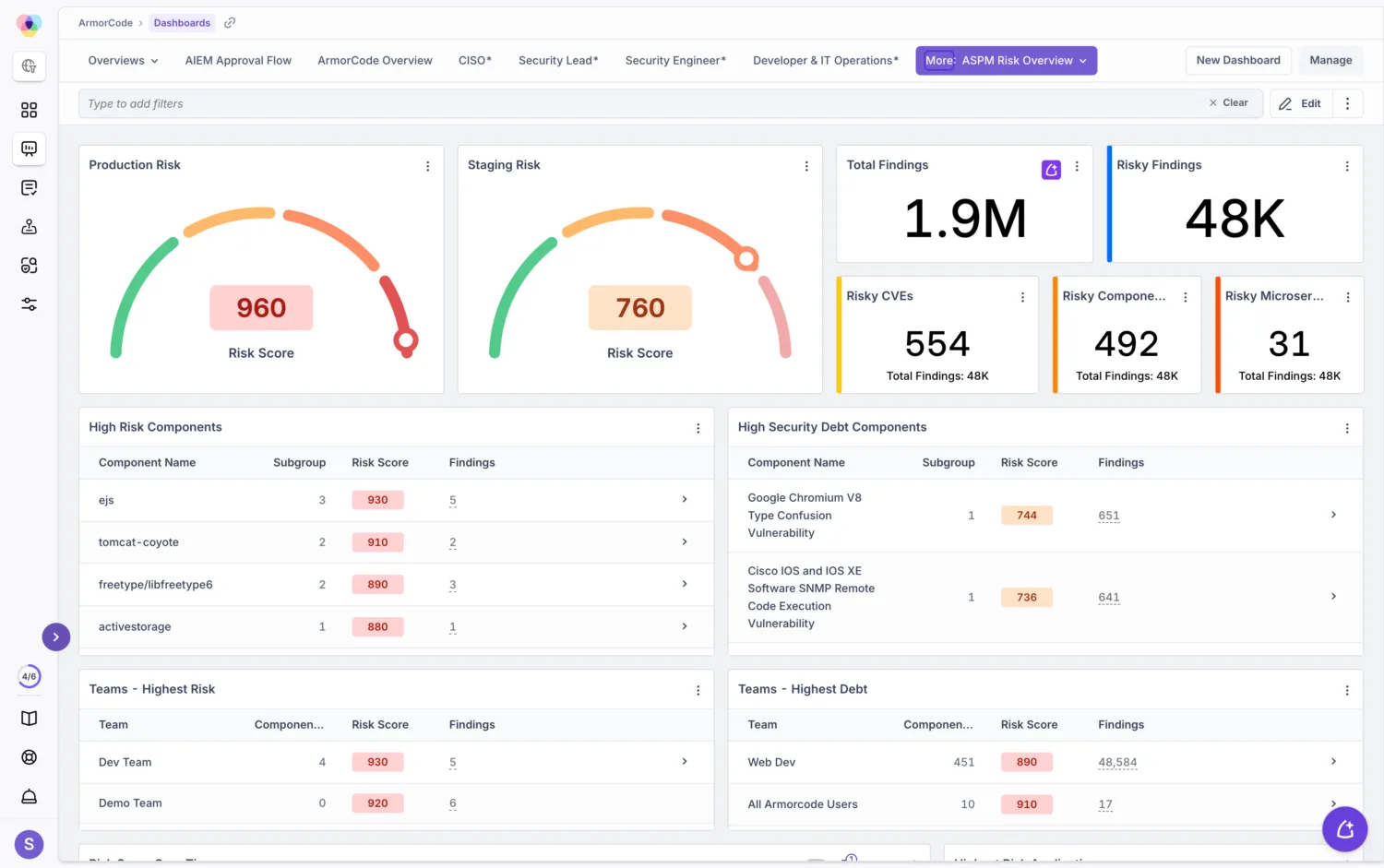
Every practice above depends on having a real, unified view of your vulnerability landscape. That’s the problem the ArmorCode Agentic Control Plane is built to solve, and it’s worth understanding how the pieces fit together.
Unified Vulnerability Data with 400+ Integrations
ArmorCode consolidates findings from 400+ security tools across the stack, spanning SAST, DAST, SCA, cloud, infrastructure, and container scanners, into a single source of truth. Deduplication and normalization strip out the noise created when the same vulnerability surfaces in multiple tools under multiple names, so teams see one record per real issue instead of five.
Context-Driven Prioritization with the Context Risk Graph
The Context Risk Graph correlates findings with assets, code repositories, cloud resources, identities, network topology, business context, and ownership. That correlation is what makes it possible to identify real business risk, rather than treating every critical CVSS score as equally urgent.
Anya Agents for Remediation and Zero-Day Response
Anya Agents apply that same context to action. The Remediation Agent generates code-aware fix guidance grounded in the specifics of your codebase, not a generic patch note. The Zero-Day Exposure Hunting Agent runs a rapid impact assessment the moment a new CVE breaks, telling you within minutes whether it touches anything you actually run. Both agents operate on top of the Context Risk Graph, which is what lets them act with the same business context a human analyst would use, at a speed no human team can match on their own. Customers using this approach have cut MTTR drastically.
Seeing Is Believing
Application security vulnerabilities aren’t going to slow down, and neither should your ability to find, prioritize, and fix the ones that actually put the business at risk. Take an ASPM tour to see how the ArmorCode Platform turns a fragmented backlog into a program you can actually run, or get started with a demo today.
Frequently Asked Questions
Q: What are application security vulnerabilities?
A: They’re weaknesses or flaws in software code, design, or configuration that attackers can exploit to compromise an application’s confidentiality, integrity, or availability. Common categories include injection flaws like SQL injection and XSS, broken authentication, sensitive data exposure, broken access control, insecure deserialization, and vulnerabilities inherited from third-party and open-source dependencies. The OWASP Top 10 is the standard taxonomy most teams use to categorize them.
Q: How are application security vulnerabilities detected?
A: Through a combination of testing approaches spread across the software development lifecycle. SAST analyzes source code directly. DAST tests a running application from the outside. SCA scans third-party and open-source dependencies for known vulnerabilities. IAST combines static and dynamic techniques. Penetration testing and manual code review add depth that automated tools can’t replicate on their own. Because no single tool catches everything, most mature programs use an ASPM platform to aggregate and correlate findings across all of them.
Q: What is the difference between CVSS and risk-based prioritization?
A: CVSS scores technical severity on a 0-10 scale, without accounting for business context, asset criticality, or whether the vulnerability is actually being exploited. Risk-based vulnerability management (RBVM) builds on that baseline by layering in EPSS for exploitation probability, CISA KEV for confirmed active exploitation, and asset criticality and threat intelligence for business impact. The result is a prioritization that tracks real organizational risk instead of a severity number in isolation. That’s how you get to the finding that roughly 3% of vulnerabilities account for 80% of actual risk once context is applied.
Q: How does ArmorCode help with application security vulnerabilities?
A: The ArmorCode Agentic Control Plane consolidates findings from 400+ security tools into a single source of truth, eliminating duplicate findings and normalizing data across scanners. The Context Risk Graph correlates those findings with assets, code repositories, cloud resources, identities, and business context to drive risk-based prioritization. Anya Agents, including the Remediation Agent and the Zero-Day Exposure Hunting Agent, act on that context to accelerate fixes and assess new exposure, and customers using the platform have reduced MTTR from 240 days to just hours.
Q: What is the vulnerability management lifecycle?
A: A continuous, five-stage process: discovery (finding vulnerabilities through SAST, DAST, SCA, and penetration testing), triage and correlation (deduplicating and normalizing findings across tools), prioritization (scoring vulnerabilities by business risk using CVSS, EPSS, KEV, and asset context), remediation (fixing vulnerabilities through patching, code changes, or compensating controls), and verification (confirming the fix actually resolved the issue). This lifecycle feeds directly into the broader Continuous Threat Exposure Management (CTEM) framework.
Key Takeaways
- AI is now driving vulnerability growth from both directions. Autonomous discovery agents are pushing 2026 CVE volume toward 66,000, while AI-generated code introduces new flaws faster than teams can review them.
- CVSS alone can’t tell you what to fix first. Severity without business context is a guess. Layering in EPSS, CISA KEV, and asset criticality is what surfaces the roughly 3% of findings that carry 80% of real risk.
- Fragmented tooling amplifies alert fatigue. A dozen scanners producing a dozen versions of the same finding isn’t more security data, it’s more noise. Unified, deduplicated findings are the precondition for prioritization to work at all.
- The vulnerability management lifecycle only works end to end. Discovery, triage, prioritization, remediation, and verification are one continuous loop. Skip verification or under-invest in triage, and the other three stages lose most of their value.
- Remediation speed is the metric that actually matters. Industry MTTR still runs into the hundreds of days for many organizations. Automated, code-aware remediation is the lever that compresses that timeline from months to days.