What is Shadow AI? The Complete Guide for Enterprise Security
Shadow AI is already inside your organization, whether IT approved it or not. Here’s what it is, why it’s not just shadow IT with a new name, and how to get ahead of it.
Shadow AI is what happens when your workforce adopts Artificial Intelligence (AI) faster than your security team can govern it. It is not a hypothetical risk sitting somewhere on a future roadmap. It is already running inside your organization right now, in the form of employees pasting client data into LLMs, developers routing proprietary code through unapproved coding assistants, and sales teams summarizing deal notes with browser extensions nobody in IT has ever reviewed.
The term borrows its structure from shadow IT, but the risk profile is different enough that treating shadow AI as a rebranded version of an old problem will leave real gaps in your exposure management program. Gartner’s own research puts a number on how widespread this already is: a survey of 302 cybersecurity leaders conducted between March and May 2025 found that 69% of organizations suspect or have direct evidence that employees are using prohibited public generative AI at work. That’s not a minority behavior security teams can dismiss as an edge case. It’s closer to the default state of most enterprises today, whether leadership has acknowledged it yet or not.
This guide breaks down what shadow AI actually means, where it shows up inside a typical enterprise, why it deserves a seat at the table next to your traditional vulnerability management priorities, and how security teams are moving from blind spots to informed, prioritized action.
Defining Shadow AI in the Modern Enterprise
Before you can manage a risk, you need a definition precise enough to act on. Shadow AI has been used loosely enough in industry conversation that it is worth being exact about what it covers and where it came from, and precise enough that two security leaders talking about it mean the same thing.
The Meaning and Scope of Shadow AI
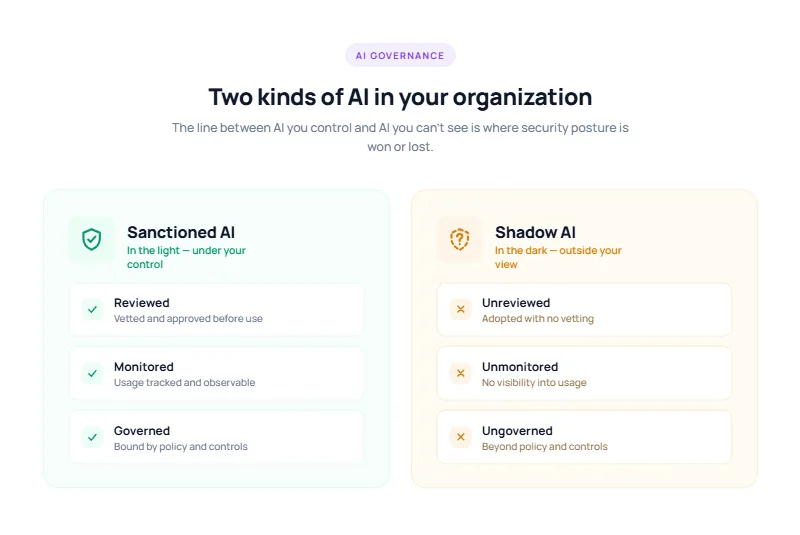
In plain terms, shadow AI is the use of artificial intelligence tools, applications, or services by employees or departments without explicit approval, oversight, or governance from the organization’s IT or security teams. That is the shadow AI definition security teams should standardize on, because it draws a clean line around what counts and what doesn’t. Sanctioned enterprise AI, reviewed by procurement and monitored by IT, is not shadow AI. The moment a tool bypasses that review process and starts touching organizational data, it qualifies, regardless of how small or well-intentioned the use case seems.
Most shadow AI doesn’t start with bad intent. An analyst wants to finish a report faster. A developer wants a second opinion on a tricky function. A marketer wants a first draft of a campaign brief before lunch. A recruiter wants help screening resumes without spending an entire afternoon on it. The motivation is productivity, not sabotage, and that is precisely what makes the problem hard to stamp out with policy alone. People aren’t trying to create risk. They’re trying to get their jobs done, and AI happens to be the fastest tool available at the exact moment they need it. Blocking that impulse outright tends to just push it further underground rather than eliminate it, which is a dynamic worth thinking about before considering a ban as the first response.
What is shadow AI in practice covers more ground than most security teams initially assume. It includes standalone consumer tools like ChatGPT, Claude, or Gemini accessed through personal accounts on a work laptop, or increasingly, on a personal phone connected to a corporate email account. It also includes AI features quietly embedded inside software your organization already licenses, features that get switched on by a vendor update without anyone in security signing off. Both fall under the same umbrella because both process organizational data outside a governed, monitored channel, even though one looks like a deliberate choice and the other looks like a routine software update. Either way, the result is the same: unmanaged AI sitting inside your environment, invisible to whatever inventory your security team thinks is complete.
It’s worth noting that shadow AI isn’t limited to chat-based tools anymore either. As AI agents and Model Context Protocol (MCP) integrations proliferate across enterprise software, the category is expanding to include autonomous or semi-autonomous processes that connect to internal systems, pull data, and take actions with far less human oversight than a person typing a prompt into a chat window. The core definition still holds: unauthorized, ungoverned, unreviewed. What’s changing is the sophistication and reach of what falls under that definition.
Shadow AI vs. Traditional Shadow IT
Shadow IT is a familiar problem. An employee spins up a personal Dropbox account to move files faster, or a team pays for a project management tool on a personal credit card because the procurement process feels too slow. Security teams have spent the better part of two decades building programs to find and rein in exactly that kind of behavior, and most mature organizations have a reasonably good handle on it by now.
Shadow AI vs shadow IT is not just a rebrand of that same story with a new buzzword attached. Traditional shadow IT typically involves unauthorized SaaS applications or hardware sitting outside sanctioned infrastructure, a discovery and asset management problem at its core. Shadow AI is structurally different because it involves the active processing, generation, and potential retention of sensitive corporate data by external language models and AI services. A rogue SaaS subscription stores your data in a location you didn’t approve. A rogue AI tool can ingest that data, transform it, generate new content from it, and in some cases retain fragments of it to improve a model that other organizations’ employees will eventually query. The asset you’re trying to protect doesn’t just sit somewhere unauthorized. It gets absorbed into something else entirely.
That distinction matters because it changes what “remediation” looks like. Deprovisioning an unauthorized SaaS account solves a shadow IT problem in an afternoon; you revoke access, maybe run a quick check on what was stored there, and move on. Rogue AI deployments don’t close out that cleanly. Once proprietary source code or a confidential term sheet has been submitted to a public model, you cannot simply revoke access and call it resolved. There is no clean deletion path for data that has already influenced a model’s weights, and there’s often no reliable way to even confirm whether it did. The remediation conversation shifts from “close the door” to “assess what already happened,” which is a fundamentally harder and slower process.
The speed of AI adoption has also compressed timelines that used to give security teams breathing room. What took years to become an enterprise-wide shadow IT problem, think of how long it took unsanctioned cloud storage or messaging apps to become ubiquitous is happening with shadow AI in a matter of months. It has moved the conversation from a data governance issue to something closer to an active intellectual property threat, and the numbers back that up. Microsoft and LinkedIn’s 2024 Work Trend Index found that 78% of AI users at work are bringing their own tools, a behavior the report calls Bring Your Own AI, and noted that this pattern misses out on the benefits of strategic AI use at scale while putting company data at risk. That is not a fringe behavior confined to one department or one generation of workers; the report specifically noted BYOAI cuts across all age groups, not just younger or new employees who are sometimes assumed to be the primary drivers of unsanctioned tool adoption.
The comparison also matters for how you staff and budget around the problem. A shadow IT program can often be handled by procurement tightening and periodic network scans. Shadow AI, given how quickly new tools and model versions ship, needs a discovery capability that runs continuously rather than a review that happens once a quarter. Treating it with a shadow IT-era cadence all but guarantees your visibility is perpetually a few months out of date.
Common Examples of Shadow AI in the Workplace
Definitions are useful, but they only become actionable once you can recognize the behavior in your own organization. Shadow AI examples tend to cluster into two categories: tools people deliberately seek out, and AI capabilities that arrive uninvited through existing software. Both are worth walking through in detail, because the mitigation strategy for each looks fairly different.
Unauthorized Use of Public LLMs
The most common scenario looks almost mundane from the outside. An employee opens a consumer-grade large language model like ChatGPT, Claude, or Gemini in a browser tab and uses it to draft an email, debug a snippet of code, or summarize a confidential contract before a meeting. None of that feels reckless in the moment. It feels like using a better version of the tools they already had, the same instinct that once had people copying a paragraph into an online grammar checker without a second thought.
The problem is what travels alongside that convenience. Pasting proprietary code, financial figures, or personally identifiable information into a public AI tool routinely violates corporate data handling policy, and it can result in unintentional data exposure because some of these models are built or fine-tuned using submitted inputs. Once that information leaves your environment, you no longer control where it lives or who might eventually see a version of it surfaced back through the model. A developer troubleshooting a proprietary algorithm at 11 p.m. isn’t thinking about model training pipelines. They’re thinking about shipping the fix. That gap between intent and consequence is where most shadow AI incidents originate, and it explains why simply telling employees “don’t do this” tends to have limited effect. The behavior is driven by a real, immediate need, and a policy memo rarely beats that need in the moment it matters.
This category also spans far more job functions than security teams sometimes assume. It’s easy to picture the engineer pasting a code snippet, but the pattern shows up just as often in legal teams running contract language through a public tool for a quick redline, HR reviewing candidate resumes with an AI screener that was never vetted for bias or data handling, and finance teams uploading spreadsheets to summarize quarterly variance. Each of those functions handles data with its own regulatory sensitivity, which means the compliance exposure from unauthorized LLM use looks different depending on which department is doing it. A sales team leaking a pricing sheet is a competitive problem. An HR team leaking candidate PII into an unvetted tool is a regulatory one.
Unvetted AI Features in Existing Software
The second category is quieter and, in some ways, more difficult to control because it doesn’t require an employee to go looking for a new tool at all. Security teams have started calling this “creeping AI.” A vendor whose software your company already licenses and has already vetted rolls out a new AI feature, meeting summarization, predictive text, automated tagging, smart search, and switches it on by default in a routine update.
Nobody asked for a security review because nobody asked for the feature at all. It simply appeared, often bundled into an update note that gets skimmed rather than read. These embedded capabilities can process sensitive data in ways your security team never evaluated, because the original vendor assessment covered a product that didn’t have this functionality yet. A collaboration tool that was approved two years ago for basic messaging might now be running an AI summarization layer over every conversation, including the ones that touch legal disputes, layoff planning, or unreleased financials. That creates a second, less visible layer of shadow AI that bypasses procurement review entirely, hiding inside software your organization already trusts and has already put through a vendor risk assessment that no longer reflects what the tool actually does.
This is arguably the harder of the two categories to manage, because the usual playbook for controlling employee behavior, training, acceptable use policies, and browser restrictions doesn’t apply. Nobody made a choice to adopt a new tool. The tool changed underneath them. Managing this category requires a different discipline: revisiting vendor risk assessments on a recurring basis rather than treating them as a one-time gate at initial procurement, and building a habit of checking release notes for AI feature announcements the same way a security team would track a CVE disclosure.
Why Shadow AI is a Critical Security Concern
Recognizing shadow AI in the wild is only half the job. Security and compliance leaders need a clear answer to the “so what” question, because budget and headcount follow business impact, not abstract risk categories. Unlike a lot of emerging technology risk, Shadow AI doesn’t just create theoretical security vulnerabilities that might matter someday. Fortunately, this is one of the better-quantified risk categories in the industry right now, which makes the business case easier to build than it was even a year or two ago.
Data Privacy and Intellectual Property Risks
The core privacy risk is straightforward: many public AI tools use submitted input data to train or improve future models. That means sensitive corporate information, a draft product roadmap, a client’s financial details, a snippet of unreleased source code, could theoretically resurface in a form accessible to users entirely outside your organization. This isn’t a theoretical edge case anymore. It’s a documented cost driver. IBM’s 2025 Cost of a Data Breach Report found that breaches involving a high level of shadow AI added an extra $670,000 to the global average breach cost, and that shadow AI was a factor in 20% of the breaches studied, adding that cost premium while exposing large amounts of personally identifiable information.
The exposure pattern gets worse once you look at what kind of data actually leaks. IBM’s research found that among organizations that experienced shadow AI-related breaches, customer PII compromise jumped to nearly two-thirds of incidents, compared with just over half across breaches generally, and that intellectual property, while stolen less frequently, carried the highest cost per record of any data type in these incidents. In other words, shadow AI incidents don’t just happen more often than the industry average would suggest; when they do happen, they tend to expose the categories of data that are hardest and most expensive to recover from.
This connects directly to the broader concept of shadow data: information that exists somewhere in your ecosystem, outside your control, outside your inventory, and outside your ability to protect it. Once your intellectual property has a shadow copy sitting on a third party’s infrastructure, your actual attack surface is larger than any asset inventory you’ve built shows, and it stays that way indefinitely. Unlike a stolen laptop or a compromised server, there’s no hardware to recover and no access log to review. The exposure simply exists, often permanently, with no clear way to confirm its scope after the fact.
Compliance and Regulatory Challenges
Unauthorized AI usage doesn’t stay contained to a security conversation. It creates direct exposure under GDPR, HIPAA, and the EU AI Act, three frameworks with very different enforcement mechanisms but a shared requirement: you have to be able to demonstrate what happens to regulated data and where it goes. Those compliance risks compound quickly once multiple frameworks apply to the same unmanaged tool. The EU AI Act in particular introduces real financial teeth for high-risk violations, and unlike GDPR, it applies specifically to how AI systems are used and governed, not just how personal data is handled generally. That makes an ungoverned AI tool touching regulated data a compliance exposure in its own right, separate from whatever data protection obligations already applied to that data before AI entered the picture.
That requirement collapses the moment you lack visibility into which AI tools are actively processing information across your enterprise. You cannot audit a data flow you don’t know exists. You cannot certify compliance for a tool that never appeared on any vendor risk assessment, and you cannot answer a regulator’s most basic question, “where did this data go and who processed it,” if part of the answer is “an AI tool an employee found on their own.” IBM’s research underscores just how wide this gap is: among the organizations studied, 63% had no AI governance policies in place to manage AI or prevent workers from using shadow AI, and 97% of organizations that experienced an AI-related security incident lacked proper AI access controls. Gartner’s research points in the same direction from a different angle, projecting that by 2030, more than 40% of global organizations will experience a security or compliance incident directly tied to unauthorized AI use, a number that reflects how governance maturity is lagging well behind adoption speed across the industry, not just at a handful of laggard companies.
When regulators ask a compliance officer to walk through data lineage for a customer record, “we don’t actually know which AI tools touched it” is not an answer that holds up under an audit, let alone a breach investigation. It also puts security and compliance leaders in an uncomfortable position internally: they’re accountable for a risk they may not have full visibility into, created by behavior that’s often happening in good faith, across departments they don’t directly control.
Moving from Blind Spots to Exposure Management
Understanding the risk is the easy part. The harder question is what a security team actually does about a category of shadow technology that changes shape every time a new model ships or a vendor pushes an update. The answer isn’t a ban, and it isn’t a one-time audit. It’s a shift in operating model, one that borrows heavily from how mature security teams have already learned to handle other fast-moving, high-volume risk categories.
The Importance of Continuous Discovery
The first step in managing shadow AI is establishing visibility, and visibility has to be continuous rather than periodic. A point-in-time audit tells you what was true on the day you ran it. Given how fast new AI tools and embedded AI features reach employees, a snapshot from last quarter is already stale, and a snapshot from last year is close to useless.
Organizations need discovery mechanisms that scan continuously across applications, cloud environments, and infrastructure to identify AI tools operating without authorization. That means watching for new SaaS integrations as they get connected, monitoring egress traffic to known AI endpoints, flagging vendor updates that introduce AI capabilities into software already inside your environment, and keeping a running inventory that updates itself rather than one that requires a manual refresh every time someone remembers to run it. The goal isn’t to build a registry of unauthorized AI systems for its own sake. It’s to build a living inventory of where AI touches your data, updated in something closer to real time than the annual compliance calendar most organizations still run on.
This is also where the difference between shadow AI and shadow IT discovery becomes practical rather than theoretical. Shadow IT discovery has historically leaned on network-level signals, unusual traffic to unapproved domains, and new SaaS billing showing up in an expense report. Those signals still matter for shadow AI, but they need to be paired with something more specific to how AI tools actually get used: browser-level visibility into which sites employees are interacting with, not just visiting, and an understanding of what’s embedded inside software you already trust well enough that you stopped actively re-checking it. A discovery program that only watches for new, unfamiliar domains will miss the AI feature that quietly activated inside a tool your organization approved three product versions ago.
Integrating AI Risks into Vulnerability Management
Discovery without prioritization just produces a longer list of things to worry about. Once shadow AI instances are identified, they need to be evaluated and ranked alongside your traditional vulnerabilities, not managed in a separate, disconnected workflow that never talks to your core security program. A shadow AI finding sitting in a spreadsheet owned by a different team than the one that owns your CVSS scoring is a finding that will get deprioritized by default, simply because nobody has the full picture needed to weigh it against everything else competing for remediation time.
That means understanding the context of how a given AI tool is being used, the sensitivity of the data it touches, and the realistic business impact if that data were exposed or misused. A marketing intern using an unauthorized grammar-checking AI on public blog drafts carries a different risk profile than an engineer routing production database queries through an unvetted coding assistant, and both of those look different again from an embedded AI feature quietly summarizing every message in your executive team’s collaboration channel. Treating all three with the same urgency wastes remediation capacity on the least consequential finding while the most consequential one waits in line behind it.
Unifying these findings into a single, prioritized view is what allows security teams to spend their limited remediation hours where they actually reduce risk, instead of treating every shadow AI finding as equally urgent. This is the same discipline that underpins mature exposure management: not just knowing what’s out there, but knowing what matters most and acting on that first, using the same lens you’d apply to a critical CVE sitting on an internet-facing asset versus a low-severity finding on an isolated internal system. Shadow AI deserves that same rigor rather than a separate, lower-stakes process, precisely because the data shows it isn’t a lower-stakes category. It’s already producing measurable, quantifiable breach costs on par with, and in some cases exceeding, the traditional vulnerability categories most security programs have spent years building processes around.
Shadow AI isn’t a passing phase that resolves itself as employees get more disciplined or vendors get more cautious. It’s the new baseline for how work gets done, and it will keep expanding as AI capabilities get cheaper, faster, and more deeply embedded in everyday software. Security teams that treat it as a single, one-time cleanup project will find themselves re-running that project every quarter, chasing a moving target with a static process. Teams that fold it into continuous discovery and unified prioritization will be the ones who can actually answer the question every board is starting to ask: do we know where our data is going, and can we prove it?
If your organization is still relying on point-in-time audits to catch unauthorized AI use, it’s worth seeing what AI Exposure Management looks like in practice. Explore ArmorCode’s AI Exposure Management, request a live demo, or take a self-guided tour of Unified Exposure Management to see how shadow AI discovery fits into a single, prioritized view of risk.
Frequently Asked Questions (FAQ) Section
Q: What is the simplest definition of shadow AI?
A: Shadow AI is the use of artificial intelligence tools, applications, or features by employees without the official knowledge, approval, or oversight of the organization’s IT and security departments.
Q: Is shadow AI worse than traditional shadow IT?
A: Shadow AI carries unique, often more severe risks than traditional shadow IT because it frequently involves inputting sensitive corporate data, intellectual property, or source code into external models that may use that data for future training, creating significant privacy and compliance liabilities.
Q: How can organizations stop shadow AI?
A: Rather than trying to completely block AI, which tends to fail as employees simply find workarounds, organizations should focus on continuous discovery to gain visibility, provide secure and sanctioned AI alternatives for employees, and integrate AI risk assessment into their broader exposure management and vulnerability prioritization workflows.
Key Takeaways
- Shadow AI is the use of AI tools or features without IT or security approval, whether that’s an employee using a public LLM like ChatGPT on their own, or an AI feature that activates inside software you already license.
- It’s not just a rebrand of shadow IT. Shadow IT is a discovery problem; unauthorized SaaS stores your data somewhere unapproved. Shadow AI is a data problem; unauthorized tools can absorb, transform, and retain your data in ways you can’t simply revoke.
- It’s already the norm, not the exception. Employees adopt these tools for the same reason they always adopt workarounds: the sanctioned option is slower than the job in front of them.
- The exposure isn’t just data loss; it’s data you can’t get back. Once proprietary code or a confidential document has been submitted to a public model, there’s no clean deletion path the way there is for a revoked account.
- It creates compliance exposure under multiple frameworks at once (GDPR, HIPAA, the EU AI Act), each with its own requirement to show what happened to regulated data and where it went.
- The fix is continuous discovery plus prioritization, not a one-time audit or an outright ban. Treat shadow AI findings with the same rigor as any other vulnerability, ranked by data sensitivity and business impact.
Sources
- Microsoft & LinkedIn, “2024 Work Trend Index Annual Report” — https://news.microsoft.com/source/2024/05/08/microsoft-and-linkedin-release-the-2024-work-trend-index-on-the-state-of-ai-at-work/
- IBM, “2025 Cost of a Data Breach Report: Navigating the AI rush without sidelining security” — https://www.ibm.com/think/x-force/2025-cost-of-a-data-breach-navigating-ai
- IBM, “Cost of a Data Breach” — https://www.ibm.com/reports/data-breach
- Gartner, “Gartner Identifies Critical GenAI Blind Spots That CIOs Must Urgently Address” — https://www.gartner.com/en/newsroom/press-releases/2025-11-19-gartner-identifies-critical-genai-blind-spots-that-cios-must-urgently-address0