
Vulnerability Remediation vs. Mitigation: Managing Risk in Modern Environments


The idea of a perfectly patched infrastructure isn’t just unrealistic; it’s bad strategy. Vulnerability remediation is the permanent removal of a security flaw by patching software, reconfiguring systems, or removing vulnerable components so attackers lose the entry point. Security teams are drowning in a backlog of findings across SAST, DAST, SCA, cloud, and infrastructure scanners. More than 48,000 CVEs were published in 2025 alone, a 20.6 percent jump on top of 2024’s already-record 40,000 (CVE.org). If your goal is to remediate everything, you’ve already lost.
The assumption that every vulnerability needs an immediate, permanent fix creates operational gridlock. Security leaders have to navigate the tension between the cure (remediation) and the shield (mitigation). This article breaks down the difference between mitigation and remediation, how factors like asset criticality and exploitability change the right response, where mitigation-only strategies create risk, how modern tooling supports both, and why coordination between security and IT operations often determines whether exposure is actually reduced without disrupting the business. Getting this distinction right is the foundation of any effective vulnerability remediation strategy.
Beyond the Patch: Defining Remediation and Mitigation
Vulnerability Remediation: The Permanent Cure
Vulnerability remediation permanently removes a vulnerability. You patch the software, reconfigure the system, remove vulnerable code, or rip out the vulnerable component entirely. You address the root cause, closing the entry point for exploits.
This is what a broader vulnerability management program aims for because it improves your long-term security posture. But it’s expensive. It requires testing, downtime, and coordination with development or IT operations teams.
Vulnerability Mitigation: The Protective Shield
Mitigation leaves the underlying flaw intact but implements compensating controls to decrease the likelihood or impact of an exploit. You deploy a Web Application Firewall (WAF) rule, segment network traffic, or use Endpoint Detection and Response (EDR) to block anomalous behavior.
Mitigation acts as a protective shield when a direct patch is unavailable, or when deploying it immediately would break critical business applications. It buys you time, not a fix.
The Shared Goal: Reducing Your Attack Surface
Both strategies aim to shrink your attack surface. Every unaddressed vulnerability gives attackers a potential foothold and increases exposure to broader security risk. Using a mix of both strategies lets security teams narrow the window of opportunity for adversaries. The objective is moving from a reactive posture, where every new vulnerability triggers an unsustainable patching cycle, to a strategic approach that prioritizes risk reduction through defensive layering and permanent fixes.
Key Differences: A Practical Comparison
The table below breaks down the vulnerability remediation vs mitigation decision across the factors that matter most: impact on root cause, speed, resource cost, and long-term risk.
| Feature | Remediation | Mitigation |
| Impact on root cause | Removes the vulnerability permanently | Leaves the vulnerability intact, adds a protective layer |
| Implementation velocity | Slower; requires testing to avoid breaking applications | Faster; can often be deployed in minutes or hours (e.g., WAF rules) |
| Resource requirements | High upfront effort (testing, deployment, downtime) | Lower upfront effort, but high ongoing maintenance |
| Longevity | Long-term fix; resolves the specific flaw until a new one emerges | Temporary or conditional; requires ongoing process discipline and continuous monitoring, and fails if the control is bypassed or misconfigured |
| Risk of security drift | Low; the patch is applied | High; requires constant monitoring to ensure the shield stays active |
The Strategic Decision Matrix: When to Remediate vs. Mitigate
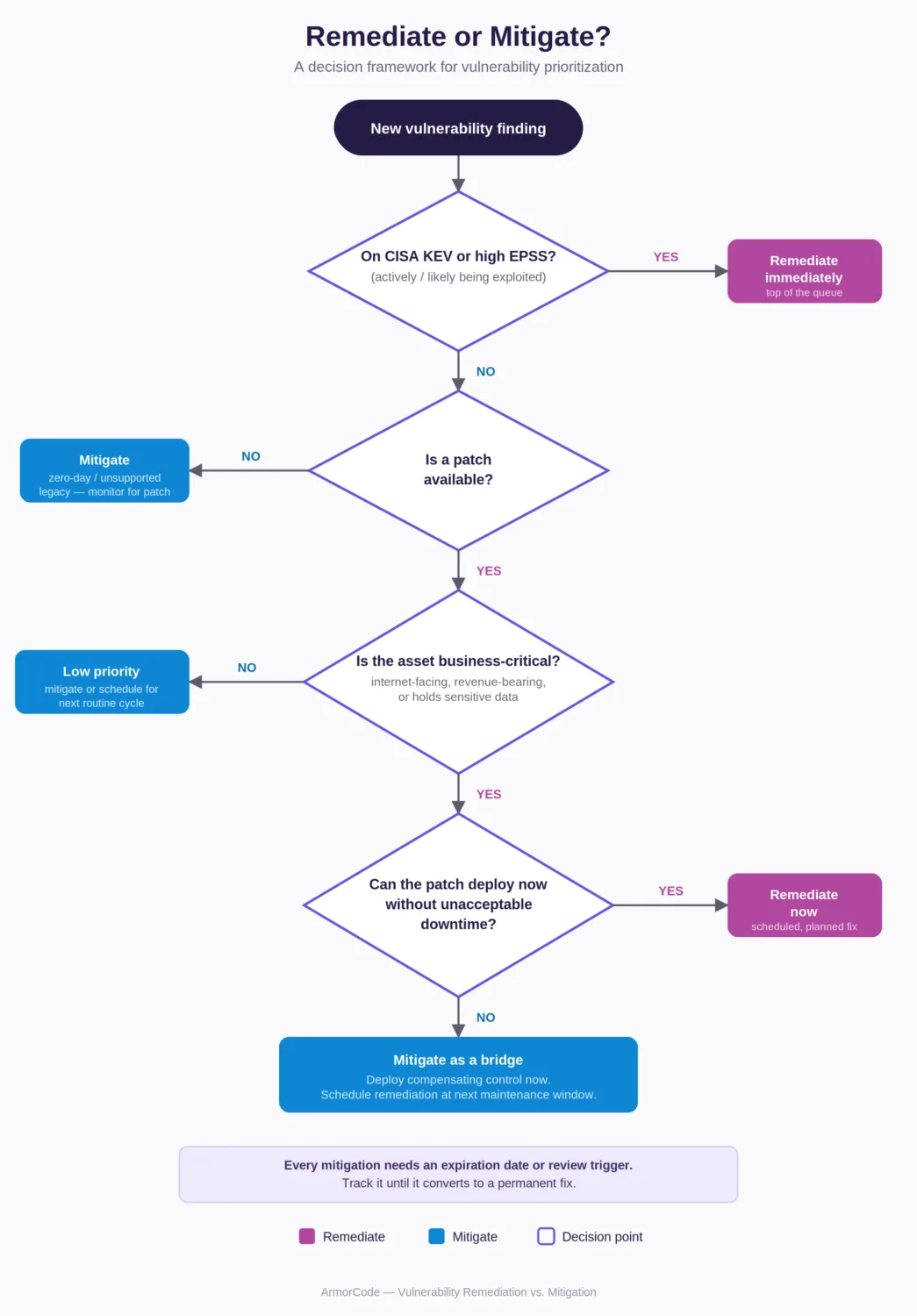
Prioritization paralysis happens when everything looks urgent. Deciding between remediation and mitigation requires looking past the CVSS score and incorporating actual business context. The framework below walks through the same four factors covered in this section: exploitability, patch availability, asset criticality, and deployment feasibility.
Assessing Asset Criticality and Business Context
Not all systems carry the same weight. A critical CVSS 9.8 on an isolated test server doesn’t carry the same urgency as the same CVE on a production system holding customer data.
A public-facing web server processing revenue demands immediate remediation. Conversely, an isolated, internal-only system nearing end of life might be better served by strict network segmentation. Context dictates the response: asset context, not severity alone, determines which high-risk vulnerabilities get prioritized first. You have to weigh the value of the asset against the risk of the vulnerability.
Evaluating Patch Availability and Technical Feasibility
Sometimes a patch doesn’t exist, particularly for vulnerable components in legacy or third-party software. With zero-day vulnerabilities or unsupported legacy software, remediation isn’t an option. Mitigation becomes your only survival mechanism.
Even when a patch exists, technical feasibility matters. If applying it requires rebooting a high-availability cluster and causing unacceptable downtime, mitigation acts as a bridge until a planned maintenance window, minimizing disruption to business operations during remediation efforts.
Calculating the Downtime Tax
The downtime tax is the hidden cost of security. Security teams demand instant patching; IT operations prioritize system uptime. Choosing mitigation when patching is too disruptive reduces friction. Clear service level objectives, agreed upper bounds on how long a given severity can stay open, give both teams a shared target and let the organization schedule disruptive remediation rather than forcing high-risk emergency updates.
Factoring in Threat Intelligence and Exploitability
Relying solely on CVSS is a trap. A high-severity vulnerability that isn’t being exploited in the wild might warrant a lower priority than a medium-severity bug with an active exploit. Integrating signals like the Exploit Prediction Scoring System (EPSS) and CISA KEV (Known Exploited Vulnerabilities) lets teams prioritize based on the probability of exploitation, not just nominal severity. Research consistently shows that 95 to 97 percent of reported vulnerabilities are never exploited in the wild, which is why this focused, risk-based approach to remediation strategy outperforms a flat CVSS-sorted list.
The Hidden Risk of “Mitigation Only”: Managing Remediation Debt
Why Long-Term Mitigation Is a Strategic Loan
Think of mitigation as a high-interest loan. You’re borrowing security by layering controls to avoid the immediate cost of remediation. Like financial debt, this accrues interest in the form of complexity.
Each layer of mitigation adds configuration overhead, obscures visibility, and complicates audits. If you never pay down the debt by patching the underlying flaw, your interest payments, the effort to maintain these controls, will eventually consume your security budget. Documenting remediation actions as you go is what makes that debt visible and supports audits, reporting, and future reference.
The Compounding Effect of a Vulnerability Backlog
A backlog of mitigated vulnerabilities creates a fragile ecosystem. Dozens of shielded but unpatched systems can hide real exposure if those controls fail, turning your environment into a house of cards. A single network configuration change, a botched EDR update, or a vendor signature shift can cause these shields to fail, instantly exposing a massive cluster of previously safe vulnerabilities. This compounding risk, made worse when teams are already struggling to triage backlogs amid false positives and alert noise, is exactly why mitigation can’t permanently replace vulnerability remediation.
Transitioning from Temporary Controls to Permanent Fixes
To avoid the remediation debt trap, treat mitigation as a step that feeds a defined remediation workflow: identify, assess, apply, verify, not a destination. Every mitigation control needs an expiration date or a recurring review trigger. Once the business context allows for a patch, or the vendor releases a stable update, you have to initiate remediation. Tracking these controls alongside your vulnerability data within a structured remediation workflow is critical so they don’t get lost in the noise.
Practical Use Cases: Mitigation vs. Remediation in Action
Handling Zero-Day Vulnerabilities
When a zero-day hits, your response plan is entirely mitigation-focused. Mitigation comes first to contain active threats until a patch is available. You monitor for anomalous traffic, tighten egress filtering, and deploy custom virtual patching via WAFs while teams wait to remediate. You’re trying to survive the storm. Once a vendor patch drops, the focus shifts to a phased remediation rollout, validated against the baseline of your mitigated state.
Managing Legacy Systems
For legacy infrastructure that can’t be patched without breaking, mitigation becomes a permanent state. The strategy shifts to defense-in-depth: isolate the system from the internet, restrict service accounts to an absolute minimum, and wrap it in intense monitoring. You aren’t curing the illness; you’re keeping the patient in a sterile environment for the rest of its lifecycle.
Prioritizing Critical Infrastructure vs. Dev Environments
Critical production infrastructure demands remediation as the default. There is no room for mitigation failure. Development environments, however, often benefit from a mitigation-first approach, though dev teams should still fix vulnerable code before release rather than relying on rebuilds alone. Because dev systems are ephemeral and frequently rebuilt, the energy spent on granular remediation is usually better directed elsewhere.
Bridging the Gap: The Role of Modern Security Tooling
The transition from reactive vulnerability management to continuous exposure management requires unifying your tooling and adding the context legacy scanners lack.
Automated Detection in the CI/CD Pipeline
Modern exposure management integrates with the CI/CD pipeline. Automating detection identifies vulnerabilities earlier in the build process, while a dynamic asset inventory keeps unmanaged endpoints from slipping through before code and services reach production. Shifting left makes remediation faster and cheaper than fixing live environments.
Using SOAR and EDR for Automated Mitigation
Security Orchestration, Automation, and Response (SOAR) platforms combined with EDR are essential for rapid response. When a threat is detected, these tools can trigger automated mitigation, isolating an endpoint or blocking a suspicious IP at the network edge, while the team investigates. This instant mitigation buys the security team time to assess the vulnerability and plan remediation.
The Evolution to Unified Vulnerability Management (UVM)
Modern tools have moved past simple scanning. Unified platforms like ArmorCode’s UVM pull findings from the scanners you already run- SAST, DAST, SCA, cloud, and infrastructure tools and correlate them into a single, deduplicated risk picture instead of a dozen disconnected lists.
By layering in asset criticality, threat intelligence, and reachability, a unified platform flags whether a vulnerability needs immediate patching or whether a compensating control is an acceptable interim measure, and tracks that control until it’s replaced with a permanent fix. This scanner-less, vendor-agnostic approach also cuts the reconciliation tax, the manual effort spent aggregating and deduplicating findings across fragmented tools. This is what modern vulnerability remediation strategies look like in practice: context-driven decisions instead of a flat, severity-sorted queue.
Overcoming Organizational Friction: Security vs. IT Operations
Navigating the Conflict Between Hardening and Uptime
The tension between Security (demanding change) and IT Operations (demanding stability) is constant. The fix is shared metrics, tracking something like Mean Time to Remediate together rather than security tracking patch counts in isolation. When both teams are incentivized on risk reduction rather than just patch counts, the conversation shifts. A patch that breaks an application is a failed security outcome, just like an unpatched vulnerability.
Developing a Shared Ticketing Workflow
A unified ticketing workflow is non-negotiable. Security teams shouldn’t just dump vulnerabilities onto IT. They need to provide a prioritized list with recommended remediation (patch to version X) alongside a recommended mitigation (apply firewall rule Y) if patching isn’t feasible, with enough context attached that the ticket supports compliance and future audits when it’s closed. This empowers IT to satisfy security requirements without sacrificing availability. Agentic AI workflows can automate this routing, delivering context directly to the right owner in Jira or ServiceNow.
Improving Transparency with Risk Assessment Reporting
Transparency kills friction. Producing clear, data-driven reports that articulate the business impact of a vulnerability and show how remediation progress strengthens the organization’s security posture builds credibility. When IT operations understand why a specific patch is critical, due to high exploitability or sensitive data, they are far more likely to prioritize the remediation, even if it requires extra effort.
Conclusion
The choice between remediation and mitigation isn’t binary. It’s a balancing act that defines the maturity of your exposure management program. While remediation provides the permanent cure, mitigation serves as an essential tool for managing operational realities and buying time.
Success means abandoning the obsession with 100 percent patching, which is unattainable, and moving toward continuous, risk-based decision-making. By leveraging both the cure and the shield, security teams can manage remediation debt, reduce organizational friction, and focus their vulnerability remediation strategies on the small slice of exposures that actually drive risk to the business. Mitigation is a strategic bridge, not a permanent vacation from responsibility. Use it to protect your systems today, but keep your focus on consistent vulnerability remediation to ensure a secure, resilient environment.
Ready to see how ArmorCode separates the vulnerabilities that matter from the ones that don’t? Request a demo or take a self-guided tour of Unified Exposure Management in the platform.
Frequently Asked Questions
Q: What is the main difference between vulnerability remediation and mitigation?
Remediation permanently eliminates a vulnerability, for example by applying a software patch, reconfiguring a system, or removing a vulnerable component. Mitigation reduces the likelihood or impact of an exploit using compensating controls, such as a WAF rule or network segmentation, while leaving the underlying flaw in place.
Q: Is vulnerability mitigation an acceptable long-term strategy?
Generally, no. Mitigation is well suited to buying time during a zero-day event or protecting legacy systems that can’t be patched without breaking. Relying on it permanently increases architectural complexity and creates remediation debt. Mitigations should be tracked and replaced with full remediation whenever the business context allows.
Q: How should security teams decide between remediation and mitigation?
Start with business context, not just CVSS score: asset criticality, patch availability, technical feasibility, and exploitability signals like EPSS and CISA KEV. A high-severity finding on a low-value, isolated asset may warrant mitigation, while a moderate-severity finding on an internet-facing, revenue-generating system usually warrants immediate remediation. The right mix of vulnerability remediation strategies depends on getting this weighting right, not on chasing a perfect CVSS-sorted queue.
Key Takeaways
- Remediation permanently removes a vulnerability. Mitigation reduces risk through compensating controls while the flaw remains in place.
- Decisions should be driven by asset criticality, patch feasibility, and exploitability data such as EPSS and CISA KEV, not CVSS score alone.
- Long-term mitigation without a plan to remediate creates remediation debt: rising complexity, audit friction, and fragile, single-point-of-failure protections.
- A unified vulnerability remediation tracking system keeps mitigated findings from getting lost, documents remediation actions for compliance and audits, and ensures they’re eventually converted to permanent fixes.