Full Disclosure Is Coming: What Google Project Zero’s New Policy Means for Every Security Team


On November 13, Google Project Zero retired the vulnerability disclosure policy it had followed since 2021. Under “90 + 30,” vendors had 90 days to fix a reported bug and 30 more days of “soak time” to get the patch to users. The new policy, “Full X,” is simpler. Project Zero publishes vulnerability details X days after reporting them to the vendor. Fixed or not, the clock runs out the same way.
X is 90 today. It drops to 60 on February 2, 2027, and to 30 on January 3, 2028.
The reasoning is worth reading in full. AI has made attackers faster at finding bugs, faster at reverse engineering patches, and more likely to find the same flaw a researcher already reported. Project Zero says it now finds several vulnerabilities a week in targets that once yielded a few a year. At that pace, a long embargo buys attackers time as readily as it buys users protection.
I think Project Zero made the right call. Much of the early commentary will focus on software vendors. The larger shift lands downstream, on every enterprise security team that runs their software.
What changed with vulnerability disclosure, and why now
The new policy removes the vendor negotiation. Grace periods and variant rules are gone. Project Zero will still track whether a bug is fixed, but that status no longer moves the disclosure date. The only exceptions are bugs already exploited in the wild, bugs someone else has already made public, and early disclosure at the vendor’s request.
Project Zero chose a gradual schedule after hearing from the vendors it reports to most. An overnight cut, they argued, could expose unfixed bugs before vendors improved their processes. The step-down from 90 to 60 to 30 days gives vendors a deadline that is hard but reachable.
The timing tracks everything else we see in the market:
- Volume is surging. FIRST raised its 2026 forecast to roughly 66,000 published CVEs, with AI-assisted discovery cited as a driver. Frontier models such as Claude Mythos have found thousands of previously unknown flaws in testing.
- Exploitation leads. Vulnerability exploitation is now the top initial access vector, present in 31 percent of breaches and ahead of credential abuse for the first time (Verizon DBIR, 2026).
- Defenders trail. Industry MTTR for critical findings runs 55 to 74 days, while attackers weaponize new flaws in about 15 (Edgescan, 2026).
Project Zero’s 90-day disclosure deadline became a reference point for coordinated vulnerability disclosure across the industry. I expect “Full X” to travel the same way. Research teams running AI-assisted discovery face the same volume problem Project Zero describes, and case-by-case negotiation does not scale to several bugs a week.
Why you need to review your patching strategy
When disclosure day arrives under “Full X,” every enterprise running the affected software lands in one of three states.
- The patch exists and is installed.
- The patch exists but is in the queue (the patch gap).
- Or no patch exists, and the details are public anyway.
The old policy worked hard to keep organizations out of that third state. The new one makes it routine. The second state has a name: patch gap, the time between a fix’s availability and its installation. Project Zero’s own model makes the patch gap nearly as dangerous as no patch at all. If time to exploit after a patch ships is effectively zero, an uninstalled patch offers little more protection than none.
“The disclosure clock no longer waits for the patch, so defenders need to know where every exposure lives, who owns it, and how to contain it well before the details go public.”
— Nikhil Gupta, CEO, ArmorCode
That changes the job. Security teams can no longer treat vendor patches as the only remediation path, or the vendor’s release as the moment work begins. On disclosure day they need answers to four questions, fast:
- Where does the affected software run in our environment?
- Is it reachable by an attacker, and does it touch sensitive data?
- Who owns the fix, and what can we do before a patch exists?
- Can we prove what we did, and when?
Severity scores answer none of these. Project Zero made the point plainly: severity does not affect the likelihood that attackers find a bug, only the impact if they do. Teams that still triage by CVSS alone will chase the wrong work while the window closes. Vulnerability prioritization has to start from exploitability, reachability, and business context.
This is the problem unified exposure management exists to solve. At ArmorCode, the Context Risk Graph correlates findings with assets, reachability, ownership, threat intelligence, and the compensating controls already in place, such as WAF and EDR coverage. When a new disclosure lands, Anya’s Zero-Day Exposure Hunting Agent can assess organizational impact and generate a report in minutes. Fixes route to the right owner with context, and a rescan confirms the fix held. One global manufacturer cut remediation time from 240 days to 7 on this model. Under a 30-day disclosure window, that difference decides whether you are exposed on day 31.
Five angles for your vulnerability remediation program
The obvious response is to patch faster. Here are five less obvious ones.
1. Your vendors’ remediation speed is now your risk. A vendor that cannot fix within the window hands its customers a public, unpatched exposure. Add disclosure readiness to third-party risk reviews and renewals. Ask how a vendor would meet a 30-day window, how fast it closes the patch gap for customers, and what non-patch mitigations it offers. Project Zero is asking vendors the same question.
2. If you ship software, you sit on both sides of the clock. Product security teams now face fixed external disclosure dates on top of EU Cyber Resilience Act reporting, which has required a 24-hour early warning for actively exploited vulnerabilities since September 11, 2026. Inbound and outbound obligations draw on the same backlog and the same owners. Run them from one system.
3. Set your own internal “Full X.” Project Zero stopped negotiating whether bugs are fixed because the negotiation became unmanageable at volume. Internal teams know that problem well: 82 percent of organizations cannot close a vulnerability without handing it to another team (Vicarius, 2026). A fixed internal window for reachable, exploitable exposures, paired with governed exceptions that expire, ends the debate and makes slippage visible.
4. Treat mitigation as remediation. Project Zero notes that vendors already protect users by disabling code paths while a fix is in progress. Enterprises can do the same with configuration changes, WAF rules, isolation, and EDR policy. Track each mitigation with an owner, an expiry, and evidence, so a temporary control never becomes a permanent blind spot.
5. Measure time exposed after disclosure. Mean time to remediate tells you how fast you fix. It does not tell you how long you sat exposed after the details went public. That second number is the one boards, insurers, and regulators will ask about, and it only exists if every finding, decision, mitigation, and fix lives in one record.
ArmorCode Zero for Project Zero
Project Zero closed its post with three words: make zero-day hard. Defenders can take the same posture. Discovery is getting cheaper for everyone, attackers included. The advantage goes to teams that can turn a disclosure into an owned, governed, verified action before the window closes. That is the discipline continuous threat exposure management (CTEM) describes, and a fixed disclosure clock now makes it mandatory.
That takes one view of risk across applications, infrastructure, supply chain, and AI, built on the 425+ tools you already run, with AI agents handling the triage and routing no human team can keep up with. And it takes proof.
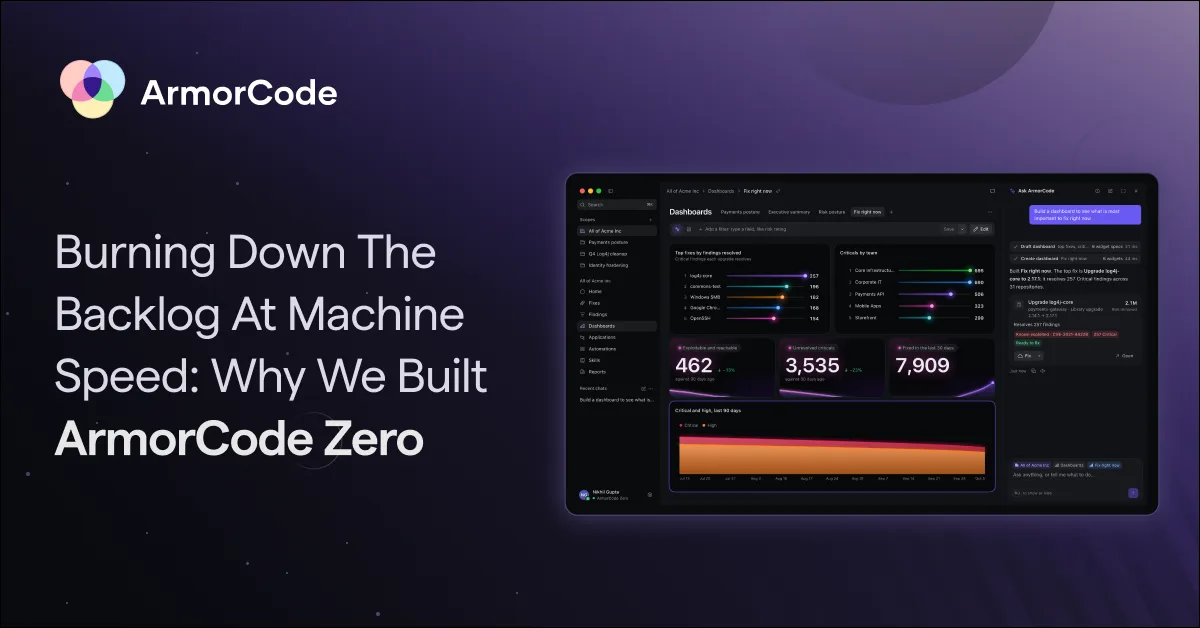
That is why we built ArmorCode Zero. When the disclosure clock starts, Zero turns findings into ranked fixes you can prove. It groups findings by the change that resolves them, ranks each fix by the risk it removes, drafts the pull request with the coding agents your engineers already use, and counts a fix as done only after ArmorCode rescans the exact commit. Your team approves every change.
Project Zero has set the clock at 90 days today and 30 days by January 2028. ArmorCode Zero, now in limited availability, is how your team keeps pace. Talk to us about getting access, and start turning every disclosure into a fix you can prove.