What Is Autonomous Exposure Remediation (AER)? A Practical Guide

Security has become a contest between machine-speed attackers and defenders who still work at human speed. Attackers are handing time-consuming tasks such as reconnaissance, exploitation, and sorting through stolen data to AI agents that can operate around the clock.
Frontier AI models are finding vulnerabilities faster than security teams can keep up. Partners in Anthropic’s Project Glasswing used its Mythos models to uncover at least 129,000 verified software vulnerabilities between April and July 2026, with more than 33,000 rated critical or high severity. Anthropic’s own conclusion is that finding bugs has become far easier, while the real bottleneck is now the human capacity to triage findings, report them, and deploy patches. The people responsible for that work are still operating at roughly the same pace as they were five years ago.
Autonomous Exposure Remediation (AER) is designed to narrow that gap. This article explains what AER is, why remediation has become the bottleneck, and how security teams can adopt greater autonomy without giving up control.
What is Autonomous Exposure Remediation (AER)?
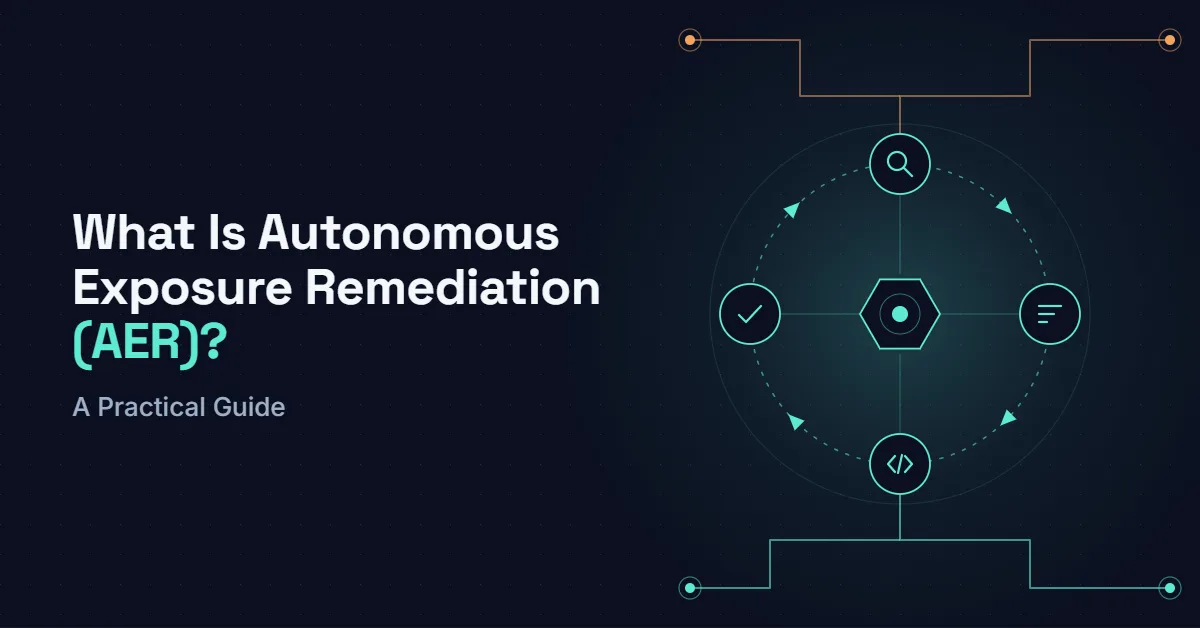
Autonomous Exposure Remediation (AER) is the use of AI agents to investigate, fix, and verify security exposures with limited human intervention, operating inside policies that humans define.
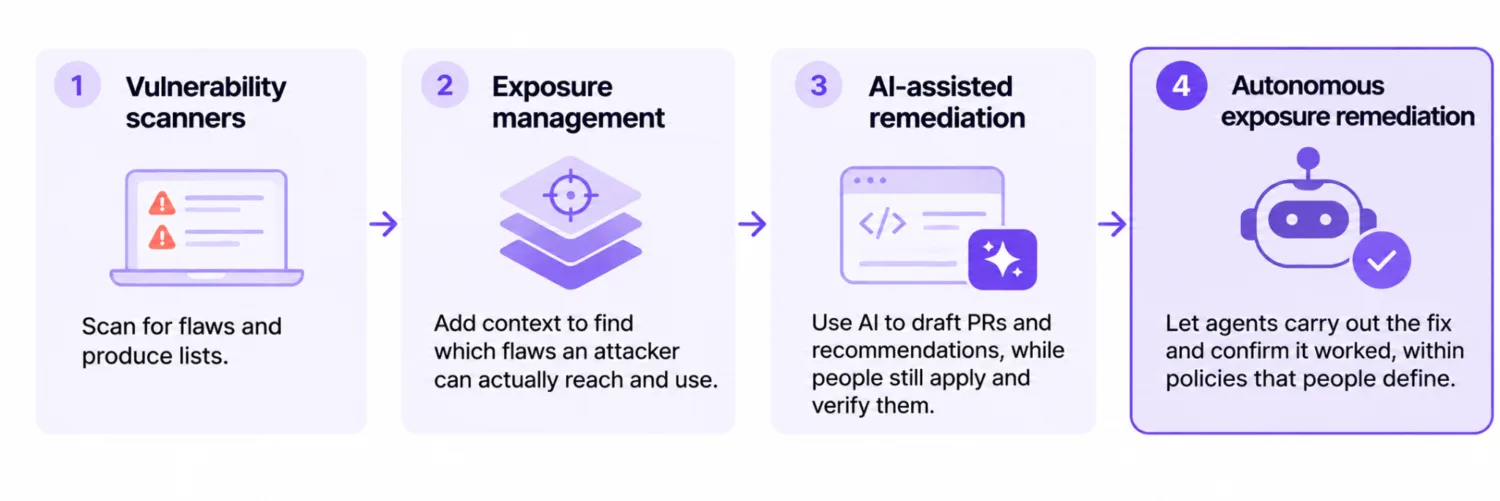
Security teams have moved through four stages in how they manage and remediate vulnerabilities. It started with vulnerability management, where scanners identified flaws and produced lists of findings. Exposure management added context, helping teams understand which vulnerabilities could actually be reached and exploited by attackers. AI-assisted remediation brought AI into the fixing process, with agents drafting pull requests (PRs) and recommending fixes, while people reviewed, applied, and verified the changes. Autonomous Exposure Remediation takes this a step further. AI agents can now carry out fixes and verify the results within the policies and permissions defined by the organization.
Analysts are starting to track the shift as well. Gartner published a research note on autonomous remediation on 23 July 2026, arguing that manual exposure remediation can’t keep pace with AI-driven exploitation, and its Emerging Tech Impact Radar: Preemptive Cybersecurity followed on 11 September 2026.
The Growing Gap Between Discovery and Remediation
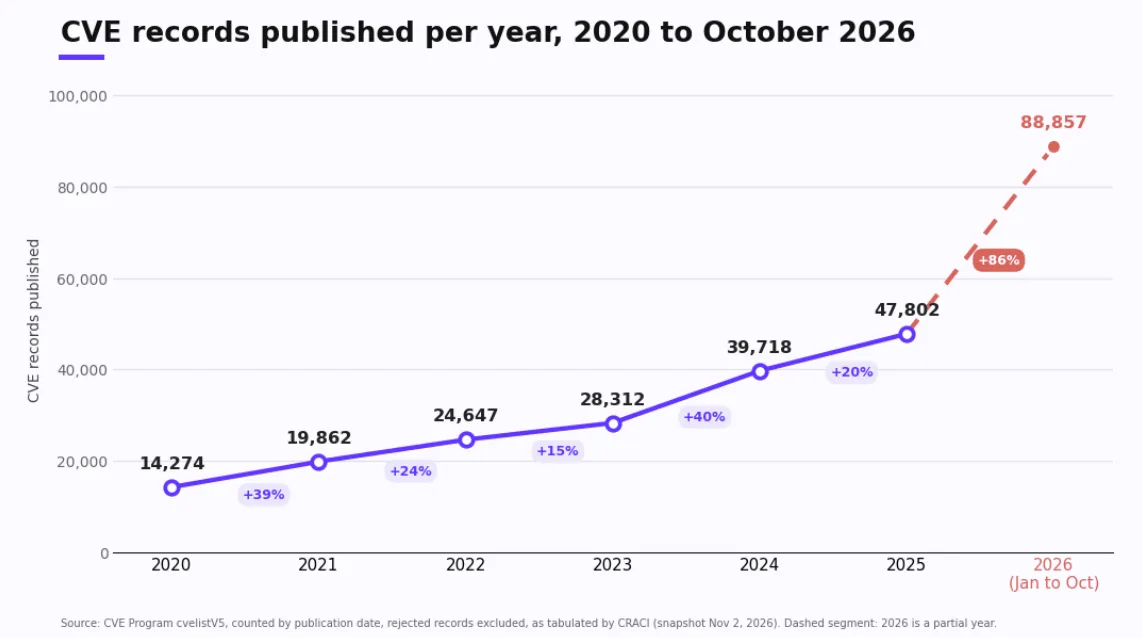
AI-assisted discovery is changing how many vulnerabilities get found. Disclosures passed 48,000 CVEs in 2025, a record and about 21% more than 2024, and 2026 is running well ahead of that. By late October the National Vulnerability Database had logged roughly 88,000 CVEs for 2026, about 1.8 times the total for all of 2025. FIRST’s mid-year forecast puts 2026 at roughly 66,000 CVEs, 46% above its original projection, and cites AI-driven discovery as a leading cause. Discovery is only the first step. Each finding still has to be investigated, prioritized, routed to the right team, and fixed, and that work has not sped up to match.
Security leaders describe the same pressure from the inside. ArmorCode’s October 2026 study, Managing Exposure at AI Scale, shows where the pressure lands. It surveyed 200 senior security and technology leaders, and 39% named better remediation coordination between security and development as their leading goal, ahead of shorter find-to-fix time (33%) and quantifying risk to prioritize remediation (28%).
Most security teams already recognize the problem. Handling a high volume of findings is one challenge, but knowing which ones need attention and getting them fixed is often harder. A longer list of findings does not automatically mean more risk, but without a clear way to isolate the exposures that matter, backlogs grow and critical issues sit unresolved. FIRST’s forecasting team makes a similar point: the share of CVEs that are exploited or high-risk has stayed roughly flat even as total volume has climbed, so the real work is finding the few that matter and fixing them quickly.
Gartner expects the fixing side to change as well, predicting that by 2028 AI agents and assistants will autonomously remediate 70% of software code vulnerabilities, up from about 10% in late 2025.
How to Build an Autonomous Exposure Remediation Program
1. Contextualize Every Exposure
Pull signals from scanners, cloud, code repositories, asset inventory and threat intelligence into one view. The ones that matter most are asset exposure, reachability, exploit status (including CISA’s Known Exploited Vulnerabilities catalog and EPSS), business criticality, threat intelligence and ownership.
2. Prioritize Exposures based on Risk
Use the context gathered in the previous step to rank exposures based on their potential impact on the business. Look beyond CVSS severity scores and consider whether the vulnerability is exploitable, whether an attacker can reach the affected asset, whether it is actively being exploited, and how critical the asset is to business operations.
3. Determine the Right Remediation
This is the stage people usually mean by “autonomous.” Depending on the issue, the response could involve generating a code fix, applying a security patch, updating a vulnerable dependency, assigning a ticket to the right owner, or putting compensating controls in place when an immediate fix isn’t possible.
The amount of work an agent can carry out on its own depends on the level of autonomy granted by the organization. Routine, low-risk fixes may proceed with minimal intervention. Changes that affect critical systems or production environments should require human approval. Every action should be logged and stay within the permissions and rules set by the organization.
4. Verify Remediation and Confirm Risk Reduction
Remediation is only complete when the fix has been applied and the original exposure is confirmed to be resolved. Rescan the affected assets, repositories, or environments to check that the vulnerability is no longer present and that the change has not introduced new issues.
If the exposure remains, send it back for further investigation or remediation. Record the actions taken, verification results, and any exceptions along the way.
Three Levels of Autonomous Exposure Remediation
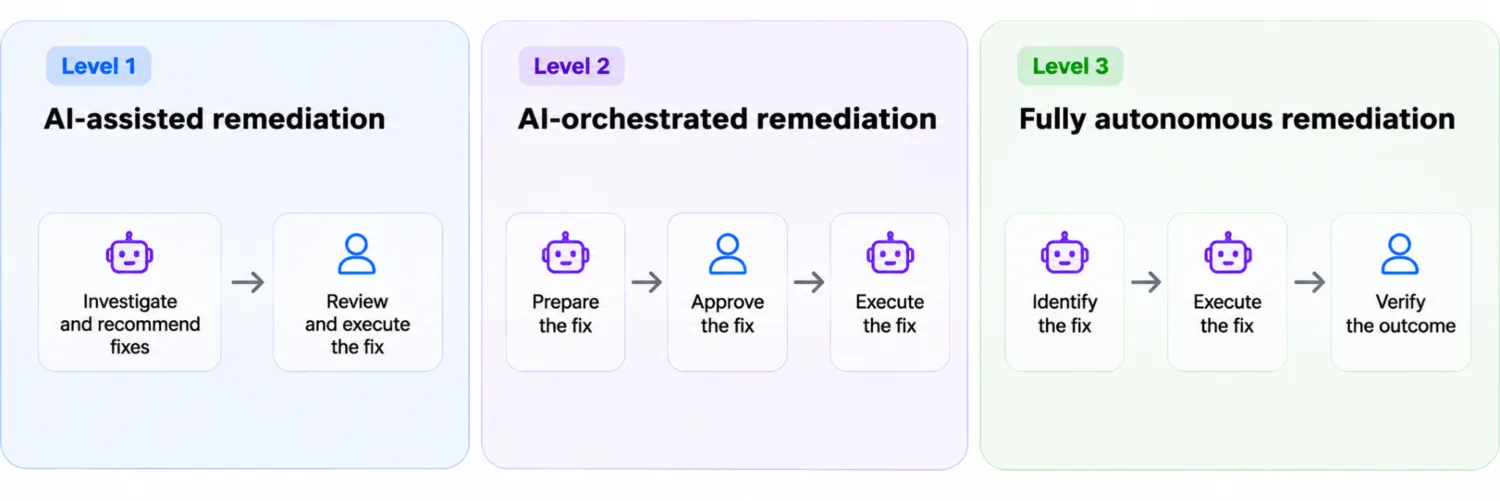
Autonomous exposure remediation can operate at three levels, depending on the organization’s policies and its readiness to delegate security tasks to AI agents.
| Level | Remediation model | How it works |
| Level 1 | AI-assisted remediation | AI analyzes findings, prioritizes risk, and recommends or generates fixes. Security and engineering teams remain responsible for executing and validating the changes. |
Level 2 | AI-orchestrated Remediation | AI agents coordinate remediation workflows and execute predefined actions within approved boundaries. Human approval may still be required for sensitive or high-impact changes. |
| Level 3 | Closed-loop Autonomous Remediation | AI agents assess exposure in context, determine the appropriate response, generate and execute fixes, and verify the outcome. Policy-based guardrails, auditability, and escalation paths govern autonomous action. |
How to measure progress
Teams can adopt these levels gradually, giving agents more responsibility as they build confidence in the process and its results. Useful measures include time to verified fix, backlog burn-down, the share of fixes handled at each level of autonomy, and the regression, rollback, and reopen rates for automated changes. If rollback and reopen rates stay low as autonomy grows, that is the evidence for moving to the next level.
How ArmorCode approaches Autonomous Exposure Remediation
Where ArmorCode fits today: Anya Agents and ArmorCode Zero work at the first two levels. Zero drafts the fix with the coding agent your team already uses, opens a pull request for human approval, and verifies the result by rescanning the exact commit. Teams choose how far to extend autonomy as trust builds.
Context Is What Makes Autonomy Possible
AER relies on context to make the right decisions. An agent needs to know which assets are important, who owns them, and whether a vulnerability can actually be exploited. The same critical vulnerability can be urgent on an internet-facing payment service and far less so on an isolated test server. Without this context, an autonomous system could prioritize the wrong fixes or make changes that introduce unnecessary risk. Context also keeps AI spend focused: ArmorCode’s analysis shows that correlating security and business context isolates roughly 3% of findings that account for about 80% of actual risk, so agents work on the fixes that matter instead of everything.
ArmorCode’s Context Risk Graph correlates security findings with assets, repositories, cloud resources, identities, network topology, business context and ownership. It also carries ownership and threat intelligence, so teams can see where exposures exist and how they relate to the business instead of assessing each finding in isolation.
Anya Agents: AI Agents for Exposure Remediation
Anya Agents are purpose-built AI agents, each scoped to a specific workflow, bounded, reusable, and grounded in the Context Risk Graph. Armorcode offers many built in agents such as:
- The Remediation Agent generates code-aware remediation guidance for a finding or group of findings.
- The Zero-Day Exposure Hunting Agent assesses organizational impact of a newly disclosed CVE by pulling threat intelligence and correlating it against existing findings and supply chain exposure.
- The Finding Overview Agent summarizes a finding in plain language.
- The Risk Analyzer Agent explains why a finding received its risk score.
Recently, we announced four more AI agents. The Vulnerability Researcher investigates whether a CVE is exploitable in the customer’s own environment. The Mitigation Engineer works with existing WAF rules and EDR (endpoint detection and response) policies to contain risk until a permanent fix lands. The Cloud Security Engineer evaluates cloud misconfigurations, and the Patch Orchestrator plans and sequences patch rollouts across affected systems.
Each agent contributes to a different part of the process, helping teams move from understanding an exposure to determining the right response and coordinating remediation. This combined approach provides the foundation for Autonomous Exposure Remediation, with the goal of reducing manual effort and moving more of the remediation lifecycle toward controlled, verified execution.
All Anya agents draw on the same Context Risk Graph, so each one starts with the asset, ownership, and exposure details. Teams don’t have to build separate contexts for every agent or pay for the same analysis twice. If the built-in agents don’t cover a workflow, organizations can build their own on the Anya harness, and agents can run inside ArmorCode workflows or be called from outside the platform through APIs and MCP server integrations.
The agents operate within defined roles, permissions, and governance controls, with every action recorded for audit. Teams can choose the level of automation they are comfortable with, while keeping a human involved in the process.
ArmorCode Zero
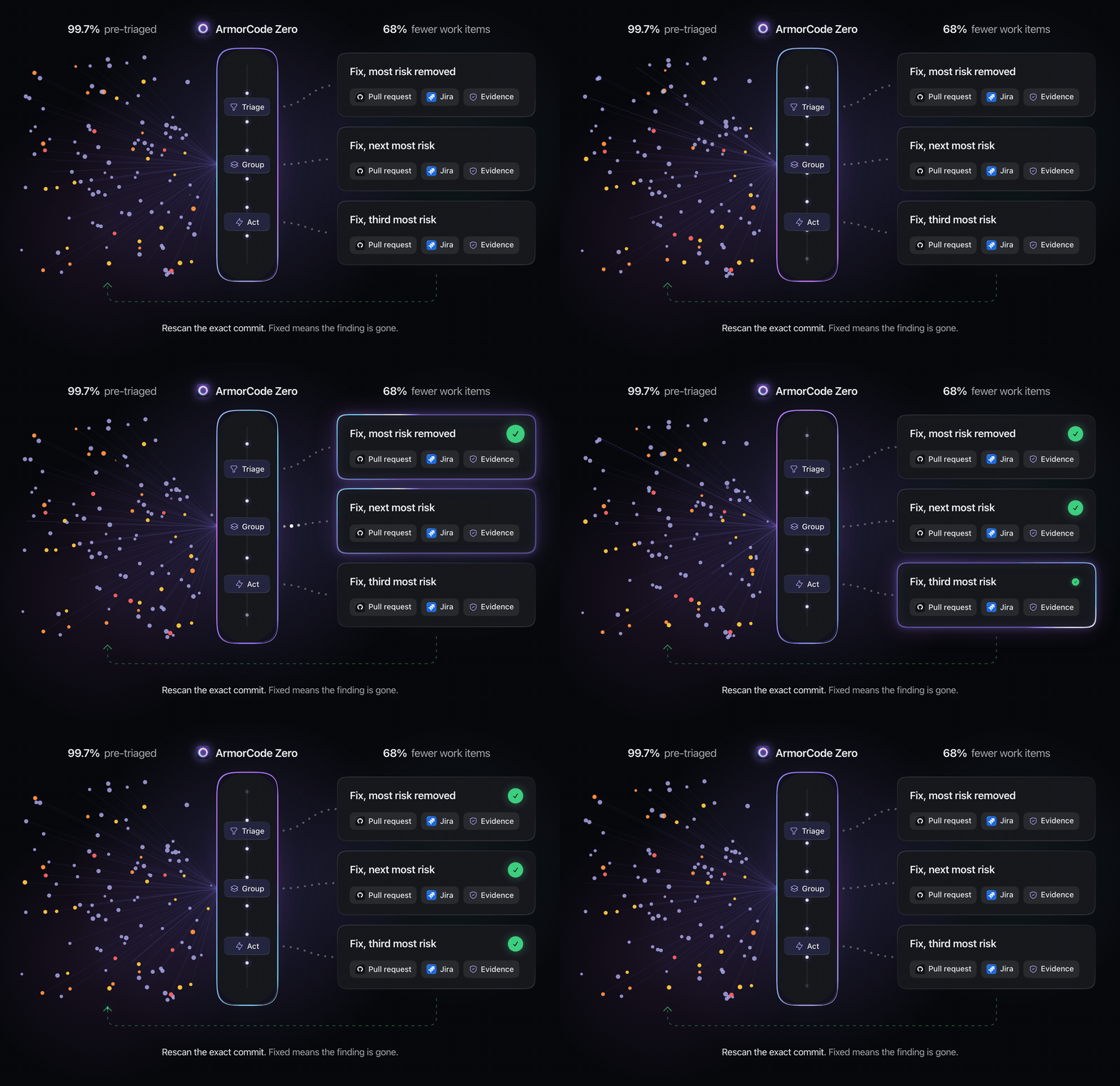
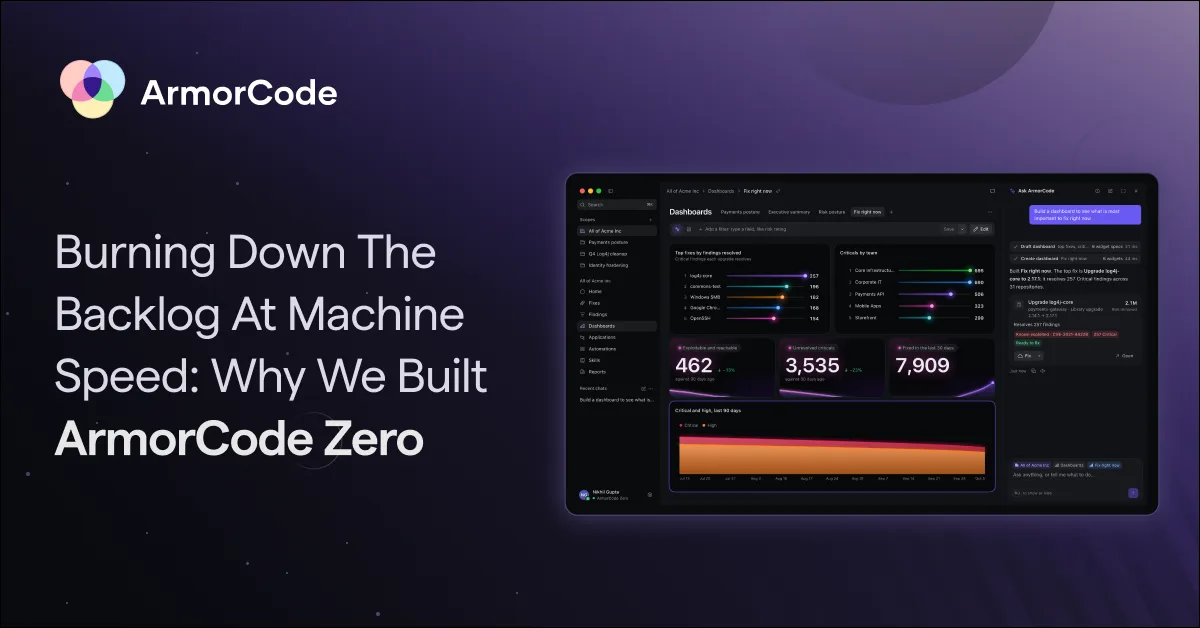
ArmorCode Zero is the product built around the later steps of the remediation loop. ArmorCode Zero reads vulnerability findings, prepares an initial triage assessment, and groups issues by the change needed to resolve them, so one dependency upgrade replaces dozens of separate tickets. For execution, Zero connects to the coding agents engineering teams already use, such as Claude Code and Codex, and drafts code changes as a pull request for human review. Verification is part of the definition of done: a fix counts only once the exact commit has been rescanned and the original finding no longer appears.
Teams remain in control through governed agents, approval cards, clearly defined boundaries, and a complete audit record.
Conclusion
Discovery will keep outpacing human capacity. FIRST’s forecast of roughly 66,000 CVEs this year is a preview of the volume teams should plan around, and more people triaging tickets is not a workable answer. Reducing risk depends on how quickly a team can act on the exposures that matter. Autonomous exposure remediation puts the effort there, though human oversight still matters, particularly for changes that affect critical systems and production environments.
The goal is to make remediation a more manageable part of security operations. As organizations adopt greater levels of autonomy, they can spend less time working through individual findings and more time making measurable progress in reducing exposure risk.
ArmorCode is designed around that shift. Our platform processes more than 400 billion security findings a year across 425+ integrations covering applications, cloud, infrastructure, and software supply chains, correlates them with business context, and turns them into a short list of work that measurably reduces risk. ArmorCode customers have cut mean time to remediate (MTTR) by 75% and vulnerability backlog by 60%. Across our customer base, more than 100,000 agents are deployed and have taken more than 1 billion agentic actions.
See how ArmorCode helps teams move from prioritized exposure to verified fix with autonomous remediation: request a demo.